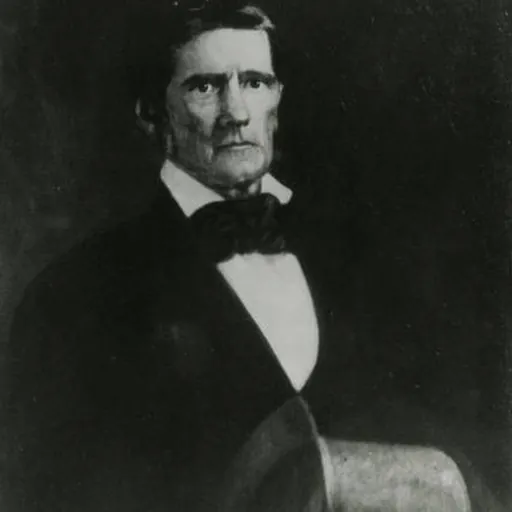
Robert Jefferson Breckinridge
American politician and Presbyterian minister
About Robert Jefferson Breckinridge
Lived 1800 – 1871 (aged 71). Robert Jefferson Breckinridge was an American politician, christian minister and writer.
Robert Jefferson Breckinridge (March 8, 1800 – December 27, 1871) was a politician and Presbyterian minister. He was a member of the Breckinridge family of Kentucky, the son of Senator John Breckinridge.
A restless youth, Breckinridge was suspended from Princeton University for fighting, and following his graduation from Union College in 1819, was prone to engage in a lifestyle of partying and revelry. But, he was admitted to the bar in 1824 and elected to the Kentucky General Assembly in 1825. A serious illness and the death of a child in 1829 prompted him to turn to religion, and he became an ordained minister in 1832.
That year Breckinridge accepted the call to pastor the Second Presbyterian Church of Baltimore, Maryland. While at the church, he became involved in a number of theological debates. During the Old School-New School Controversy within the Presbyterian Church in the 1830s, Breckinridge became a hard-line member of the Old School faction, and played an influential role in the ejection of several churches in 1837. He was rewarded for his stances by being elected moderator of the Presbyterian Church's General Assembly in 1841.
After a brief stint as president of Jefferson College in Pennsylvania, Breckinridge returned to Kentucky, where he pastored the First Presbyterian church of Lexington, Kentucky, and was appointed superintendent of public education by Governor William Owsley. The changes he effected in this office brought a tenfold increase in public school attendance and led to him being called the father of the public school system in Kentucky. He left his post as superintendent after six years to become a professor at Danville Theological Seminary in Danville, Kentucky.
As the sectional conflict leading up to the Civil War escalated, Breckinridge was put in the unusual position of being a slaveholder who opposed slavery. The tragic scenario of brother against brother literally played out in Breckinridge's family, his sons fighting on both sides during the war. Following the war, Breckinridge retired to his home in Danville, where he died on December 27, 1871.
Early life Robert Breckinridge was born March 8, 1800, at Cabell's Dale near Lexington, Kentucky. He was the third son born to Senator John and Mary Hopkins (Cabell) Breckinridge. Senator Breckinridge died in 1806, leaving his wife to tend the family's large plantations. Robert soon earned a reputation of misbehaving. In one instance, he and his brother John had a physical altercation because Robert put salt in a blind cousin's coffee; in another, his mother gave him a "tremendous whipping" for beating an old slave.
Breckinridge studied education at a classical school operated by Dr. Louis Marshall, the brother of Chief Justice John Marshall, then followed his brothers, Cabell and John, to Princeton in 1817. His behavior problems continued there; in one year, he spent more than $1200.
Following his graduation, Breckinridge returned to Kentucky with no clear direction in his life. He began to amuse himself by attending various parties and other social engagements. During a visit to the state capital, he so offended one man that he was challenged to a duel. Though he obtained two pistols, he never accepted the man's challenge, and was branded a coward. The dispute was later settled in the Masonic Lodge of which both Breckinridge and the other man were members.
Service in the Kentucky General Assembly
Following the advice of his older brother, Breckinridge obtained his law license on January 3, 1824, but the practice of law did not suit him. He instead decided to follow the family tradition and seek public office, campaigning for a seat in the Kentucky House of Representatives. Even in his early political career, he began to articulate his stance on the issues that would become his legacy.
First, he shunned the states' rights viewpoint, stressing instead the need for a strong interdependence between the states. Second, he called for an end to slavery. Third, he emphasized the importance of education. Though they agreed on this last point, Breckinridge's father had ardently opposed emancipation of slaves and favored states' rights. Historian James C. Klotter opines that Louis Marshall and Robert's mother Mary may have influenced his positions.
The most politically charged issue in Kentucky during Breckinridge's campaign, however, was the Old Court-New Court controversy. The Panic of 1819 had left many Kentuckians in dire financial straits. Legislators sought to relieve some of the financial burden by passing a law of replevin which favored debtors. The Kentucky Court of Appeals, (the highest court in the Commonwealth at the time,) declared the law unconstitutional. The next year, an incensed General Assembly passed legislation that dissolved the court and replaced it with a new court. Neither court acknowledged the other as valid, and a confused public lost respect for public authority in general. The issue was generally split along party lines, with Democrats generally favoring the New Court and Whigs favoring the Old Court.
Breckinridge dodged the issue during the campaign, which he won in 1825, but once he took office, he had to come down on one side or the other. He voted in favor of the Old Court, reflecting his upper-class status and affinity for the establishment. In so doing, he identified himself with the party of Kentucky's favorite son, Henry Clay. The Whigs would control Kentucky politics for the next twenty-five years. In 1826, the majority of the General Assembly sided with the Old Court and abolished the New Court.
Eventually, tensions faded, but a bigger decision awaited Robert Breckinridge in 1828. He was chosen to sit on a committee that would draft Kentucky's response to the Nullification Crisis. Because much of South Carolina's reasoning for their actions was based on the logic of the Kentucky Resolutions, which had been supported by Senator John Breckinridge, Robert Breckinridge now had to determine whether he should support the words of his late father or refute them. In the end, his Unionist sympathies overrode his sense of loyalty to his father; he sided with the committee's majority in condemning South Carolina's actions.
Breckinridge served as a Ruling Elder at the Presbyterian General Assembly of 1832, then relocated to Princeton, New Jersey, to study under Samuel Miller at Princeton Theological Seminary. In November 1832, he succeeded his brother John as pastor of Second Presbyterian Church of Baltimore, Maryland. His tenure saw numerous converts, but he was put at odds with his brother and Samuel Miller over practices employed in his church. His counselors were also concerned that he was wavering on his belief in the doctrine of limited atonement. Eventually, he was persuaded back into the doctrines of the orthodox Calvinism and became one of the leaders of the Old School Presbyterian movement. and in 1843 added his recommendation to Louis Giustiniani's anti-Catholic book.
Breckinridge was equally controversial in internal church politics. He rebuked the Synod of the Western Reserve for de-emphasizing and effectively abandoning the office of Ruling Elder. He also condemned the governance of Presbyterian missionaries by anyone other than the Presbyterian church. In 1834, he was the chief author of the Act and Testimony, a document summarizing the contentions between the Old and New Schools. The New School resented Breckinridge and those who signed the Act and Testimony, and even some in the Old School camp had hoped for a more moderate course. The differences between the Old and New Schools widened over the teachings of Albert Barnes, and the New School members were ejected from the Presbyterian Church in 1837. Because of his leadership in the Old School-New School controversy, Breckinridge was elected moderator of the Old School branch's General Assembly in 1841.
Breckinridge was inaugurated as president of Jefferson College on September 27, 1845. During his tenure, he also pastored a church in the city of Canonsburg, Pennsylvania. College administration apparently did not suit him, however. A student uprising against the president and the faculty occurred in 1846, hastening the end of his short stay at the school. A desire to see his children, most of whom were living with relatives scattered throughout Kentucky and Virginia, also factored into his decision to resign his post in 1847. On his resignation, he was awarded an honorary LL.D from the school.
Disagreements among the children of both partners' previous marriages exacerbated an already tense union, which almost ended in divorce in September 1856. Robert managed to reconcile with his wife, and they remained together until Virginia's death in 1859.
Breckinridge's personal turmoil did not hinder his political accomplishments. He was appointed Superintendent of Public Instruction by Governor William Owsley. He was the sixth person to hold the office since its creation in the 1830s. The task was daunting. Only one of every ten school-age children in Kentucky ever attended school, and at least thirty Kentucky counties had received no state educational funds since 1840.
Breckinridge began reforms immediately and zealously. He secured the General Assembly's passage of a two-cent property tax for education. The tax was subject to voter approval, and Breckinridge worked hard to publicize the issue. His efforts paid off, as the tax passed by almost a two-to-one margin. Continuing to publicize needs and push legislators to action, Breckinridge enjoyed the support of five of the six governors under whom he served. Only John L. Helm, who opposed a state-funded school system, challenged him, but Helm's veto of a Breckinridge educational bill was overridden in the General Assembly. Breckinridge's reforms manifested tangible results. From 1847 to 1850, educational spending increased from $6,000 to $144,000. By 1850, only one out of every ten school age children did not attend school.
On November 5, 1868, Breckinridge married his third wife, Margaret Faulkner White. A year later, he resigned his professorship at Danville Seminary. He died on December 27, 1871, after an extensive illness, and was buried in Lexington Cemetery.
Breckinridge Hall, a three-story building on Morehead State University's campus, is named for Robert J. Breckinridge.
Selected works The Knowledge of God, Objectively Considered: Being the First Part of Theology Considered as a Science of Positive Truth, Both Inductive and Deductive The Knowledge of God, Subjectively Considered: Being the Second Part of Theology Considered as a Science of Positive Truth, Both Inductive and Deductive Our country – its peril and its deliverance. Breckinridge's protest against the use of instrumental music in worship Presbyterian Government not a Hierarchy, but a Commonwealth Presbyterian Ordination not a Charm, but an Act of Government Some Thoughts on the Development of the Presbyterian Church in the U.S.A. The Christian Pastor, One of Christ's Ascension Gifts Letter of Robert J. Breckinridge to the Second Presbyterian Church of Baltimore Robert J. Breckinridge's speech at the laying of the cornerstone of the Clay Monument The Calling of the Church of Christ: A Discourse to Illustrate the Posture and Duty of the Presbyterian Church in the United States of America
Don’t just read it —
keep it.
Full-length biographies made to live with: read them, listen on the way to work, watch them tonight.
- E-book
- Audio
- Video
Instant download · yours to keep · every purchase keeps this site free
Important facts
Family & relationships
People in Robert Jefferson Breckinridge's life
Named in this biography and alive at the same time



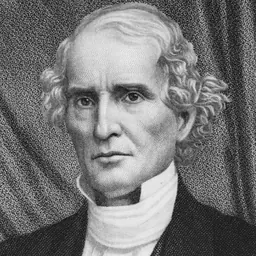
Related people
Same field, nearest in time


Contemporaries
People whose lives overlapped Robert Jefferson Breckinridge's






Frequently asked questions
Who was Robert Jefferson Breckinridge?
American politician and Presbyterian minister (1800–1871)
When was Robert Jefferson Breckinridge born?
Robert Jefferson Breckinridge was born on 8 March 1800 in Cabell's Dale, Kentucky.
When did Robert Jefferson Breckinridge die?
Robert Jefferson Breckinridge died on 27 December 1871 in Danville.
What was Robert Jefferson Breckinridge's occupation?
Robert Jefferson Breckinridge was a politician, christian minister and writer.
What nationality was Robert Jefferson Breckinridge?
Robert Jefferson Breckinridge was American.
Sources & further reading
· Wikipedia: Robert Jefferson Breckinridge
· DBpedia: Robert Jefferson Breckinridge
Cite this page
APA: Biography.guide. (2026). Robert Jefferson Breckinridge. https://biography.guide/robert-jefferson-breckinridge/
MLA: "Robert Jefferson Breckinridge." Biography.guide, https://biography.guide/robert-jefferson-breckinridge/.
Chicago: "Robert Jefferson Breckinridge." Biography.guide. https://biography.guide/robert-jefferson-breckinridge/.
Data last updated: 2026-09-22 · Spot an error? Report a correction.
Portrait: Wikimedia Commons · author & licence
Page generated 2026-09-27 05:04 UTC