
About Robert III of Loritello
Lived 1150 – 1182 (aged 31–32). Robert III of Loritello was an Italian military personnel and baron.
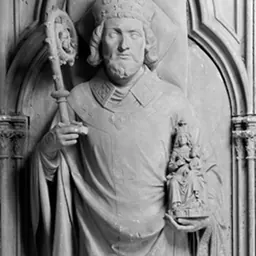
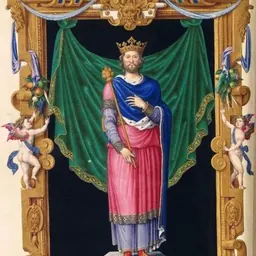
The statue of il Sedente (the sitting one) on Ruvo Cathedral may depict its founder, Robert of Loritello. Robert of Bassunvilla (also Basunvilla and Bassonville) (c. 1125 – died 15 September 1182) was the count of Conversano (from 1138) and Loritello (from 1154, as Robert III). His family had a long history in Vassonville, near Dieppe.
Robert (II) was the son of Robert I of Bassunvilla, who had been granted Conversano by Roger II. Robert inherited this possession on his father's death. Roger II had cause later to confiscate the county of Loritello from William, his own relative. On his deathbed, he asked his son William I to appoint Robert count of Loritello, a quasi-autonomous post. Soon however, he was implicated (truly or falsely) in rebellion and fled first to the Holy Roman imperial court of Frederick Barbarossa and then the Byzantine imperial court of Manuel I Comnenus. He may have laid claim to the throne, on the basis of a forged will. He had the assistance of John Ducas when he returned to lead the revolt of 1155–1156, but the Byzantine general Michael Palaeologus died at Bari and William defeated the imperial troops.
By the Treaty of Benevento of 1156, Pope Adrian IV guaranteed Robert's right to leave the kingdom peacefully, but he renewed instead his designs on the land of the diocese of Penne. In 1157 he was encouraged in his rebellious efforts by a new emissary of Manuel I. This was Alexius Axuch, the son of Manuel's chief advisor John Axuch. Though his constable, Richard of Mandra, was captured, he evaded the royal army and continued in defiance of William I's authority. In 1161, he conquered much territory to the south. William responded by chasing him from Taranto and almost razing Salerno. In 1163, however, he was forced to flee again to Barbarossa.
In 1167, he was with the army of Rainald of Dassel at the Battle of Monte Porzio on 29 May, when a great Roman army was defeated.
In 1169, Margaret of Navarre, regent of William II and widow of William I, and her council of advisors restored Robert to all his former possessions. His widow Adelisa, daughter of Roger II, inherited Conversano.
Don’t just read it —
keep it.
Full-length biographies made to live with: read them, listen on the way to work, watch them tonight.
- E-book
- Audio
- Video
Instant download · yours to keep · every purchase keeps this site free
Important facts
People in Robert III of Loritello's life
Named in this biography and alive at the same time


Related people
Same field, nearest in time
Contemporaries
People whose lives overlapped Robert III of Loritello's



Frequently asked questions
Who was Robert III of Loritello?
Italo-Norman noble
When was Robert III of Loritello born?
Robert III of Loritello was born in 1150 in Kingdom of Sicily.
When did Robert III of Loritello die?
Robert III of Loritello died in 1182.
What was Robert III of Loritello's occupation?
Robert III of Loritello was a military personnel and baron.
What nationality was Robert III of Loritello?
Robert III of Loritello was Italian.
Sources & further reading
· Wikipedia: Robert III of Loritello
· DBpedia: Robert III of Loritello
Cite this page
APA: Biography.guide. (2026). Robert III of Loritello. https://biography.guide/robert-iii-of-loritello/
MLA: "Robert III of Loritello." Biography.guide, https://biography.guide/robert-iii-of-loritello/.
Chicago: "Robert III of Loritello." Biography.guide. https://biography.guide/robert-iii-of-loritello/.
Data last updated: 2026-09-20 · Spot an error? Report a correction.
Page generated 2026-09-27 05:32 UTC