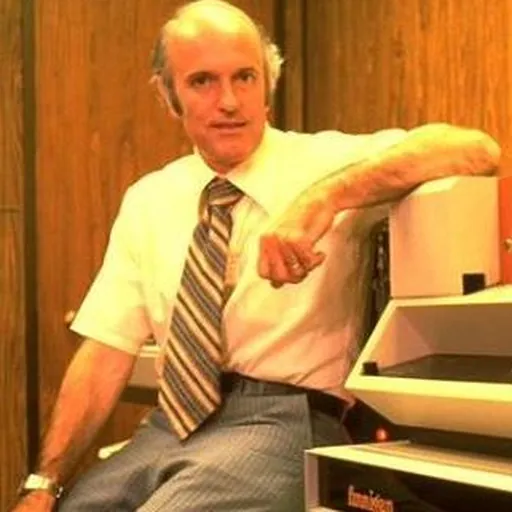
About Robert E. Finnigan
Lived 1927 – 2022 (aged 95). Robert E. Finnigan was an American electrical engineer and chemist.
Robert Emmet Finnigan (May 27, 1927 – August 14, 2022) was an American pioneer in the development of gas chromatography–mass spectrometry equipment (GC/MS). Finnigan founded the Scientific Instruments Division of Electronic Associates, Inc., producing the first commercial quadrupole mass spectrometer in 1964. He then formed Finnigan Instruments Corporation to combine a computer system with a quadrupole mass spectrometer and gas chromatograph. Finnigan's GC/MS/computer systems are used to detect and identify trace organic compounds, making them important instruments for the monitoring and protection of the environment. They were adopted by the United States Environmental Protection Agency as a standard instrument for monitoring water quality and were fundamental to the work of the EPA. He was one of seven children, who were raised primarily by their father after their mother's early death. In 1952, he entered the University of Illinois at Urbana–Champaign, receiving an M.S. in electrical engineering in 1954 and a Ph.D. in electrical engineering in 1957. His master's thesis work with Edward C. Jordan used the ILLIAC to solve complex mathematical functions in antenna theory. For his Ph.D. he researched servomechanism theory with Gilbert Fett, completing the thesis Transient Analysis of Non-Linear Servomechanisms Using Describing Functions with Root-Locus Techniques.
Lawrence Livermore Laboratory In 1957, as a captain in the United States Air Force, Robert Finnigan joined the University of California Radiation Laboratory at Livermore (later the Lawrence Livermore National Laboratory). Finnigan worked on Project Pluto, a United States government program to develop nuclear powered ramjet engines for the Supersonic Low Altitude Missile (SLAM), a type of cruise missile. Finnigan led the group that developed computer control systems for the nuclear reactor that powered the missile.
In early 1968, Finnigan Instrument Corporation delivered its first prototype quadrupole GC/MS instruments. One was sent to Nobel Prize winner Joshua Lederberg at Stanford University. The other was sent to Purdue University. A major strength of the instrument was precise quantitation. It could be used to detect trace contaminants in environmental samples, to identify drugs in a case of overdose, and to measure drug metabolites. The EPA surveyed possible monitoring instruments for use in monitoring organic pollutants. Speed, cost, and performance were all important concerns. The target machine was projected as having the ability to scan for pesticides with a resolving power of 1,000 to 10,000, across a broad range of 10 nanograms to one microgram. A computer-controlled system was desirable. An international array of instruments were reviewed, of which only two used quadrupole technology. An expert panel recommended Finnigan's quadrupole GC/MS to the EPA for further evaluation, and twenty Finnigan Model 1015/System 150 instruments were ordered soon after by the EPA. By 1979, the Finnigan GC/MS was the preferred instrument at the EPA for the analysis of environmental pollutants in water and wastewater. The EPA also based its instruction manuals and standards for environmental testing on the Finnigan GC/MS, publishing the results in the Federal Register in 1979. By 1984, all public water was to be tested by using a GC/MS apparatus. In the 1980s, an estimated 60-70% of Finnigan's GC/MS sales went to the environmental market. Robert Finnigan continued to consult for the company for several years after the acquisition. He has also consulted with other entrepreneurial companies.
Awards and honors 2017, "From Discovery to Precision Medicine: Mass Spectrometry Through the Years and Beyond" at Pittcon 2017, a session focused on the contributions of Robert E. Finnigan 2008, Selected for "Legends of Environmental Chemistry" by American Chemical Society, ACS annual meeting, New York 1999, Instrumentation Hall of Fame (Charter Member) by Pittcon, American Chemical Society and Chemical Heritage Foundation 1980, Distinguished Service in Engineering, College of Engineering, University of Illinois 1975, Distinguished Alumni Award, Electrical and Computer Engineering Department, University of Illinois
Don’t just read it —
keep it.
Full-length biographies made to live with: read them, listen on the way to work, watch them tonight.
- E-book
- Audio
- Video
Instant download · yours to keep · every purchase keeps this site free
Important facts
People in Robert E. Finnigan's life
Named in this biography and alive at the same time

Related people
Same field, nearest in time


Contemporaries
People whose lives overlapped Robert E. Finnigan's


Frequently asked questions
Who was Robert E. Finnigan?
American electrical engineer
When was Robert E. Finnigan born?
Robert E. Finnigan was born on 27 May 1927 in Buffalo.
When did Robert E. Finnigan die?
Robert E. Finnigan died on 14 August 2022 in Palo Alto.
What was Robert E. Finnigan's occupation?
Robert E. Finnigan was an electrical engineer and chemist.
What nationality was Robert E. Finnigan?
Robert E. Finnigan was American.
Sources & further reading
· Wikipedia: Robert E. Finnigan
Cite this page
APA: Biography.guide. (2026). Robert E. Finnigan. https://biography.guide/robert-e-finnigan/
MLA: "Robert E. Finnigan." Biography.guide, https://biography.guide/robert-e-finnigan/.
Chicago: "Robert E. Finnigan." Biography.guide. https://biography.guide/robert-e-finnigan/.
Data last updated: 2026-09-22 · Spot an error? Report a correction.
Portrait: Wikimedia Commons · author & licence
Page generated 2026-09-27 05:04 UTC