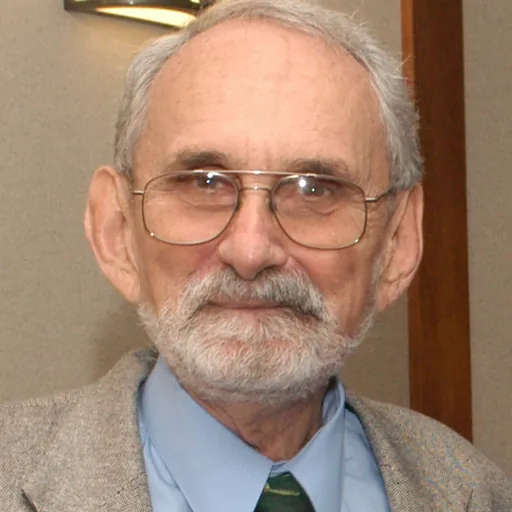
About Robert Curl
Lived 1933 – 2022 (aged 88). Robert Curl was an American chemist and university teacher, known for Fullerenes.
Robert Floyd Curl Jr. (August 23, 1933 – July 3, 2022) was an American chemist who was Pitzer–Schlumberger Professor of Natural Sciences and professor of chemistry at Rice University. He was awarded the Nobel Prize in Chemistry in 1996 for the discovery of the nanomaterial buckminsterfullerene, and hence the fullerene class of materials, along with Richard Smalley (also of Rice University) and Harold Kroto of the University of Sussex.
Early life and education Born in Alice, Texas, United States, Curl was the son of a Methodist minister. Due to his father's missionary work, his family moved several times within southern and southwestern Texas, and the elder Curl was involved in starting the San Antonio Medical Center's Methodist Hospital. Curl attributes his interest in chemistry to a chemistry set he received as a nine-year-old, recalling that he ruined the finish on his mother's porcelain stove when nitric acid boiled over onto it. His high school offered only one year of chemistry instruction, but in his senior year his chemistry teacher gave him special projects to work on. At Berkeley, he worked in the laboratory of Kenneth Pitzer, then dean of the college of chemistry, with whom he would become a lifelong collaborator. Curl's graduate research involved performing infrared spectroscopy to determine the bond angle of disiloxane.
Nobel Prize Curl's research at Rice involved the fields of infrared and microwave spectroscopy. In 1985, Curl was contacted by Harold Kroto, who wanted to use a laser beam apparatus built by Smalley to simulate and study the formation of carbon chains in red giant stars. Smalley and Curl had previously used this apparatus to study semiconductors such as silicon and germanium. This discovery was based solely on the single prominent peak on the mass spectrograph, implying a chemically inert substance that was geometrically closed with no dangling bonds. Curl was responsible for determining the optimal conditions of the carbon vapor in the apparatus, and examining the spectrograph. The fullerenes, a class of molecules of which buckminsterfullerene was the first member discovered, are now considered to have potential applications in nanomaterials and molecular scale electronics.
Later research Curl's later research interests involved physical chemistry, developing DNA genotyping and sequencing instrumentation, and creating photoacoustic sensors for trace gases using quantum cascade lasers. He is known in the residential college life at Rice University for being the first master of Lovett College.
Curl retired in 2008 at the age of 74, becoming a University Professor Emeritus, Pitzer-Schlumberger Professor of Natural Sciences Emeritus, and Professor of Chemistry Emeritus at Rice University. Alexander von Humboldt Senior US Scientist Award, University of Bonn, Germany, 1984 Golden Plate Award of the American Academy of Achievement, 1997 Fellow of the American Academy of Arts and Sciences, 1998 International Prize for New Materials, American Physical Society, 1992 University of Bochum Research Prize, 2004 National Historic Chemical Landmark, American Chemical Society, 2010 Citation for Chemical Breakthrough Award, Division of History of Chemistry, American Chemical Society, 2015 Fellow of the Optical Society of America
Selected publications
Journal articles:
Technical reports: Curl, R. F. and G. P. Glass. "Infrared Absorption Spectroscopy and Chemical Kinetics of Free Radicals. Final Performance Report, August 1, 1985 – July 31, 1994," National Accelerator Laboratory, Rice University, United States Department of Energy, (June 1995). Curl, R. F. and G. P. Glass. "Infrared Absorption Spectroscopy and Chemical Kinetics of Free Radicals, Final Technical Report," Rice University, United States Department of Energy, (November 2004).
Don’t just read it —
keep it.
Full-length biographies made to live with: read them, listen on the way to work, watch them tonight.
- E-book
- Audio
- Video
Instant download · yours to keep · every purchase keeps this site free
Important facts
People in Robert Curl's life
Named in this biography and alive at the same time

Related people
Same field, nearest in time



Contemporaries
People whose lives overlapped Robert Curl's



Frequently asked questions
Who was Robert Curl?
American chemist (1933–2022)
When was Robert Curl born?
Robert Curl was born on 23 August 1933 in Alice.
When did Robert Curl die?
Robert Curl died on 3 July 2022 in Houston.
What was Robert Curl's occupation?
Robert Curl was a chemist and university teacher.
What was Robert Curl known for?
Robert Curl was known for Fullerenes.
What nationality was Robert Curl?
Robert Curl was American.
Sources & further reading
Cite this page
APA: Biography.guide. (2026). Robert Curl. https://biography.guide/robert-curl/
MLA: "Robert Curl." Biography.guide, https://biography.guide/robert-curl/.
Chicago: "Robert Curl." Biography.guide. https://biography.guide/robert-curl/.
Data last updated: 2026-09-21 · Spot an error? Report a correction.
Portrait: Wikimedia Commons · author & licence
Page generated 2026-09-27 05:00 UTC