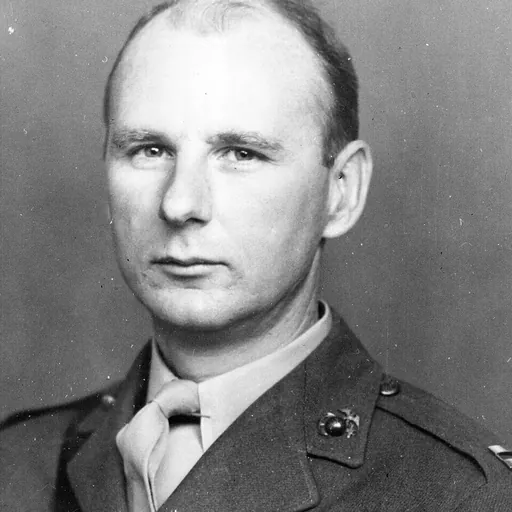
About Robert B. Luckey
Lived 1905 – 1974 (aged 69). Robert B. Luckey was a military personnel.
Robert Burneston Luckey (July 9, 1905 – September 9, 1974) was a decorated officer in the United States Marine Corps with the rank of lieutenant general. A veteran of several wars, Luckey completed his career as commanding general, Fleet Marine Force, Atlantic.
Early career
Robert B. Luckey was born on July 9, 1905, in Hyattsville, Maryland, but his family later moved to Washington, D.C., where he graduated from Central High School in summer 1923. He then enrolled the University of Maryland in College Park and was a member of ROTC unit as Cadet First lieutenant.
Luckey graduated with Bachelor of Arts in June 1927 and entered the Marine Corps service on August 10 of that year. He was commissioned second lieutenant on that date and was ordered to the Basic School at Philadelphia Navy Yard for basic officer training, which he completed in February 1928. Luckey was subsequently attached to 2nd Marine Brigade and sailed for expeditionary duty to Nicaragua.
He led his battery during the Fleet Exercise at Culebra, Puerto Rico and was transferred to the headquarters, 1st Marine Brigade, Fleet Marine Force under Brigadier General Holland Smith, before he returned to the United States.
After two months of combat, Luckey was appointed executive officer, 11th Marine Regiment under Colonel Pedro del Valle and served in that capacity during the later stages of Guadalcanal Campaign. He later took part in the Battle of Cape Gloucester at New Britain in December 1943 and January 1944 and received the Bronze Star Medal with Combat "V" for his service there.
Luckey was ordered back to the United States in February 1944 and following a brief leave at home, he was appointed director of the Artillery School at Marine Corps Schools, Quantico. He held that command until October of that year, when he was ordered back to the Pacific area for duty as commanding officer, 15th Marine Regiment. The 15th Marines were designated as the main artillery component for the newly established 6th Marine Division. Luckey was promoted to colonel in December 1944.
Postwar service The Visit of Chiang Kai-shek during the fleet exercise on March 27, 1960. From left to right: MG Richard C. Mangrum (CG, 1st MAW), RADM Charles O. Triebel (Commander, Amphibious Group ONE), Chiang Kai-shek, LTG Thomas A. Wornham (CG, FMFPac) and Luckey (CG, 3rd Marine Division). Luckey during his promotion to Major general by his wife and Commandant Randolph M. Pate Luckey and his regiment were ordered to Qingdao, China, where he participated in the surrender and repatriation of the Japanese forces in that country. For his service in China, he was decorated with his second Bronze Star Medal and also received the Order of the Cloud and Banner by the government of Republic of China.
The 15th Marines were deactivated with the rest of 6th Marine Division in March 1946 and Luckey departed for the United States. Upon his arrival in the States, he entered the Senior course at the Naval War College in Newport, Rhode Island, and graduated in June 1947.
In July 1951, Luckey was transferred back to Camp Lejeune and assumed duty as assistant chief of staff for operations on the staff of 2nd Marine Division. He served in this capacity consecutively under major generals Ray A. Robinson and Edwin A. Pollock and later assumed duty as divisional chief of staff.
On November 1, 1961, Luckey was promoted to lieutenant general and assumed command of Fleet Marine Force, Atlantic and held that command during the Cuban Missile Crisis emergency in October 1962. He also supported the employment of helicopters in the Amphibious Warfare. He held that command until August 1, 1963, when he was succeeded by James P. Berkeley and retired from active duty after 36 years of Marine Corps service.
Death
Lieutenant General Robert B. Luckey settled in West Tisbury, Massachusetts, and died there on September 9, 1974, aged 69. He was married to the former Miss Cary Walker of Vineyard Haven, Massachusetts, daughter of Army Brigadier General Meriwether Lewis Walker and granddaughter of Brigadier General Asa B. Carey. They have a daughter, Laura, and two sons, Thomas and William.
Decorations
Here is the ribbon bar of Lieutenant General Robert B. Luckey:
Don’t just read it —
keep it.
Full-length biographies made to live with: read them, listen on the way to work, watch them tonight.
- E-book
- Audio
- Video
Instant download · yours to keep · every purchase keeps this site free
Important facts
People in Robert B. Luckey's life
Named in this biography and alive at the same time



Related people
Same field, nearest in time



Contemporaries
People whose lives overlapped Robert B. Luckey's


Frequently asked questions
Who was Robert B. Luckey?
American Marine Corps Lieutenant General
When was Robert B. Luckey born?
Robert B. Luckey was born on 9 July 1905 in Hyattsville.
When did Robert B. Luckey die?
Robert B. Luckey died on 9 September 1974 in West Tisbury.
What was Robert B. Luckey's occupation?
Robert B. Luckey was a military personnel.
Sources & further reading
Cite this page
APA: Biography.guide. (2026). Robert B. Luckey. https://biography.guide/robert-b-luckey/
MLA: "Robert B. Luckey." Biography.guide, https://biography.guide/robert-b-luckey/.
Chicago: "Robert B. Luckey." Biography.guide. https://biography.guide/robert-b-luckey/.
Data last updated: 2026-09-22 · Spot an error? Report a correction.
Portrait: Wikimedia Commons · author & licence
Page generated 2026-09-27 05:02 UTC