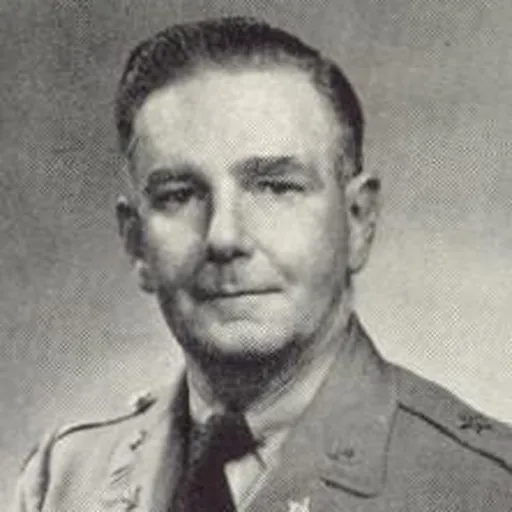
Robert A. McClure
United States army general and psychological warfare specialist
About Robert A. McClure
Lived 1897 – 1957 (aged 59–60). Robert A. McClure was an American military personnel.
Robert Alexis McClure (March 4, 1897 – January 1, 1957) was a United States Army major general, psychological warfare specialist, and military government officer. He is recognized in U.S. Army and Army Special Operations historical material as the “Father of U.S. Army Special Warfare” for his role in rebuilding Army psychological warfare after World War II, establishing the Psychological Warfare Center at Fort Bragg, North Carolina, and promoting the activation of the 10th Special Forces Group.
During World War II, McClure served as chief of the Information and Censorship Section at Allied Force Headquarters and later as chief of the Psychological Warfare Division at Supreme Headquarters Allied Expeditionary Force. After the war, he led information-control and reorientation work in occupied Germany and continued related work through the Army Civil Affairs Division. During the Korean War, he headed the Office of the Chief of Psychological Warfare, where he helped organize psychological warfare units, training, doctrine, and special operations capabilities that became central to the institutional development of U.S. Army Special Warfare.
Early life Robert McClure was born on March 4, 1897, in Mattoon, Illinois, to George H. McClure and Hattie J. Rudy. He was the eldest child, with two younger sisters, Persis Elizabeth and Mary Susan. He also had a half-brother William Eckert, who served as a Lieutenant General in the United States Air Force and later became the fourth commissioner of Major League Baseball. After his parents' 1907 divorce, McClure's mother moved the family to Madison, Indiana, where she married Frank Eckert.
McClure grew up on a farm a short distance from the Kentucky border with Indiana. He attended school in Madison until transferring to the Kentucky Military Institute in Lyndon, Kentucky, from which he graduated in 1915.
World War I After his graduation, McClure joined the Philippine Constabulary in August 1916 as a 3rd Lieutenant. The Philippine Constabulary was a militarized Filipino police force established by the U.S. Army after the Spanish-American War in 1898. Led by U.S. officers, its mission was to conduct counterinsurgency operations. During his service in the counter-insurgency force, McClure accepted a commission as an Infantry 1st Lieutenant in the United States Army on August 9, 1917, four months after the American entry into World War I. His first assignment was with the 31st Infantry Regiment based out of Fort William McKinley, Philippine Islands. McClure subsequently served in Tianjin, Republic of China, as part of the 15th Infantry Regiment in 1918. The unit was responsible for securing rail access between the port of Qinhuangdao, Tianjin and Tongzhou.
Interwar years
In 1920 following the WWI draw-down, Captain McClure briefly returned to the Philippine Islands, stationed in Manila with the 27th Infantry Regiment. With the continuing draw-down and realignment of forces, McClure received reassignment.
Upon his return to the United States in 1920, McClure was assigned to the 19th Infantry Regiment located at Camp Sherman, Ohio, where he served as the post exchange officer. Being an Army officer that relished working in an operational context, McClure reportedly despised this assignment.
McClure received orders in 1922 to Fort Benning, GA, where he served as an Infantry instructor assigned to the 29th Infantry Regiment. McClure's capability as an expert horseman proved an asset to the Infantry School, and for a time he was an instructor for horsemanship at Fort Benning, leading the military base in several wins in Georgia horse show competitions.
While serving in the 29th, Captain McClure became the commander of the regimental headquarters company, which he described to his hometown newspaper as "the most desirable assignment I have had."
In between leadership assignments, McClure graduated from the U.S. Army's Infantry School in 1925 and the Cavalry School's Troop Officers Course in Fort Riley, Kansas, in June 1926. Major General Robert H. Allen, Chief of Infantry recognized Captain McClure's graduation from the Cavalry School as an infantry officer stating, "It is of real importance to the Infantry, and to the service."
Brigadier General McClure was given the task of consolidating several military functions into a cohesive unit: public relations, censorship and psychological warfare; with, in McClure's own words "a slop over into civil affairs" included.
McClure moved quickly to create and field psychological warfare units. By spring 1951, the Army had activated the 1st Loudspeaker and Leaflet Company, 2nd Loudspeaker and Leaflet Company, 5th Loudspeaker and Leaflet Company, and 1st Radio Broadcasting and Leaflet Group, and had federalized the 301st Radio Broadcasting and Leaflet Group, a Reserve unit from New York. He also established psychological warfare instruction at the Army General School at Fort Riley, where the first psychological warfare officers course graduated in June 1951. . Declassified U.S. diplomatic records show that on August 16, 1953, he conferred with Iranian Army Chief of Staff Taqi Riahi over reports of a coup and the Shah’s decree. On September 6, 1953, McClure reported to Army Chief of Staff Matthew Ridgway on discussions with the Shah about Iranian military organization and requirements.
McClure retired from the Army in 1956 and died of a heart attack soon after at Fort Huachuca, Arizona.
On January 19, 2001, the U.S. Army Special Operations Command headquarters building at Fort Bragg, North Carolina, was dedicated in his honor. In 2010, McClure was inducted into the U.S. Special Operations Command Commando Hall of Honor. In 2013, he was inducted into the Psychological Operations Regiment as a Distinguished Member of the Regiment.
The Psychological Operations Regiment also presents the Major General Robert A. McClure Medallion Award in his honor. The award has Bronze, Silver, and Gold tiers and recognizes individuals for significant contributions to the Psychological Operations Regiment.
Decorations During his 39 years of military service to the United States, Major General McClure received a number of military awards, including some foreign decorations.
Here is his ribbon bar:
Don’t just read it —
keep it.
Full-length biographies made to live with: read them, listen on the way to work, watch them tonight.
- E-book
- Audio
- Video
Instant download · yours to keep · every purchase keeps this site free
Important facts
People in Robert A. McClure's life
Named in this biography and alive at the same time

Related people
Same field, nearest in time





Contemporaries
People whose lives overlapped Robert A. McClure's


Frequently asked questions
Who was Robert A. McClure?
United States army general and psychological warfare specialist (1897-1957)
When was Robert A. McClure born?
Robert A. McClure was born on 4 March 1897 in Illinois.
When did Robert A. McClure die?
Robert A. McClure died in 1957 in Fort Huachuca.
What was Robert A. McClure's occupation?
Robert A. McClure was a military personnel.
What nationality was Robert A. McClure?
Robert A. McClure was American.
Sources & further reading
· Wikipedia: Robert A. McClure
Cite this page
APA: Biography.guide. (2026). Robert A. McClure. https://biography.guide/robert-a-mcclure/
MLA: "Robert A. McClure." Biography.guide, https://biography.guide/robert-a-mcclure/.
Chicago: "Robert A. McClure." Biography.guide. https://biography.guide/robert-a-mcclure/.
Data last updated: 2026-09-23 · Spot an error? Report a correction.
Portrait: Wikimedia Commons · author & licence
Page generated 2026-09-27 05:07 UTC