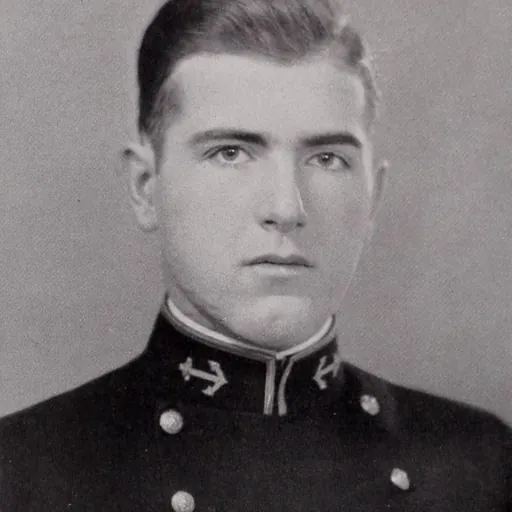
About Rob Roy McGregor
Lived 1907 – 2000 (aged 93). Rob Roy McGregor was an American military officer.
Robert Roy McGregor (7 February 1907 – 5 September 2000), was an American submarine commander during World War II who reached the rank of Rear Admiral in the United States Navy.
Early life Robert Roy McGregor was born in Seattle, Washington, on 7 February 1907, son of Frank McGregor and Lydia (née Schmidt). His father was a navy gunner, serving on and being promoted to chief gunner. McGregor was accepted to the United States Naval Academy on 16 June 1925. While attending the Naval Academy, Midshipman McGregor participated in wrestling and lacrosse. While attending submarine school at New London, McGregor and two other officers were injured when a torpedo motor they were working on exploded. McGregor was promoted to Lieutenant Junior Grade in June 1932 and upon completion of submarine school was assigned to the . While serving aboard the S-14, McGregor became qualified on submarines. In November 1934, he was transferred from S-14 to . In 1935 he was transferred to . While assigned to R-4, he became qualified to command submarines and was transferred to the Third Naval District in New York where he was promoted to the rank of Lieutenant. In January 1938 Lieutenant McGregor was assigned to before taking command of his first submarine, , on 28 March. S-36 was assigned to the United States Asiatic Fleet and stationed at Naval Base Cavite. McGregor married Mary Elizabeth Osborn at Sterberg Chapel in Manila on 20 January 1940.
Near Qing-bang, Dongji Islands, in the eastern Zhoushan Archipelago on 1 October Grouper fired on the Japanese transport Lisbon Maru which was, unknown to the Grouper, transporting about 1,800 prisoners of war. Three of Grouper torpedoes missed, but the fourth one hit, "stopping the freighter dead in the water" Grouper fired two more torpedoes, one of which hit. When an enemy aircraft appeared and dropped depth charges on Grouper, it dived to escape.
The sinking resulted in deaths of more than 800 British prisoners. Grouper arrived in Midway on 21 October, credited with 12,000 tons of enemy freight sunk, for which McGregor was awarded the Silver Star for "conspicuous gallantry and intrepidity in action".
Grouper third patrol Grouper was refitted at Midway and had an SJ radar installed. On 12 November, Grouper embarked for the Solomon Sea. On 17 December, McGregor sighted two large camouflaged freighters. He fired six torpedoes, damaging one freighter, and sinking the 8,000 ton Bandoeng Maru. McGregor and his crew finished their patrol, arriving in Brisbane on 31 December 1942.
Grouper fourth patrol After refitting, Grouper left Brisbane on 21 January 1943, to patrol north of the Solomon Islands. Grouper made contact with two convoys. Attacking the first convoy, it fired a number of torpedoes, all of which missed. The second convoy was made up of more than 20 destroyers. McGregor waited until the last destroyers were passing, but an Allied air raid on the convoy caused his target to alter course, ruining his chance to attack. On 9 February, McGregor received orders to rescue 1LT Lawrence R. McKulla, a pilot who had been shot down 26 January and was stranded on Rengi Island. Grouper continued its patrol, gathering intelligence on Japanese radar stations, and arrived in Brisbane on 18 March. McGregor's commanding officer James Fife Jr. was known for being a cold and unforgiving leader. "Fife's patrol report endorsements were long, detailed, professional and often harsh. Two skippers who felt the lash were Dick Lake in Albacore and Rob Roy McGregor in Grouper" Fife's report on Grouper fourth war patrol was particularly harsh, claiming McGregor had not been aggressive enough, causing him to miss a golden opportunity. McGregor's war patrol was officially unsuccessful, as a result, McGregor was relieved of command. He was subsequently sent to serve on the staff of Submarine Squadrons Eight and Six before being assigned to new construction. It was not until 16 May 1944, with the commissioning of , that McGregor was given another chance at commanding a submarine. The Navy seemingly took back its punitive action against McGregor, as in March 1945 he was awarded a second Silver Star for his second patrol commanding Grouper. On 3 December, McGregor fired on a convoy. He was credited with sinking one ship and damaging a second, adding 15,000 tons to his record. Sea Cat finished her patrol and returned to Guam on 27 December. McGregor was awarded his third silver star for the successful war patrol.
Later career In May 1952, McGregor took command of the destroyer tender . His final command was of Destroyer Squadron 5 in the Mediterranean.
Personal life and death McGregor married Mary Osborn in 1940. They had three children: Rob Roy Junior, Allison Gay and Mary Cameron.
Don’t just read it —
keep it.
Full-length biographies made to live with: read them, listen on the way to work, watch them tonight.
- E-book
- Audio
- Video
Instant download · yours to keep · every purchase keeps this site free
Important facts
People in Rob Roy McGregor's life
Named in this biography and alive at the same time



Related people
Same field, nearest in time



Contemporaries
People whose lives overlapped Rob Roy McGregor's


Frequently asked questions
Who was Rob Roy McGregor?
U.S. Navy officer
When was Rob Roy McGregor born?
Rob Roy McGregor was born on 7 February 1907.
When did Rob Roy McGregor die?
Rob Roy McGregor died on 5 September 2000.
What was Rob Roy McGregor's occupation?
Rob Roy McGregor was a military officer.
What nationality was Rob Roy McGregor?
Rob Roy McGregor was American.
Sources & further reading
· DBpedia: Rob Roy McGregor (admiral)
Cite this page
APA: Biography.guide. (2026). Rob Roy McGregor. https://biography.guide/rob-roy-mcgregor/
MLA: "Rob Roy McGregor." Biography.guide, https://biography.guide/rob-roy-mcgregor/.
Chicago: "Rob Roy McGregor." Biography.guide. https://biography.guide/rob-roy-mcgregor/.
Data last updated: 2026-09-23 · Spot an error? Report a correction.
Portrait: Wikimedia Commons · author & licence
Page generated 2026-09-27 05:05 UTC