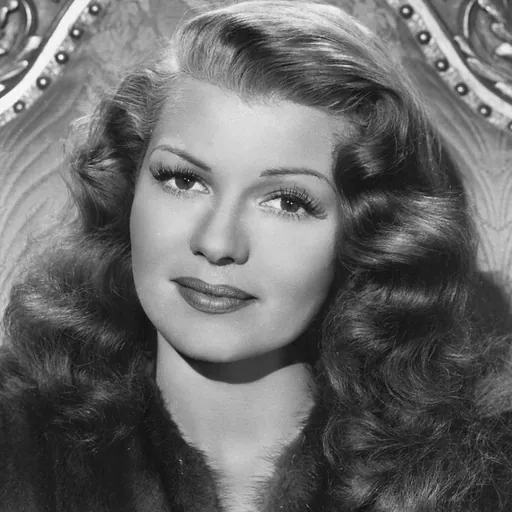
About Rita Hayworth
Lived 1918 – 1987 (aged 68). Rita Hayworth was an American film actor, dancer, stage actor, television actor, model and actor.
Rita Hayworth (born Margarita Carmen Cansino; October 17, 1918 – May 14, 1987) was an American actress, dancer, and pin-up girl. She achieved fame in the 1940s as one of the top stars of the Golden Age of Hollywood, and appeared in 61 films over 38 years. The press coined the term "The Love Goddess" to describe Hayworth after she became the most glamorous screen idol of the 1940s. She was the second top pin-up girl for GIs during World War II, after Betty Grable.
Hayworth is widely known for her performance in the 1946 film noir Gilda, opposite Glenn Ford, in which she played the femme fatale in her first major dramatic role. She is also known for her performances in Only Angels Have Wings (1939), The Strawberry Blonde (1941), Blood and Sand (1941), The Lady from Shanghai (1947), Pal Joey (1957), and Separate Tables (1958). Fred Astaire, with whom she made two films, You'll Never Get Rich (1941) and You Were Never Lovelier (1942), once called her his favorite dance partner. She also starred in the Technicolor musical Cover Girl (1944), with Gene Kelly. She is listed as one of the top 25 female motion picture stars of all time in the American Film Institute's survey AFI's 100 Years...100 Stars. For her contribution to the motion picture industry, Hayworth received a star on the Hollywood Walk of Fame at 1645 Vine Street in 1960. It has been speculated by friends that she was Romani, but this has never been confirmed and she referred to herself as "just another dirty-faced Mexican kid." In academic journals, in an article focused on ethnic represenation in Hollywood, she is described as "Latin" and "Spanish-Irish American." Her Spanish-born father was from Castilleja de la Cuesta, a town near Seville, Spain. Her mother, Volga Hayworth, was an American of Irish and English descent who had performed with the Ziegfeld Follies. The couple married in 1917. They also had two sons. Her maternal uncle Vinton Hayworth was an actor.
Eduardo Cansino wanted his daughter to become a professional dancer, while her mother hoped she would become an actress. Her paternal grandfather, Antonio Cansino, was a renowned classical Spanish dancer. He popularized the bolero, and his dancing school in Madrid was world-famous. Antonio Cansino instructed his granddaughter in her first dance lesson. Hayworth later recalled, "From the time I was three and a half... as soon as I could stand on my own feet, I was given dance lessons." She said: "I didn't like it very much... but I didn't have the courage to tell my father, so I began taking the lessons. Rehearse, rehearse, rehearse, that was my girlhood."
She attended dance classes every day for a few years in a Carnegie Hall complex, where she was taught by her uncle Angel Cansino. In 1926, at the age of eight, she was featured in La Fiesta, a short film for Warner Bros.
In 1931, Eduardo Cansino partnered with his 12-year-old daughter to form an act called the Dancing Cansinos. Her hair was dyed from brown to black to give her a more mature and "Latin" appearance. Since under California law Margarita was too young to work in nightclubs and bars, her father took her with him to work across the border in Tijuana, Mexico. In the early 1930s, it was a popular tourist spot for people from Los Angeles. Her biographer, Barbara Leaming, wrote that her mother may have been the only person to know of the abuse; she slept in the same bed as her daughter to try to protect her. Leaming wrote that the abuse contributed to Hayworth's difficulty in relationships as an adult.
Hayworth took a bit part in the film Cruz Diablo (1934) at age 16, which led to another bit part in the film In Caliente (1935) with the Mexican actress Dolores del Río.
Career Early career During her time at Fox, Hayworth was billed as Rita Cansino and appeared in unremarkable roles, often cast as the exotic foreigner. In late 1934, aged 16, she performed a dance sequence in the Spencer Tracy film Dante's Inferno (1935), and was put under contract in February 1935. While on loan to Warner Bros., Hayworth appeared as the second female lead in The Strawberry Blonde (1941), opposite James Cagney. Although Astaire made 10 films with Ginger Rogers, his other main dancing partner, Hayworth's sensuality surpassed Rogers' cool technical expertise. "Rita's youthful exuberance meshed perfectly with Fred's maturity and elegance", says Levinson.
In August 1941, Hayworth was featured in an iconic Life photo in which she posed in a negligee with a black lace bodice. Bob Landry's photo made Hayworth one of the top two pin-up girls of the World War II years; the other was Betty Grable, in a 1943 photograph. For two years, Hayworth's photograph was the most requested pin-up photograph in circulation. In 2002, the satin nightgown Hayworth wore in the photo sold for $26,888.
In March 1942, Hayworth visited Brazil as a cultural ambassador for the Roosevelt administration's Good Neighbor policy, under the auspices of the Office of the Coordinator of Inter-American Affairs. During the 1940s Hayworth also contributed to the OCIAA's cultural diplomacy initiatives in support of Pan-Americanism through her broadcasts to South America on the CBS "Cadena de las Américas" radio network.
In 1943, she was suspended without pay for nine weeks because she refused to appear in Once Upon a Time.
Peak years at Columbia Hayworth had top billing in one of her best-known films, the Technicolor musical Cover Girl, released in 1944. The film established her as Columbia's top star of the 1940s, and it gave her the distinction of being the first of only six women to dance on screen with both Gene Kelly and Fred Astaire. "I guess the only jewels of my life", Hayworth said in 1970, "were the pictures I made with Fred Astaire ... And Cover Girl, too."
For three consecutive years, starting in 1944, Hayworth was named one of the top movie box-office attractions in the world. She was adept in ballet, tap, ballroom, and Spanish routines. Cohn continued to showcase Hayworth's dance talents. Columbia featured her in the Technicolor films Tonight and Every Night (1945) with Lee Bowman and Down to Earth (1947) with Larry Parks.
Her sexy, glamorous appeal was most noted in Charles Vidor's film noir Gilda (1946) with Glenn Ford, which caused censors some consternation. The role, in which Hayworth wore black satin and performed a legendary one-glove striptease, "Put The Blame On Mame", made her into a cultural icon as a femme fatale.
The fourth atomic bomb ever to be detonated was decorated with a photograph of Hayworth cut from the June 1946 issue of Esquire magazine. Above it was stenciled the device's nickname, "Gilda" - the name of the film in which she was starring at the time - in two-inch black letters.
In 1947, Hayworth's new contract with Columbia provided a salary of $250,000 plus 50% of films' profits.
Hayworth's performance in Welles's 1947 film The Lady from Shanghai was critically acclaimed.
Also in 1947, Hayworth was featured in a Life cover story by Winthrop Sargeant that resulted in her being nicknamed "The Love Goddess". The term was adopted and used as the title of a biopic and of a biography about her. In a 1980s interview, Hayworth said, "Everybody else does nude scenes, but I don't. I never made nude movies. I didn't have to do that. I danced. I was provocative, I guess, in some things. But I was not completely exposed."
Hiatus and return
In 1948, at the height of her fame, Hayworth met Aly Khan. They were married on May 27, 1949. Hayworth left Hollywood and sailed for France, breaking her contract with Columbia. An Ismaili Muslim suggested that Rita take the name Rehmat Khanum, meaning "Lady of the Blessings of the Almighty".
In 1951, Columbia alleged it had $800,000 invested in properties for her, including the film she had walked out on that year. A 1951 article in the British periodical The People called for a boycott of Hayworth's films:
After the collapse of her marriage to Khan, Hayworth returned to Hollywood to star in her "comeback" picture, Affair in Trinidad (1952), which again paired her with Glenn Ford. Director Vincent Sherman recalled that Hayworth seemed "rather frightened at the approach of doing another picture". She continued to clash with Cohn and was placed on suspension during filming. Hayworth refused to report for work because she objected to the script.
Hayworth continued to star in a string of successful pictures. In 1953, she had two films released: Salome with Charles Laughton and Stewart Granger, and Miss Sadie Thompson with José Ferrer and Aldo Ray. She was off the big screen for another four years, mainly because of a tumultuous marriage to the singer Dick Haymes. During her marriage to Haymes, she was involved in much negative publicity, which significantly lessened her appeal. In 1955, she sued Columbia Pictures to be released from her contract, but asked for her $150,000 salary, alleging that the filming failed to start on Joseph and His Brethren (1961) when agreed. The film was later filmed in 1961 by a foreign company as The Story of Joseph and His Brethren (film). Cohn expressed frustration with Hayworth in a 1957 interview with Time magazine:
Hayworth might be worth ten million dollars today easily! She owned 25% of the profits with her own company and had hit after hit and she had to get married and had to get out of the business and took a suspension because she fell in love again! In five years, at two pictures a year, at 25%! Think of what she could have made! But she didn't make pictures! She took two or three suspensions! She got mixed up with different characters! Unpredictable! Kim Novak had become Columbia's top female star. Her last musical was Pal Joey (1957) with Frank Sinatra and Novak (Hayworth had top billing in both pictures but actually played a supporting role in Pal Joey). Hayworth then left Columbia for good.
Later career Hayworth received good reviews for her performances in Separate Tables (1958), with Burt Lancaster and David Niven, They Came to Cordura (1959) with Gary Cooper and The Story on Page One (1960). She was meant to be in Summer of the Seventeenth Doll with Lancaster but both withdrew after the original play failed on Broadway. She continued working throughout the 1960s. In 1962, her planned Broadway debut in Step on a Crack was cancelled for undisclosed health reasons. In 1964 Circus World was released, in which John Wayne was her co-star and for which she received a Golden Globe nomination as Best Actress in a dramatic role. The Money Trap (1965) paired her, for the last time, with good friend Glenn Ford.
Even after Harry Cohn had died, Hayworth still resented her treatment by both him and Columbia. She spoke bluntly in a 1968 interview:
Hayworth resented that the studio had failed to train her to sing or even to encourage her to learn to sing.
Hayworth continued to act in films until the early 1970s. She made comedic television appearances on Laugh In and The Carol Burnett Show in the 1970s. Her second-to-last film was French director Georges Lautner's Road to Salina (1970), starring Mimsy Farmer and Robert Walker Jr. Her last film was The Wrath of God (1972), a western.
Public image Hayworth was a top glamour girl in the 1940s, a pin-up girl for military servicemen and a beauty icon for women. At and , she was tall enough to be a concern for dancing partners such as Fred Astaire. She reportedly changed her hair color eight times in eight movies.
In 1949, Hayworth's lips were voted best in the world by the Artists League of America. She had a modeling contract with Max Factor to promote its Tru-Color lipsticks and Pan-Stik and Pan–Cake makeup.
Personal life Hayworth's two younger brothers, Eduardo Cansino Jr. and Vernon Cansino, both served in World War II. Vernon left the United States Army in 1946 with several medals, including the Purple Heart, and later married Susan Vail, a dancer. Eduardo Jr. followed Hayworth into acting; he was also under contract with Columbia Pictures. In 1953, he made his screen debut in The Great Adventures of Captain Kidd.
In 1941, Hayworth said she was the antithesis of the characters she played: "I naturally am very shy ... and I suffer from an inferiority complex." Her provocative role in Gilda, in particular, made people expect her to be what she was not. Hayworth once said, with some bitterness, "Men go to bed with Gilda, but wake up with me."
Marriages, relationships and family Hayworth married and divorced five times in 24 years. She had affairs with several of her leading men, most notably Victor Mature in 1942, during the filming of My Gal Sal.
Hayworth had two daughters and two grandsons, one by each daughter. Her older daughter was the daughter of her second husband, Orson Welles. She had a son who was placed for adoption at birth, by some accounts, at Hayworth's urging, and he is featured in the 2008 documentary film Prodigal Sons.
Hayworth's younger daughter, Yasmin Aga Khan, is the daughter of Aly Khan.
Hayworth filed for divorce from him on February 24, 1942, with a complaint of cruelty. She noted to the press that his work took him to Oklahoma and Texas while she lived and worked in Hollywood. Judson was as old as her father, who was enraged by the marriage, which caused a rift between Hayworth and her parents until the divorce. Judson had failed to tell Hayworth before they married that he had previously been married twice. None of her colleagues knew about the planned wedding (before a judge) until she announced it the day before. For the civil ceremony, she wore a beige suit, a ruffled white blouse, and a veil. A few hours after they got married, they returned to work at the studio. They had a daughter, Rebecca, who was born on December 17, 1944, and died at the age of 59 on October 17, 2004. They struggled in their marriage, with Hayworth saying that Welles did not want to be tied down:
On November 10, 1947, she was granted a divorce that became final the next year. The divorce was civil and they remained friendly afterwards.
Relationship with Glenn Ford
Hayworth had an intermittent, long-term relationship with Glenn Ford that started during the filming of Gilda in 1945 and continued through their numerous marriages. Their relationship is documented in the 2011 biography Glenn Ford: A Life by Ford's son, Peter Ford. Peter writes that Hayworth became pregnant during the filming of The Loves of Carmen and traveled to France to get an abortion. Ford later moved next door to her in Beverly Hills in 1960, and they continued their relationship until the early 1980s.
Aly Khan
In 1948, Hayworth left her film career to marry Aly Khan, a son of Sultan Mohammed Shah, Aga Khan III, the leader of the Ismaili community of Shia Islam. They were married on May 27, 1949.
Aly Khan and his family were heavily involved in horse racing, owning and racing horses. Hayworth had no interest in the sport but became a member of the Del Mar Thoroughbred Club anyway. Her filly, Double Rose, won several races in France and finished second in the 1949 Prix de l'Arc de Triomphe.
In 1951, while still married to Hayworth, Khan was spotted dancing with the actress Joan Fontaine in the nightclub where he and Hayworth had met. Hayworth threatened to divorce him in Reno, Nevada. In May, Hayworth moved to Nevada to establish legal residence to qualify for a divorce. She stayed at Lake Tahoe with their daughter, saying there was a risk the child would be kidnapped. Hayworth filed for divorce from Khan on September 2, 1951, on the grounds of "extreme cruelty, entirely mental in nature".
Hayworth said she might convert to Islam, but did not. During the custody fight over their daughter, Yasmin Aga Khan, born , Aly said he wanted her to be raised as a Muslim; Hayworth wanted the child to be raised as a Christian. Hayworth rejected his offer of $1 million if she would rear Yasmin as a Muslim from age seven and allow her to go to Europe to visit him for two or three months each year, saying:
In January 1953, Hayworth was granted a divorce from Aly Khan on the grounds of extreme mental cruelty. Yasmin, three years old, played about the court while the case was being heard, finally climbing onto the judge's lap.
Dick Haymes
When Hayworth and Dick Haymes first met, he was married and his singing career was waning. Haymes was desperate for money because two of his ex-wives were suing him for unpaid child support. His financial problems were so bad that when he tried to return to California, he was arrested.
On July 7, 1954, his ex-wife Nora Eddington got a bench warrant for his arrest because he owed her $3,800 in alimony. Less than a week earlier, his ex-wife Joanne Dru also got a bench warrant because she said he owed $4,800 in child support payments for their three children. Hayworth ended up paying most of Haymes's debts.
Haymes was born in Argentina and did not have solid proof of US citizenship. Not long after he met Hayworth, US officials initiated proceedings to have him deported to Argentina for being an illegal alien. He hoped Hayworth could influence the government and keep him in the United States. When she assumed responsibility for his citizenship, a bond was formed that led to marriage. The two married on September 24, 1953, at the Sands Hotel, Las Vegas, and their wedding procession went through the casino.
From the start of their marriage, Haymes was deeply in debt to the Internal Revenue Service (IRS). When Hayworth took time off from attending his comeback performances in Philadelphia, audiences sharply declined. Haymes's $5,000 weekly salary was attached by the IRS to pay a $100,000 bill, and he was unable to pay his pianist. Haymes's ex-wives demanded money while Hayworth publicly bemoaned her own lack of alimony from Aly Khan. At one point, the couple was effectively imprisoned for 24 hours in Manhattan at the Hotel Madison while sheriff's deputies waited outside, threatening to arrest Haymes for outstanding debts.
At the same time, Hayworth was fighting a severe custody battle with Khan, during which she reported death threats against their children. While living in New York, Hayworth sent the children to live with their nanny in Westchester County. They were found and photographed by a reporter from Confidential magazine.
After a tumultuous two years together, Haymes struck Hayworth in the face in 1955 in public at the Cocoanut Grove nightclub in Los Angeles. Hayworth packed her bags, walked out, and never returned. The assault and crisis shook her, and her doctor ordered her to remain in bed for several days.
Hayworth was short of money after her marriage to Haymes. She had failed to gain child support from Aly Khan. She sued Orson Welles for back payment of child support, which she claimed had never been paid. This effort was unsuccessful and added to her stress.
James Hill
Hayworth began a relationship with film producer James Hill, whom she married on February 2, 1958. He put her in one of her last major films, Separate Tables. This film was popular and highly praised, although The Harvard Lampoon named her the worst actress of 1958 for her performance. On September 1, 1961, Hayworth filed for divorce, alleging extreme mental cruelty. Hill later wrote Rita Hayworth: A Memoir, in which he suggested that their marriage collapsed because he wanted Hayworth to continue making movies while she wanted them both to retire from Hollywood.
In his autobiography, Charlton Heston wrote about Hayworth's marriage to Hill. One night, Heston and his wife Lydia joined the couple for dinner at a restaurant in Spain with the director George Marshall and the actor Rex Harrison, Hayworth's co-star in The Happy Thieves. Heston wrote that the occasion "turned into the single most embarrassing evening of my life", describing how Hill heaped "obscene abuse" on Hayworth until she was "reduced to a helpless flood of tears, her face buried in her hands". Heston wrote that the others sat stunned, witnesses to a "marital massacre", and, though he was "strongly tempted to slug him" (Hill), he left with his wife after she stood up, almost in tears. Heston wrote, "I'm ashamed of walking away from Miss Hayworth's humiliation. I never saw her again."
Health
Orson Welles noted Hayworth's problem with alcohol during their marriage, but he never believed that her problem was alcoholism. "It certainly imitated alcoholism in every superficial way", he recalled in 1983. "She'd fly into these rages, never at me, never once, always at Harry Cohn or her father or her mother or her brother. She would break all the furniture and she'd get in a car and I'd have to get in the car and try to control her. She'd drive up in the hills suicidally. Terrible, terrible nights. And I just saw this lovely girl destroying herself. I admire Yasmin so much."
Yasmin Aga Khan spoke of her mother's long struggle with alcohol:
In 1972, Hayworth wanted to retire from acting, but she needed money. At the suggestion of Robert Mitchum, she agreed to film The Wrath of God. The experience exposed her poor health and her worsening mental state. Because she could not remember her lines, her scenes were shot one line at a time.
In March 1974, both her brothers died within a week of each other, which caused her great sadness and led to heavy drinking. In January 1976, at London's Heathrow Airport, Hayworth was removed from a TWA flight after having an angry outburst while traveling with her agent. The event attracted much publicity; a photograph where she looked disheveled was published in newspapers the next day. Hayworth's alcoholism hid symptoms of what was eventually understood to be Alzheimer's disease.
Yasmin Aga Khan spoke of her mother's disease:
Biographer Barbara Leaming wrote that Hayworth aged prematurely because of her alcoholism and also because of the many stresses in her life. "Despite the artfully applied make-up and shoulder-length red hair, there was no concealing the ravages of drink and stress", she wrote of Hayworth's arrival in New York in May 1956 in order to begin work on Fire Down Below, her first film in three years. "Deep lines had crept around her eyes and mouth, and she appeared worn, exhaustedolder than her thirty-eight years."
In July 1981, Hayworth's health had deteriorated to the point that a Los Angeles Superior Court judge ruled that she should be placed under the care of her daughter, Yasmin Aga Khan of New York City. Hayworth lived in an apartment at The San Remo on Central Park West adjoining that of her daughter, who arranged for her mother's care during her final years.
Political views Hayworth was a lifelong Democrat and an active member of the Hollywood Democratic Committee. She was active in the campaign of Franklin D. Roosevelt during the 1944 presidential election. In 1968, Hayworth was part of a Hollywood committee that endorsed Robert F. Kennedy's presidential campaign.
Religion Hayworth was a Catholic whose marriage to Aly Khan was deemed illicit by Pope Pius XII.
Death
Hayworth lapsed into a semicoma in February 1987. She died at age 68 from complications associated with Alzheimer's disease, on May 14, 1987, at her home in Manhattan. President Ronald Reagan, who was one of Hayworth's contemporaries in Hollywood (and who also suffered from Alzheimer's in his final years), issued a statement:
A funeral service was held on May 18, 1987, at the Church of the Good Shepherd. She was interred at Holy Cross Cemetery, Culver City. Her headstone includes Yasmin's sentiment: "To yesterday's companionship and tomorrow's reunion."
Filmography +Film and television Year Title Role
1926 Short; credited as Rita Cansino Charlie Chan in Egypt Nayda
Legacy The public disclosure and discussion of Hayworth's illness drew international attention to Alzheimer's disease, which was little known at the time, by Yasmin Aga Khan, in honor of her mother. She is the hostess for the events and is a major sponsor of Alzheimer's disease charities and awareness programs. , a total of more than $72 million had been raised through events in Chicago, New York, and Palm Beach, Florida.
On October 17, 2016, a press release from the Springer Associates Public Relations Agency announced that Rita Hayworth's former manager and friend, Budd Burton Moss, initiated a campaign to solicit the United States Postal Service to issue a commemorative stamp featuring Hayworth. Springer Associates also announced that the Academy of Motion Picture Arts and Sciences would be lobbied in hopes of having an honorary Academy Award issued in memory of Hayworth. The press release added that Hayworth's daughter, Yasmin Aga Khan, the Alzheimer's Association of Greater Los Angeles, and numerous prominent personalities of stage and screen were supporting the Moss campaign. The press release stated the target date for fulfillment of the stamp and Academy Award to be on October 17, 2018, the centennial of Hayworth's birth.
Cultural references
The film I Remember Better When I Paint (2009) describes how Hayworth took up painting while struggling with Alzheimer's. In 1983, Lynda Carter, who was of a similar Irish and Hispanic ancestry, played and danced as Hayworth in a TV biopic Rita Hayworth: The Love Goddess.
In the Baptiste episode "Shell", Baptiste talks to Kim about Hayworth in an attempt to gain information from her about Natalie after noticing that she has several DVDs of Hayworth's films; the Dream Room has a poster of Gilda.
Hayworth's name can be heard in the Madonna hit from 1990, "Vogue", ("Rita Hayworth gave good face") among other artists from classical Hollywood cinema. Her name is also mentioned in Tom Waits's song "Invitation to the Blues", from his 1976 album Small Change.
In the Sicilian scenes of the film The Godfather, the bodyguard of Michael Corleone is heard shouting the name "Rita Hayworth" to GI's passing by in jeeps.
Hayworth is the main topic of the song, "Take, Take, Take" by the White Stripes and also referenced in "White Moon"; both from their Get Behind Me Satan album, released in 2005. In a 2005 interview with Rolling Stone, Jack White said, "Rita Hayworth became an all-encompassing metaphor for everything I was thinking about while making the album."
The film The Shawshank Redemption was adapted from a Stephen King novella, "Rita Hayworth and Shawshank Redemption", from his 1982 collection Different Seasons. A succession of posters, starting with one of Rita Hayworth, hides a hole in a jail cell wall in the novella. In the film, a poster of Rita Hayworth was used for the first third of the film, then changed to a poster of Marilyn Monroe for the middle third, then Raquel Welch for the last third. The film also includes a scene where the prison movie night shows Rita Hayworth's film Gilda.
In the film Mulholland Drive, an amnesiac character who cannot remember her real name gives herself the name Rita. She sees the name on a poster for Hayworth’s film Gilda that hangs in the room where she’s standing at the time she’s first asked her name.
Don’t just read it —
keep it.
Full-length biographies made to live with: read them, listen on the way to work, watch them tonight.
- E-book
- Audio
- Video
Instant download · yours to keep · every purchase keeps this site free
Important facts
Family & relationships
People in Rita Hayworth's life
Named in this biography and alive at the same time




Related people
Same field, nearest in time



Contemporaries
People whose lives overlapped Rita Hayworth's


Frequently asked questions
Who was Rita Hayworth?
American actress (1918–1987)
When was Rita Hayworth born?
Rita Hayworth was born on 17 October 1918 in New York City.
When did Rita Hayworth die?
Rita Hayworth died on 14 May 1987 in Upper West Side, New York City.
What was Rita Hayworth's occupation?
Rita Hayworth was a film actor, dancer, stage actor, television actor, model and actor.
What nationality was Rita Hayworth?
Rita Hayworth was American.
Sources & further reading
Cite this page
APA: Biography.guide. (2026). Rita Hayworth. https://biography.guide/rita-hayworth/
MLA: "Rita Hayworth." Biography.guide, https://biography.guide/rita-hayworth/.
Chicago: "Rita Hayworth." Biography.guide. https://biography.guide/rita-hayworth/.
Data last updated: 2026-09-23 · Spot an error? Report a correction.
Portrait: Wikimedia Commons · author & licence
Page generated 2026-09-27 05:05 UTC