
About Richmond H. Thomason
Born 1939. Richmond H. Thomason is an American philologist, university teacher, logician, philosopher, analytic philosopher and artificial intelligence researcher.
Richmond Hunt Thomason (born 1939) is an American philosopher, logician, and computer scientist. He is professor emeritus of philosophy, linguistics, and electrical engineering and computer science at the University of Michigan, where he previously held the James B. and Grace J. Nelson Professorship.
Thomason is known for his work on modal and tense logic, the semantics of natural language, deontic logic, and the logical foundations of knowledge representation in artificial intelligence. He edited the influential collection Formal Philosophy: Selected Papers of Richard Montague and has authored widely used textbooks, including Symbolic Logic: An Introduction and, with Zoltán Gendler Szabó, the textbook Philosophy of Language. He is a fellow of the Association for the Advancement of Artificial Intelligence and a managing editor of Studia Logica. After completing his doctorate, he remained at Yale as instructor, assistant professor, and, from 1969, tenured associate professor of philosophy.
In modal and tense logic, Thomason is known for work on indeterministic models of time and the semantics of future contingents. In his paper "Indeterminist time and truth-value gaps" he developed a branching-time semantics in which future-tense sentences about genuinely open possibilities may fail to be either true or false. Later work, including the widely cited essay "Combinations of tense and modality" in the Handbook of Philosophical Logic, elaborated a family of so-called T×W structures that combine temporal and modal accessibility relations for the analysis of temporal and modal discourse.
Thomason has also contributed to deontic logic and the logic of action, exploring the relations between obligation, ability, and temporal structure. Work such as "Deontic logic as founded on tense logic" develops systems in which deontic operators are analysed against a background of branching time, with applications to reasoning about agency and practical deliberation.
In the philosophy of language and formal semantics, Thomason was an early proponent of Montague grammar and helped disseminate Richard Montague's work through his editing of Formal Philosophy: Selected Papers of Richard Montague. He has written influential papers on intensional semantics and propositional attitudes, including "A model theory for propositional attitudes" in Linguistics and Philosophy. With Robert Stalnaker he authored "A semantic theory of adverbs", which applied these tools to natural-language adverbial constructions.
Thomason has been active in developing logical and computational models of discourse, presupposition, and pragmatics. His essay "Accommodation, Meaning, and Implicature: Interdisciplinary Foundations for Pragmatics" surveys and extends work on presupposition accommodation and conversational inference. With Matthew Stone he has proposed computational architectures that treat presuppositions as private commitments in dialogue and link dynamic semantic theories to reasoning in conversation.
In artificial intelligence, Thomason's work has focused on nonmonotonic reasoning, inheritance systems, and the logical foundations of knowledge representation. He was elected a fellow of the Association for the Advancement of Artificial Intelligence in 1993 for contributions at the interface of logic and AI. Later work, such as "Knowledge Representation for Philosophers", surveys the field of knowledge representation and reasoning for a philosophical audience, highlighting planning, description logics, and nonmonotonic logics.
Thomason has also written on context and indexicality, the logic of practical reasoning, and formal models of agents' beliefs and desires, often aiming to integrate insights from philosophy, linguistics, and computer science.
Selected publications Symbolic Logic: An Introduction (Macmillan, 1970). "Indeterminist time and truth-value gaps", Theoria 36 (1970): 264–281. With Robert C. Stalnaker, "A semantic theory of adverbs", Linguistic Inquiry 4 (1973): 195–220. Editor, Formal Philosophy: Selected Papers of Richard Montague (Yale University Press, 1974). "A model theory for propositional attitudes", Linguistics and Philosophy 4 (1980): 47–70. "Combinations of tense and modality", in D. M. Gabbay and F. Guenthner (eds.), Handbook of Philosophical Logic, vol. 2 (Reidel, 1984), 135–165. Editor, Philosophical Logic and Artificial Intelligence (Kluwer Academic Publishers, 1988). "Accommodation, meaning, and implicature: Interdisciplinary foundations for pragmatics", in P. R. Cohen, J. Morgan, and M. Pollack (eds.), Intentions in Communication (MIT Press, 1990), 325–363. "Knowledge Representation for Philosophers", in S. O. Hansson and V. F. Hendricks (eds.), Introduction to Formal Philosophy (Springer, 2012), 371–385. With Zoltán Gendler Szabó, Philosophy of Language (Cambridge University Press, 2017).
Don’t just read it —
keep it.
Full-length biographies made to live with: read them, listen on the way to work, watch them tonight.
- E-book
- Audio
- Video
Instant download · yours to keep · every purchase keeps this site free
Important facts
People in Richmond H. Thomason's life
Named in this biography and alive at the same time


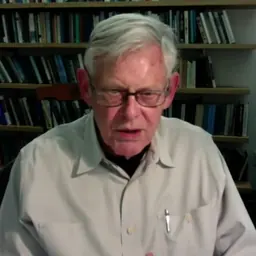

Related people
Same field, nearest in time




Contemporaries
People whose lives overlapped Richmond H. Thomason's




Frequently asked questions
Who is Richmond H. Thomason?
Ph.D. Yale University 1965
When was Richmond H. Thomason born?
Richmond H. Thomason was born in 1939 in Chicago.
What is Richmond H. Thomason's occupation?
Richmond H. Thomason is a philologist, university teacher, logician, philosopher, analytic philosopher and artificial intelligence researcher.
What nationality is Richmond H. Thomason?
Richmond H. Thomason is American.
Sources & further reading
· Wikipedia: Richmond H. Thomason
Cite this page
APA: Biography.guide. (2026). Richmond H. Thomason. https://biography.guide/richmond-h-thomason/
MLA: "Richmond H. Thomason." Biography.guide, https://biography.guide/richmond-h-thomason/.
Chicago: "Richmond H. Thomason." Biography.guide. https://biography.guide/richmond-h-thomason/.
Data last updated: 2026-09-20 · Spot an error? Report a correction.
Page generated 2026-09-27 05:34 UTC