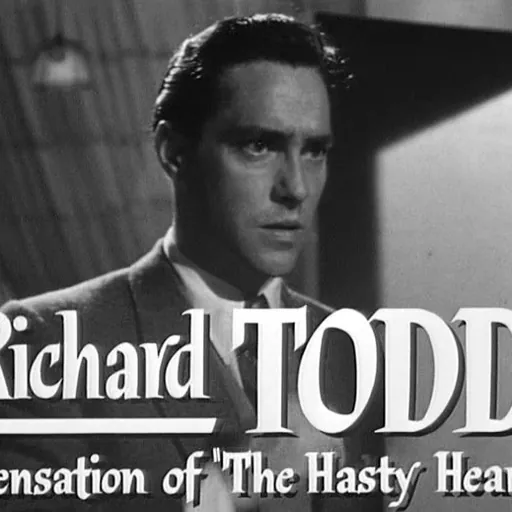
About Richard Todd
Lived 1919 – 2009 (aged 90). Richard Todd was a British and Irish film actor, stage actor, television actor, director and actor.
Richard Andrew Palethorpe-Todd (11 June 19193 December 2009) was an Irish-British actor, known for his leading man roles of the 1950s. He received a Golden Globe Award for Most Promising Newcomer – Male, and an Academy Award for Best Actor nomination and a Golden Globe Award for Best Actor nomination for his performance as Corporal Lachlan MacLachlan in the 1949 film The Hasty Heart.
His other notable roles include Jonathan Cooper in Stage Fright (1950), Wing Commander Guy Gibson in The Dam Busters (1955), Sir Walter Raleigh in The Virgin Queen (1955), and Major John Howard in The Longest Day (1962). Prior to his acting career, Todd was a captain in the British Army during the Second World War, fighting in the D-Day landings as a member of the 7th (Light Infantry) Parachute Battalion.
Early life and career Richard Todd was born in Dublin. His father, Andrew William Palethorpe-Todd, was an Irish physician and an international Irish rugby player who gained three caps for his country. Richard spent a few of his childhood years in India, where his father, an officer in the British Army, served as a physician.
He first appeared professionally as an actor at the Open Air Theatre, Regent's Park in 1936 in a production of Twelfth Night. He played in regional theatres and then co-founded the Dundee Repertory Theatre in Scotland in 1939. He also appeared as an extra in British films including Good Morning, Boys (1937), A Yank at Oxford (1938) and Old Bones of the River (1939).
Military service Lieutenants Tony Bowler (left) and Richard Todd of the 7th (Light Infantry) Parachute Battalion in Wales prior to D-Day, 1944.
Todd enlisted soon after the outbreak of the Second World War, entering the Royal Military College, Sandhurst in late 1939. On 29 January 1941, he was one of 26 cadets injured when 'D' Block of New College was hit by a German bomb in an attack by the Luftwaffe. In his memoirs, he describes seeing the bomb pass through the ceiling in front of him before he was blown out of the building by its blast, landing on a grass bank and suffering lacerations; five cadets were killed in the incident. Todd passed out in the spring of 1941. On the day he received his commission, he tried to join several friends at the Café de Paris in London, but could not get a table booked for the evening. That evening, the venue was destroyed in an air raid and 15 newly commissioned subalterns were killed.
Pegasus Bridge, where Lieutenant Todd landed on D-Day, 6 June 1944.
He was commissioned into the 2nd/4th Battalion of the King's Own Yorkshire Light Infantry (KOYLI). Following arctic warfare training in Iceland he returned to the UK as a lieutenant (having been promoted to that rank on 1 October 1942). He was among the first British soldiers to land in Normandy and the first Irishman. His battalion parachuted after glider-borne forces had landed to capture the Pegasus Bridge near Caen.
After three months fighting in Normandy, the 6th Airborne Division returned to the UK to reconstitute and went back to the continent three months later as emergency reinforcements to halt the Battle of the Bulge the German offensive in the Ardennes. Short of transport as they advanced into Germany, Todd, as the motor transport officer, was responsible for gathering a rag-tag selection of commandeered vehicles to ferry troops forward. After VE day, the division returned to the UK for a few weeks, then was sent on counter-insurgency operations in Palestine. During this posting he was seriously injured when his Jeep overturned, breaking both shoulders and receiving a concussion. He returned to the UK to be demobilised in 1946.
Career Associated British Picture Corporation After the war, Todd was unsure what direction to take in his career. His former agent, Robert Lennard, had become a casting agent for Associated British Picture Corporation and advised him to try out for the Dundee Repertory Company. Todd did so, performing in plays such as Claudia, where he appeared with Catherine Grant-Bogle, who became his first wife. Lennard arranged for a screen test and Associated British offered him a seven-year contract in 1948. Todd was cast in the lead in For Them That Trespass (1949), directed by Alberto Cavalcanti. The film was a minor hit and Todd's career was launched.
Todd had appeared in the Dundee Repertory stage version of John Patrick's play The Hasty Heart, portraying the role of Yank and was chosen to appear in the 1948 London stage version of the play, this time in the leading role of Cpl. Lachlan McLachlan. This led to his being cast in that role in the film adaptation of the play, filmed in Britain, alongside Ronald Reagan and Patricia Neal for Warner Bros. (which was a part owner of Associated British). Todd was nominated for the Academy Award for Best Actor for the role in 1949. He was also voted favourite British male film star in Britain's National Film Awards. The film was the tenth most popular movie at the British box office in 1949.
Todd was now much in demand. He was lent to Constellation Films to appear in the thriller The Interrupted Journey (1949). Alfred Hitchcock then used him in Stage Fright (1950), opposite Marlene Dietrich and Jane Wyman – Hitchcock's first British film since 1939. Associated British put him in the drama Portrait of Clare (1950), which did not perform well at the box office. Neither did Flesh and Blood (1951) for London Films, in which Todd had a dual role. Director King Vidor offered Todd a lead in Lightning Strikes Twice (1951), for Warners. Far more popular was The Story of Robin Hood and His Merrie Men (1952), in which Todd played the title role for Walt Disney Productions.
Associated British put him in 24 Hours of a Woman's Life (1952), with Merle Oberon. The Rank Organisation borrowed him for Venetian Bird (1952), directed by Ralph Thomas. Todd turned down the lead in The Red Beret because he disliked the script. Disney reunited the Robin Hood team in The Sword and the Rose (1953), with Todd as Charles Brandon, 1st Duke of Suffolk. It was not as popular as Robin Hood in the U.S. but performed well in Europe. The same went for Disney's Rob Roy: The Highland Rogue (1953), in which Todd played the title role. Disney pulled back on making costume films as a result.
In 1953, he appeared in a BBC television adaptation of the novel Wuthering Heights as Heathcliff. Nigel Kneale, responsible for the adaptation, said the production came about purely because Todd had turned up at the BBC and told them that he would like to play Heathcliff for them. Kneale had only a week to write the script, as the broadcast was rushed into production.
20th Century Fox Todd's career received a boost when 20th Century-Fox signed him to a non-exclusive contract and cast him as the United States Senate Chaplain Peter Marshall in the film version of Catherine Marshall's best selling biography A Man Called Peter (1955), which was a popular success.
Even more popular was The Dam Busters (1955) in which Todd played Wing Commander Guy Gibson. This was the most successful film at the British box office in 1955 and became the defining role of Todd's movie career.
The success of Man Called Peter led 20th Century Fox to offer Todd a four-picture contract. Associated British signed the actor to a new contract to make one film a year, but which enabled him to make "outside" movies. Todd's first film for Fox under the new deal was The Virgin Queen (1955), playing Sir Walter Raleigh opposite Bette Davis' Queen Elizabeth I. It did not do as well as Peter. He agreed to appear in Loser Takes All but had to pull out when that film was delayed.
In France, Todd played Axel Fersen opposite Michèle Morgan in Marie Antoinette Queen of France (1956), which was popular in France but not widely seen elsewhere. Fox cast him in D-Day the Sixth of June (1956), opposite Robert Taylor, which was a mild success.
Yangtse Incident: The Story of H.M.S. Amethyst (1957) was an attempt to repeat the success of The Dam Busters, with the same director (Michael Anderson) and Todd playing another real-life hero. It was popular in Britain but not on the scale of The Dam Busters.
He was Dunois, Bastard of Orléans in Saint Joan (1957), directed by Otto Preminger.
Chase a Crooked Shadow (1958) was a thriller with director Anderson for Associated British. Intent to Kill (1958) was another thriller, which he was forced to do under his contract with Fox. He returned to war films with Danger Within (1958), a POW story. Then there were more thrillers, with Never Let Go (1960), directed by John Guillermin and co-starring Peter Sellers in a rare straight acting role; Todd gave what has been called one of his best performances.
Few of these films had been overly popular but Todd was still the top-billed star of The Long and the Short and the Tall (1961), with Laurence Harvey and Richard Harris, for Associated British. He tried comedy with Don't Bother to Knock (1961), again for Associated British in conjunction with Todd's own company, Haileywood Films. This was followed by The Hellions (1961), shot in South Africa.
Decline as a star Todd's cinema career rapidly declined in the 1960s as the counter-culture movement in the arts became fashionable in Britain, with social-realist dramas commercially replacing the more middle-class orientated dramatic productions that Todd's performance character-type had previously excelled in.
The Boys (1962) was a courtroom drama film in which Todd played the lead prosecuting barrister. He had a good part among the many stars in Fox's The Longest Day (1962), playing British Major John Howard whom Todd knew during the airborne action just before and on D-Day as he, Lt. Richard Todd, himself had actually taken part in the 1944 landings. (In an odd twist, another actor, Patrick Jordan played the role of Lt. Todd in the movie); this was his biggest hit for some time. He appeared in The Very Edge (1963), a thriller, then he played Harry Sanders in two films for Harry Alan Towers: Death Drums Along the River (1963) and Coast of Skeletons (1965). He also had a small role in Anderson's Operation Crossbow (1965).
In 1964. he was a member of the jury at the 14th Berlin International Film Festival.
He had a supporting part in The Battle of the Villa Fiorita (1965) and the lead in The Love-Ins (1968).
Todd claims William Wyler offered him the lead in The Collector but the actor felt he was miscast and persuaded him not to cast him. "It was not the first time that I had talked myself out of a picture — there had been The Guns of Navarone, League of Gentlemen and Ice Cold in Alex — but this latest stupidity of mine came when I desperately needed to make another important international film."
Later career In the 1970s, Todd gained new fans when he appeared as the reader for Radio Four's Morning Story. In the 1980s, his distinctive voice was heard as narrator of Wings Over the World, a 13-part documentary series about the history of aviation shown on Arts & Entertainment television. He appeared before the camera in the episode about the Lancaster bomber. Todd continued to act on television, including roles in Virtual Murder; Silent Witness and in the Doctor Who story "Kinda" in 1982. In 1989, he appeared in the first episode of the sixth season of Murder, She Wrote in which he played Colonel Alex Schofield in the episode titled "Appointment in Athens".
He formed Triumph Theatre Productions with Duncan C. Weldon and Paul Elliott in the late 1960s. This company produced more than 100 plays, musicals and pantomimes all over the country; some of them starred Todd.
His acting career extended into his 80s, and he made several appearances in British shows such as Heartbeat and The Royal. He appeared in The Royal as Hugh Hurst, a retired solicitor, in the episode "Kiss and Tell" (2003); his last appearance in Heartbeat was as Major Harold Beecham in the 2007 episode "Seeds of Destruction".
Richard Todd was appointed an Officer of the Order of the British Empire (OBE) in 1993.
He was the subject of This Is Your Life on two occasions: in March 1960 when he was surprised by Eamonn Andrews at the BBC's Lime Grove Studios; and in November 1988 when Michael Aspel surprised him on stage at the Theatre Royal Windsor.
Richard Todd appeared in the "Midsomer Murders" episode "Birds of Prey" (2003) as Charles Edmonton. In the episode, his character is killed by Dr. Naomi Sinclair. He dies after receiving a fatal injection while asleep.
Unmade projects Todd was the first choice of author Ian Fleming to play James Bond in Dr. No, but a scheduling conflict gave the role to Sean Connery. In the 1960s, Todd unsuccessfully attempted to produce a film of Ian Fleming's The Diamond Smugglers
In his book British Film Character Actors (1982), Terence Pettigrew described Todd as "an actor who made the most of what he had, which could be summed up as an inability to sit still while there was a horse to leap astride, a swollen river to swim or a tree to vanish into."
Personal life Todd was married twice; both marriages ended in divorce. His first wife was actress Catherine Grant-Bogle, whom he met in Dundee Repertory. They were married from 1949 until 1970. They had a son, Peter (1952–2005), and a daughter, Fiona Margaret Todd born 1956. In 1960 he had a son Jeremy Todd-Nelson with model Patricia Nelson. He was married to model Virginia Mailer from 1970 until 1992; they had two sons together, Andrew then Seamus (1977–1997). In retirement, Todd lived in the village of Little Ponton and later in Little Humby, eight miles from Grantham, Lincolnshire.
Tragically, two of Todd's five children committed suicide using family firearms. On 7 December 1997, Todd's youngest son Seamus Palethorpe-Todd who was 20, shot himself in the head with a shotgun lying on his bed at their home in Lincolnshire while home on a break from Newcastle University where he was a first year student studying politics; an inquest determined that the suicide might have been a depressive reaction to the drug he was taking for severe acne. Eight years later on 21 September 2005, Todd's eldest son Peter, who was 53, also using a shotgun, killed himself in his car in East Malling, Kent, following marital difficulties. Peter had been suffering depression.
Todd bought a dairy farm in 1957 and Jersey cows to stock it along with hens and pigs. He sold a brand of his own cream to restaurants, shops and supermarkets across the Midlands and south of England.
He was an admirer of Margaret Thatcher and he dined with her at 10 Downing Street along with and Ronald Reagan (with whom he had kept in touch since they made "The Hasty Heart" together.) His body was buried between his two sons Seamus and Peter at St. Guthlac's Church in Little Ponton in Lincolnshire. The gravestone's epitaph reads "Richard Andrew Palethorpe Todd, 1919–2009, husband of Virginia and Kitty, loving father of Peter, Fiona, Andrew, Seamus and Jeremy, Exit Dashing Young Blade" (a reference to the Queen Mother's description of him).
Selected filmography Year Film Role Director Notes 1937 Good Morning, Boys Extra in crowd scene Marcel Varnel uncredited 1938 A Yank at Oxford Extra in sporting event Jack Conway uncredited 1938 Old Bones of the River Extra in crowd scene Marcel Varnel uncredited 1949 For Them That Trespass Herbert Edward Logan Alberto Cavalcanti 1949 The Hasty Heart Cpl. Lachlan "Lachie" MacLachlan Vincent Sherman 1949 The Interrupted Journey John North Daniel Birt 1950 Stage Fright Jonathan Cooper Alfred Hitchcock 1950 Portrait of Clare Robert Hart Lance Comfort 1951 Flesh and Blood Charles Cameron / Sutherland Anthony Kimmins 1951 Lightning Strikes Twice Richard Trevelyan King Vidor 1952 The Story of Robin Hood and His Merrie Men Robin Hood Ken Annakin 1952 24 Hours of a Woman's Life The Young Man Victor Saville 1952 Venetian Bird Edward Mercer Ralph Thomas 1952Elstree StoryNarratorGilbert Gunn 1953 The Sword and the Rose Charles Brandon Ken Annakin 1954 Rob Roy: The Highland Rogue Rob Roy MacGregor Harold French 1954 The Bed Capitaine Davidson 1955 A Man Called Peter Peter Marshall Henry Koster biopic 1955 The Dam Busters Wing Commander Guy Gibson, V.C, D.S.O., D.F.C. Michael Anderson 1955 The Virgin Queen Sir Walter Raleigh Henry Koster 1956 Marie-Antoinette reine de France Comte Axel von Fersen Jean Delannoy 1956 D-Day the Sixth of June Lt. Col. John Wynter Henry Koster 1957 Yangtse Incident: The Story of H.M.S. Amethyst John Kerans Michael Anderson 1957 Saint Joan Jean de Dunois, Bastard of Orleans Otto Preminger 1958 Chase a Crooked Shadow Ward Prescott Michael Anderson 1958 The Naked Earth Danny Vincent Sherman 1958 Intent to Kill Dr. Bob McLaurin Jack Cardiff 1959 Danger Within Lt. Col. David Baird, M.C Don Chaffey 1960 Never Let Go John Cummings John Guillermin 1961 The Long and the Short and the Tall Sgt. Mitchem Leslie Norman 1961 Don't Bother to Knock Bill Ferguson Cyril Frankel 1961 The Hellions Sgt. Sam Hargis Ken Annakin 1962 Le Crime ne paie pas Col. Roberts William Gérard Oury segment "L'homme de I'avenue" 1962 The Boys Victor Webster Sidney J. Furie 1962 The Longest Day John Howard British Army officer 1963 The Very Edge Geoffrey Lawrence Cyril Frankel 1963 Death Drums Along the River Inspector Harry Sanders Lawrence Huntington 1964 Coast of Skeletons Inspector Harry Sanders Robert Lynn 1965 Operation Crossbow Wing Cmdr. Kendall Michael Anderson 1965 The Battle of the Villa Fiorita Darrell Delmer Daves 1967 The Love-Ins Dr. Jonathan Barnett Arthur Dreifuss 1968 Subterfuge Col. Victor Redmayne Peter Graham Scott 1968 Last of the Long-haired Boys Trigg 1970 Dorian Gray Basil Hallward Massimo Dallamano 1972 Asylum Walter Roy Ward Baker segment "Frozen Fear" 1977 No. 1 of the Secret Service Arthur Loveday Lindsay Shonteff 1978 The Big Sleep Commander Barker Michael Winner 1979 Home Before Midnight Geoffrey Steele Pete Walker 1979 Bloodbath Terence Silvio Narizzano 1983 House of the Long Shadows Sam Allyson Pete Walker 1992 Incident at Victoria Falls Lord Roberts Bill Corcoran
Box-office rankings British exhibitors regularly listed Todd among the most popular local stars at the box office in various polls: 1950 – 7th most popular British star 1952 – 5th most popular British star in Britain 1954 – 9th most popular British star 1955 – 7th most popular British star 1957 – 3rd most popular star in Britain
Select theatre credits An Ideal Husband by Oscar Wilde (1965) – Strand Theatre, London with Margaret Lockwood, Michael Denison, Dulcie Gray and Roger Livesey – also toured South Africa Dear Octopus by Dodie Smith (1967) – Haymarket Theatre, London "The Winslow Boy" (1971) – national tour with Patrick Barr, Elizabeth Sellars and David Nicholas Wilkinson " A Christmas Carol" (1971–72) – Theatre Royal, Brighton with Patrick Barr, Elizabeth Sellars, Mervyn Johns and David Nicholas Wilkinson Sleuth (1972–73) – Australian tour Equus (1975) – Australian tour The Business of Murder (1983–91) – Mayfair Theatre, London
Books Caught in the Act London: Hutchinson (1986) In Camera, an Autobiography Continued London: Hutchinson (1989)
Don’t just read it —
keep it.
Full-length biographies made to live with: read them, listen on the way to work, watch them tonight.
- E-book
- Audio
- Video
Instant download · yours to keep · every purchase keeps this site free
Important facts
People in Richard Todd's life
Named in this biography and alive at the same time




Related people
Same field, nearest in time



Contemporaries
People whose lives overlapped Richard Todd's

Frequently asked questions
Who was Richard Todd?
Irish-British actor (1919-2009)
When was Richard Todd born?
Richard Todd was born on 11 June 1919 in Dublin.
When did Richard Todd die?
Richard Todd died on 3 December 2009 in Grantham.
What was Richard Todd's occupation?
Richard Todd was a film actor, stage actor, television actor, director and actor.
What nationality was Richard Todd?
Richard Todd was British and Irish.
Sources & further reading
Cite this page
APA: Biography.guide. (2026). Richard Todd. https://biography.guide/richard-todd-film-actor/
MLA: "Richard Todd." Biography.guide, https://biography.guide/richard-todd-film-actor/.
Chicago: "Richard Todd." Biography.guide. https://biography.guide/richard-todd-film-actor/.
Data last updated: 2026-09-22 · Spot an error? Report a correction.
Portrait: Wikimedia Commons · author & licence
Page generated 2026-09-27 05:04 UTC