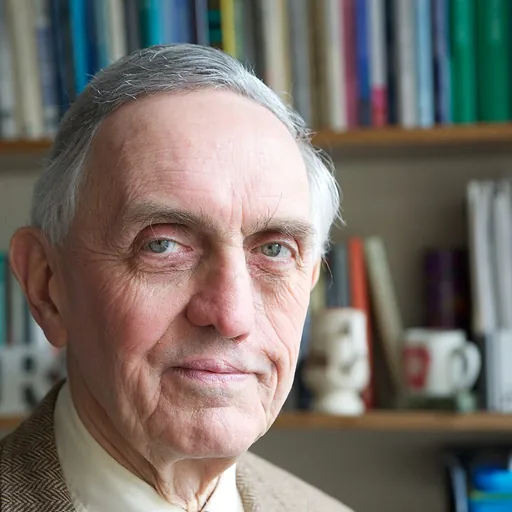
About Richard Rose
Born 1933. Richard Rose is an American political scientist and university teacher.
Richard Rose is a political scientist, author, and academic whose comparative studies in social science have significantly influenced political science and public policy in both practice and theory. He is a Professor and Director of the Centre for the Study of Public Policy at the University of Strathclyde (UOS) in Scotland, and is a visiting fellow at the Robert Schuman Centre of the European University Institute and the WZB Berlin Social Science Center.
Rose is most known for his research in the comparative study of public policy, employing both quantitative and qualitative analyses.
Rose's publications encompass peer-reviewed articles and books covering democracy, elections and parties, governance, public expenditure and the welfare state. He has received numerous awards, including honorary doctorates from the European University Institute in Florence and Orebro University in Sweden, as well as lifetime achievement awards from various organizations such as the Political Studies Association of the United Kingdom, the European Consortium for Political Research, the Policy Studies Organization, and the Comparative Study of Electoral Systems (CSES).
Rose is also Fellow of the British Academy, Royal Society of Edinburgh, a Former Fellow of Woodrow Wilson International Center. He is an honorary foreign member of the American Academy of Arts and Sciences, and Finnish Academy of Science and Letters, and was a founding editor of the Journal of Public Policy.
Early life and education Rose was born on 9 April 1933 in St. Louis Missouri. He took his undergraduate degree at Johns Hopkins University in comparative literature in 1953 and was a graduate student at the London School of Economics from 1953 to 1954. He pursued studies at Oxford, graduating with a DPhil from Nuffield College with a thesis, titled "The Relation of Socialist Principles to British Labour Foreign Policy 1945-51."
Career Rose started his career as a lecturer in the Department of Government at the University of Manchester in 1960. In 1966, he assumed the role of Professor of Politics at UOS in Glasgow, Scotland where he established the Centre for the Study of Public Policy the first public policy center in a European university. Cambridge University, Stanford, Johns Hopkins University, Central European University, and the Chinese University of Hong Kong. He has also been a visiting fellow at the Brookings Institution, the American Enterprise Institute, the International Monetary Fund, the Max Planck Institute for Transformation Research Berlin, the Paul Lazarsfeld Gesellschaft and the European Centre for Social Policy Research, Vienna. the European Parliament, the Council of Europe, OECD, the World Bank, and UN agencies. In 2007, drawing on insights from the Northern Ireland conflict, he presented a parable on conflict in divided states during an Oval Office meeting with President George W. Bush. In addition, he has been an election night commentator on television for BBC and RTE, and was the first by-lined political commentator of The Times (London) in 1964 and contributed to the Daily Telegraph in London, The Economist, and Times Higher Education. Since 1998, he has volunteered as a consultant for Transparency International's Global Barometer Surveys on corruption and has written a monthly online commentary discussing the electoral implications of public opinion polls since 2023.
Research Rose has made contributions to the study of political science. He has authored articles and books in political science, economics, sociology, public administration, law, social policy, geography, and social medicine.
Rose's first books were about British politics and elections, starting with The British General Election of 1959 with D. E. Butler (1960), followed by works such as Politics in England (1965) and How Sick Is British Democracy? (2021), which delved into British politics and elections. Expanding his scope to cover various regions of the United Kingdom, he authored Governing without Consensus: An Irish Perspective (1971) and Understanding the United Kingdom (1982). His comparative studies of parties and elections in Europe combining quantitative and institutional data have included, The International Almanac of Electoral Behavior (1991) co-authored with T. Mackie, Do Parties Make a Difference? (1984), and Representing Europeans: A Pragmatic Approach (2015). Adding to his body of work in this field, his book titled, How Referendums Challenge European Democracy: Brexit and Beyond was published in 2020. The UK Political Studies Association annually awards a Richard Rose prize to a political scientist under the age of 40 who has made a distinctive contribution to the study of British politics.
In comparative public policy, Rose has produced books, beginning with Can Government Go Bankrupt? co-authored with B.G. Peters in 1978 and Understanding Big Government (1985). These books have been followed by numerous other works on public employment, taxation, laws, and inheritance in public policy. Concurrently, he conducted comparative studies of heads of government Presidents and Prime Ministers which he edited with E. Suleiman in 1980, The Post-Modern President: The White House Meets the World (1991), and The Prime Minister in a Shrinking World (2001). and The Welfare State East and West with Rei Shiratori in 1986. He also authored Welfare Goes Global: Making Progress and Catching Up (2024) which compares health, education and female employment of people living in countries with 95 percent of the world's population. In recognition of his contributions to comparative public policy, a 14-chapter volume titled The Problem of Governing: Essays for Richard Rose has been published.
Following the fall of the Berlin Wall, Rose created a series of New Democracy Barometer sample surveys to collect evidence about the political, economic and social transformation of post-Communist societies. Since 1991 he has conducted more than 100 nationwide sample surveys in eleven Central and East European countries that are member states of the European Union. These surveys also include the successor states of Yugoslavia, Belarus, and Ukraine and 20 nationwide surveys in Russia. His book Understanding Post-Communist Transformation: A Bottom-Up Approach (2009) gives a full list of articles and books analyzing that survey data.
Rose has given a personal account of fieldwork across continents in a memoir titled Learning about Politics in Time and Space, including a chapter entitled "Reflections of a Comparative Social Scientist."
Awards and honors 1992 – Fellow, The British Academy 2019 – Lifetime Career Achievement Award, International Public Policy Association 2019 – Fellow, Royal Society of Edinburgh
Don’t just read it —
keep it.
Full-length biographies made to live with: read them, listen on the way to work, watch them tonight.
- E-book
- Audio
- Video
Instant download · yours to keep · every purchase keeps this site free
Important facts
People in Richard Rose's life
Named in this biography and alive at the same time




Related people
Same field, nearest in time



Contemporaries
People whose lives overlapped Richard Rose's




Frequently asked questions
Who is Richard Rose?
American political scientist (born 1933)
When was Richard Rose born?
Richard Rose was born on 8 April 1933 in St. Louis.
What is Richard Rose's occupation?
Richard Rose is a political scientist and university teacher.
What nationality is Richard Rose?
Richard Rose is American.
Sources & further reading
· DBpedia: Richard Rose (political scientist)
Cite this page
APA: Biography.guide. (2026). Richard Rose. https://biography.guide/richard-rose-political-scientist/
MLA: "Richard Rose." Biography.guide, https://biography.guide/richard-rose-political-scientist/.
Chicago: "Richard Rose." Biography.guide. https://biography.guide/richard-rose-political-scientist/.
Data last updated: 2026-09-23 · Spot an error? Report a correction.
Portrait: Wikimedia Commons · author & licence
Page generated 2026-09-27 05:04 UTC