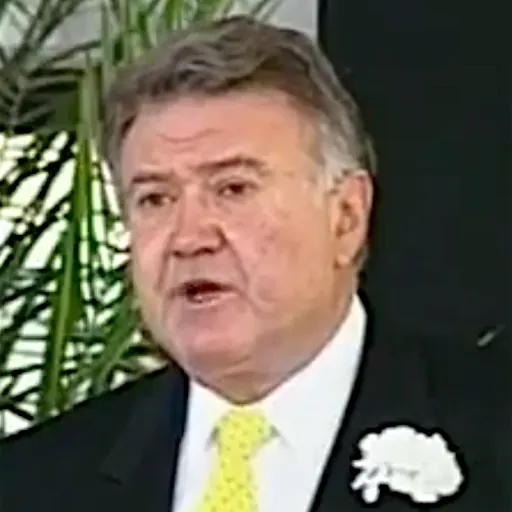
About Richard Pratt
Lived 1934 – 2009 (aged 74). Richard Pratt was a Polish and Australian businessperson and sports executive, known for Carlton Football Club.
Richard J. Pratt (born Ryszard Przecicki; 10 December 193428 April 2009
Early life Ryszard Przecicki was born in the Free City of Danzig (present-day Gdańsk, Poland) to Jewish parents Leon and Paula on 10 December 1934. His family emigrated to Australia in 1938, seeking safe refuge from the Nazis, and settled in Shepparton, Victoria, changing their surname from Przecicki to Pratt. Pratt had a rough journey travelling to Australia without getting caught by the Nazis. The family faced food shortages en route. Pratt was educated at Grahamvale Primary School, Shepparton High School, and University High School, and he enrolled in a Bachelor of Commerce degree at the University of Melbourne in 1953. He played Australian rules football as a ruckman. After starting his career at Lemnos (now the Shepparton Swans), Pratt played for Carlton in the Victorian Football League's (VFL) under-19s competition. He was awarded the Morrish Medal in 1953 for being deemed the "best and fairest" U-19 player that year. Pratt did not continue his footballing career to senior VFL level, instead focusing on other interests.
Pratt combined study with acting with the Union Theatre Repertory Company and working as salesman for the family business, Visy Board. After touring London and New York in 1957 with a production of Ray Lawler's Summer of the Seventeenth Doll, playing the role of Johnnie Dowd, he returned to Melbourne and Visy. He also appeared on television.
Business career Following the death of his father Leon in February 1969, Pratt took over his father's business at Visy Industries, which at that time had several hundred employees and an annual turnover of A$5 million. The following year, NCA paid costs and returned documents seized.
Also in the 1990s, Visy was ordered by the Australian Competition & Consumer Commission (ACCC) to pay a half-million-dollar fine for illegal anti-competitive behaviour.
Public career As well as his business interests, Pratt was known for his involvement in public service, having held posts including foundation chancellor of Swinburne University of Technology, president of the Victorian Arts Centre Trust, and Chairman of the Board of Management of the Mental Health Research Institute of Victoria.
Through the Pratt Foundation, the Pratt family are among Australia's leading philanthropists, donating up to A$10 million a year. Pratt was named Environmental Visionary of the Year in 1998 by the Keep Australia Beautiful Campaign.
Pratt also donated considerable funds to both major political parties (for example, A$300,000 in Financial Year 2004–05), as well as to Prime Minister John Howard's Liberal government.
In 1996, an investigation by The Australian newspaper documented from internal company documents that Pratt maintained a multimillion-dollar network of advisors. In his tenure as Carlton Football Club President, Pratt was largely responsible for overseeing major changes at Carlton Football Club, which would help put the club back on track to become a powerhouse again where Pratt was also largely responsible for bringing in major sponsor Hyundai and for helping the Blues crack 40,000 members for the first time. and the appointment of former CEO of Collingwood Football Club, Greg Swann as the CEO of Carlton Football Club. The club also returned to a stable off-field position during Pratt's presidency. and before their marriage lived in Sydney. After the success of Visy Industries, they enjoyed a lavish lifestyle, with a private jet and a range of apartments, including a penthouse at the Sherry-Netherland Hotel in New York City; their main home was the historic mansion Raheen, in the Melbourne suburb of Kew,
Another daughter, Paula, was born in 1997 to his longtime mistress, socialite Shari-Lea Hitchcock. In 2000, this affair became the subject of widespread media attention owing to a court case involving Ms Hitchcock and a nanny hired to look after her daughter. At the time, Pratt was accused of trying to pay hush money to the nanny who had launched legal action against Ms Hitchcock.
Pratt was the godfather of Deborah Beale, who is the former wife of Bill Shorten and daughter of Julian Beale.
After a well-publicised battle with prostate cancer, Richard Pratt died at his Kew residence on 28 April 2009, the day after all charges against him had been dropped due to his ill health.
Philanthropy Pratt donated A$10 million every year through the Pratt Foundation to refugees, artists and others. The Foundation was established in 1978 by Jeanne and Richard Pratt as a vehicle for their philanthropy. During the 1980s and 1990s, the Pratts became known in Australia for funding the arts, medical research and higher education. Since then, the Pratt family has donated about A$200 million to worthy causes. Jeanne also set up The Production Company, which produced musicals in Melbourne from 1999–2020.
Conviction for price fixing In December 2005, the ACCC commenced a civil penalty proceeding against Visy companies, Pratt, and others, for alleged involvement in a cartel in the packaging industry.
On 10 October 2007, Pratt was formally accused of price fixing, cheating customers and companies out of approximately A$700 million in the nation's biggest-ever cartel case.
The ACCC alleged "very serious contraventions" of the law and that these had been "carefully and deliberately concealed" by Visy senior executives. The ACCC counsel further stated:"There can be no suggestion that Visy acted in ignorance of its obligations under the act" and further added that the deliberate use of pre-paid mobile phones that could not be traced and the holding of meetings in private homes, motel rooms and suburban parks "...provides a strong indication that Visy was fully aware that the conduct was illegal". Pratt was aggrieved by the criminal prosecution and its effect on his reputation, stating: "I feel very angry—Visy is seen as Richard Pratt's company—there is a certain amount of character assassination for me personally because I am a tall poppy in the community; it's a big scalp (for the ACCC). My reputation is something I have been building for 50 years and so I am worried that the general public will now see me as a rich person who has made his money doing something that is wrong in the eyes of the law." Federal Court of Australia judge Justice Heerey said Pratt and his senior executives were knowingly concerned in the cartel, which involved price fixing and market sharing. Pratt had been facing four separate charges under Section 5 of the Act, the penalty for each charge ranges from a fine of $2,200 to 12 months' jail.
On 27 April 2009, this criminal prosecution of Pratt for charges of impropriety (lying to the ACCC during its successful investigation into the Visy/Amcor price-fixing scandal) were abandoned on account of his poor health and impending death. However, Commonwealth Prosecutor Mark Dean SC told the Federal Court the Commonwealth Director of Public Prosecutions believed the prosecution would have succeeded. Pratt died the following day.
Honours Pratt was appointed an Officer of the Order of Australia (AO) in 1985, and a Companion of the Order (AC) in 1998. Jeanne Pratt has also been appointed a Companion of the Order of Australia. However, Richard Pratt returned his awards in February 2008 after he was fined A$36 million for price fixing.
On 16 May 2007, he was awarded the Woodrow Wilson Medal for Corporate Citizenship. This is given to executives who "by their examples and their business practices, have shown a deep concern for the common good beyond the bottom line. They are at the forefront of the idea that private firms should be good citizens in their own neighborhoods and in the world at large".
In every Carlton Football Club home match against the Collingwood Football Club in the Australian Football League, the winner takes home a cup named after Pratt.
Don’t just read it —
keep it.
Full-length biographies made to live with: read them, listen on the way to work, watch them tonight.
- E-book
- Audio
- Video
Instant download · yours to keep · every purchase keeps this site free
Important facts
Family & relationships
People in Richard Pratt's life
Named in this biography and alive at the same time







Related people
Same field, nearest in time


Contemporaries
People whose lives overlapped Richard Pratt's




Frequently asked questions
Who was Richard Pratt?
Australian businessman (1934–2009)
When was Richard Pratt born?
Richard Pratt was born on 10 December 1934 in Gdańsk.
When did Richard Pratt die?
Richard Pratt died on 28 April 2009 in Kew.
What was Richard Pratt's occupation?
Richard Pratt was a businessperson and sports executive.
What was Richard Pratt known for?
Richard Pratt was known for Carlton Football Club.
What nationality was Richard Pratt?
Richard Pratt was Polish and Australian.
Sources & further reading
· DBpedia: Richard Pratt (businessman)
Cite this page
APA: Biography.guide. (2026). Richard Pratt. https://biography.guide/richard-pratt-businessperson/
MLA: "Richard Pratt." Biography.guide, https://biography.guide/richard-pratt-businessperson/.
Chicago: "Richard Pratt." Biography.guide. https://biography.guide/richard-pratt-businessperson/.
Data last updated: 2026-09-23 · Spot an error? Report a correction.
Portrait: Wikimedia Commons · author & licence
Page generated 2026-09-27 05:07 UTC