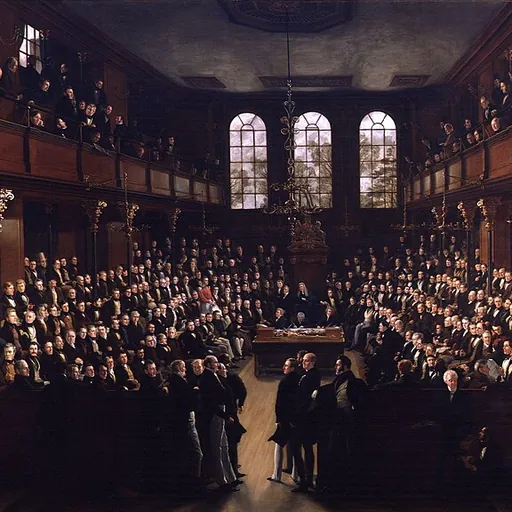
About Richard Potter
Lived 1778 – 1842 (aged 63–64). Richard Potter was a British politician and businessperson.
Richard Potter (1778–1842) was an English radical non-conformist Liberal Party MP for Wigan, and a founding member of the Little Circle which was key in gaining the Reform Act 1832.
Early life The fifth and youngest son of John Potter (1728–1802), Richard Potter was born on 31 January 1778, in Tadcaster, Yorkshire and he died on 13 July 1842, in Penzance, Cornwall.
His father, John Potter, was born on 7 December 1728 in Tadcaster and died there on 28 November 1802. He is buried in grave 40655 at St Mary the Virgin's Church in Tadcaster. He worked as a journeyman in London and on the death of his father, also John Potter born 1691, on 16 June 1758, and his mother, Anne, on 2 May 1762, he succeeded to their draper's shop in Tadcaster. He took a farm at Wighill where he dealt in sheep and wool. On 23 December 1785 an indenture was made for the lease of Wingate Hill Farm between Sir Walter Vavasour and John Potter "The produce of it (Wingate Hill Farm) having been successively on the advance, his shop, too, having been conducted by his wife and children, all his concerns prospered, and enabled him to set two of his sons (William and Richard) up in Manchester at the beginning of this year (1802) with a capital possessed by few beginners (£14,000). And he died worth twelve thousand pounds, which, on the death of his spouse, he left equally to his sons and daughters."
William and Richard Potter opened a warehouse in Manchester at 5 Cannon Street, and a few months later they were joined by Thomas. The firm of William, Thomas and Richard Potter was established on 1 January 1803. William stood down from the business in 1806 when it became Thomas and Richard Potter.
First Little Circle
The Potter family were wealthy Unitarians who were members of Cross Street Chapel and the Portico Library, and were concerned with the welfare of the poor. Thomas and Richard Potter became concerned with unfair representation of the people in parliament in rapidly expanding industrialised towns in the Victorian era, such as Birmingham, Leeds, Manchester and Salford, and decided to form a group to promote change.
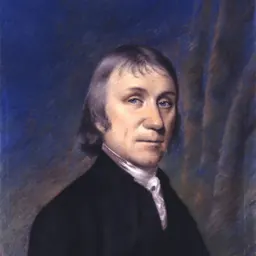
In 1815, the first Little Circle was formed, around a core of members from the Cross Street Chapel who were influenced by the ideas of Jeremy Bentham and Joseph Priestley. The founding members included John Edward Taylor (cotton merchant), Joseph Brotherton (a non-conformist minister and pioneering vegetarian), Thomas Preston, and Thomas and Richard Potter. Meetings were held in a room at the back of the Potters' Cannon Street counting-house, generally known as the "plotting-parlour", they decided the time was right to advance their liberalist agenda. In 1820, Brotherton, Shuttleworth and Thomas Potter founded the Manchester Chamber of Commerce. In the following year, the group supported John Edward Taylor in founding the liberal newspaper the Manchester Guardian, to which they all contributed. Published by law only once a week, Taylor continued to edit the newspaper until his death.
Business career Whilst Richard applied himself almost exclusively to political movements and reform, becoming Member of Parliament for Wigan in 1830, his brother Thomas was left in more or less sole charge of the management of the warehouse. It developed into the largest concern of its type in Manchester. Seven were Unitarians, including five from the Cross Street Chapel: Thomas and Richard Potter, Abasolm Watkin, Mark Philips, John Shuttleworth, John Benjamin Smith, brothers Edward and William Baxter (all cotton merchants), Fenton Atkinson (prominent Manchester attorney), William Harvey and John Edward Taylor.
The group supported social reform issues discreetly: Taylor survived a trial for libel; Shuttleworth organised the defence of plebeian reformers accused of administering an illegal oath. including a son, Richard (1817–1892), who became chairman of the Great Western Railway and president of the Grand Trunk Railway, Canada; and a daughter Sarah Anne (1822–1846) who married Talavera Vernon Anson, an officer of the Royal Navy, and had two sons.
Richard Potter died in July 1842, aged 64 in Penzance, Cornwall.
Don’t just read it —
keep it.
Full-length biographies made to live with: read them, listen on the way to work, watch them tonight.
- E-book
- Audio
- Video
Instant download · yours to keep · every purchase keeps this site free
Important facts
People in Richard Potter's life
Named in this biography and alive at the same time




Related people
Same field, nearest in time


Contemporaries
People whose lives overlapped Richard Potter's



Frequently asked questions
Who was Richard Potter?
English radical Liberal politician
When was Richard Potter born?
Richard Potter was born in 1778.
When did Richard Potter die?
Richard Potter died in 1842.
What was Richard Potter's occupation?
Richard Potter was a politician and businessperson.
What nationality was Richard Potter?
Richard Potter was British.
Sources & further reading
· DBpedia: Richard Potter (British politician)
Cite this page
APA: Biography.guide. (2026). Richard Potter. https://biography.guide/richard-potter-politician/
MLA: "Richard Potter." Biography.guide, https://biography.guide/richard-potter-politician/.
Chicago: "Richard Potter." Biography.guide. https://biography.guide/richard-potter-politician/.
Data last updated: 2026-09-22 · Spot an error? Report a correction.
Portrait: Wikimedia Commons · author & licence
Page generated 2026-09-27 05:03 UTC