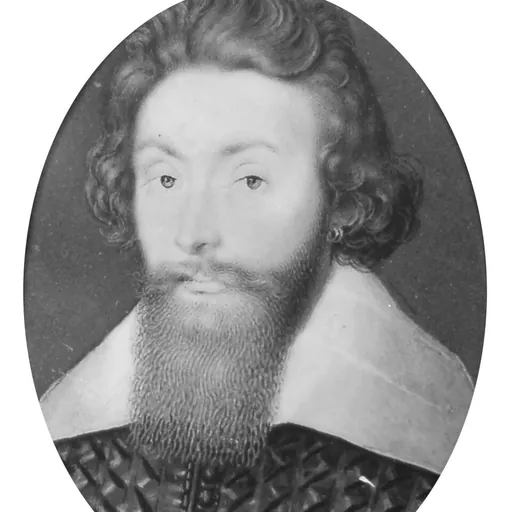
About Richard Leveson
Lived 1570 – 1605 (aged 34–35). Richard Leveson was a politician.
Vice-Admiral Sir Richard Leveson (c. 1570 – 2 August 1605) was a Royal Navy officer, politician and landowner. His origins were in the landed gentry of Shropshire and Staffordshire. A client and son-in-law of Charles Howard, 1st Earl of Nottingham, he became a vice-admiral under him. He served twice as MP for Shropshire in the House of Commons of England. He was ruined by the burden of debt built up by his father.
Family background Richard Leveson's parents were Sir Walter Leveson (1551-1602) of Lilleshall, Shropshire, and then the entire manor, and at Trentham, where James bought the lands of the dissolved priory. Walter was initially an enclosing and improving landlord, raising the family's profile still further, and serving as MP for Shropshire three times.
Anne Corbet, the daughter of Sir Andrew Corbet of Moreton Corbet, who was vice-president of the powerful Council of Wales and the Marches. The Corbets were very important landowners in Shropshire, supplying knights of the shire through much of the reign of Queen Elizabeth: in concert with the Levesons, they could dictate the representation of Shropshire in the English parliament.
The Leveson and Corbet families were the most powerful of the landed gentry families in Shropshire, a county without a resident aristocracy. Both underwent a crisis in the late Elizabethan and Jacobean periods as a result of overspending and succession problems, coupled with unwise exposure to the vagaries of the State. In Richard Leveson's case, the problems stemmed almost entirely from his father's impulsive and irrational behaviour, stemming apparently from a serious mental illness.
Naval career
Inscription on memorial to Richard Leveson, giving career details. Leveson took to the sea in his teenage years and his career was secured by marriage in 1587 to Margaret, the daughter of Charles Howard, 1st Earl of Nottingham, who had been appointed Lord High Admiral in 1585.
In 1588 Leveson served as a volunteer on board the Ark Royal against the Spanish Armada, and in 1596 had a command in the expedition against Cádiz, on which occasion he was knighted. In 1597 he is said to have commanded the Hope in 'the Islands' voyage' under Robert Devereux, 2nd Earl of Essex, though other lists describe him as commanding the Nonpareil. It is possible that he moved from one ship to the other during the expedition. In 1599 he commanded the Lion in the fleet fitted out, under Lord Thomas Howard, in expectation of a Spanish attempt at invasion. In 1600, with the style of 'admiral of the narrow seas,' he commanded a squadron sent towards the Azores to look out for the Spanish treasure-ships. Great care was taken to keep their destination secret; but the Spaniards, warned by experience, changed the route of their ships, and so escaped. In October 1601 he was appointed captain-general and admiral of certain of her Majesty's ships to serve against the Spaniards lately landed in Ireland. (Cal. State Papers, Ireland), and in the early days of December fought a battle off Castlehaven and forced his way into the harbour of Kinsale, where, after a severe action, he destroyed the whole of the enemy's shipping under Pedro de Zubiaur.
Early in 1602 Leveson was appointed to command a powerful fleet of nine English and twelve Dutch ships, which were to infest the Spanish coast. The Dutch ships were, however, late in joining, and Leveson, leaving his vice-admiral Sir William Monson, to wait for them, put to sea with only five ships on 19 March 1602. Within two or three days the queen sent Monson orders to sail at once to join his admiral, for she had word that 'the silver ships were arrived at Terceira.' They had, in fact, arrived and left again; and before Monson could join him Leveson fell in with them. With his very small force he could do nothing. 'If the Hollanders,' wrote Monson, 'had kept touch, according to promise, and the queen's ships had been fitted out with care, we had made her majesty mistress of more treasure than any of her progenitors ever enjoyed.' It was not till the end of May that the two English squadrons met with each other, and on 1 June, being then off Lisbon, they had news of a large carrack and eleven galleys in Cezimbra bay. Some of the English ships had been sent home as not seaworthy; others had separated; there were only five with Leveson when, on the morning of the 3rd, he found the Spanish ships both under the command of Federico Spinola and Álvaro de Bazán strongly posted under the guns of the castle. At ten o'clock he stood into the bay, and after a fight which lasted till five in the evening, two of the galleys were burnt, and the rest, with the carrack, Saõ Valentinho capitulated and were taken to England. The prize money from the carrack worth £3,000 was awarded by Queen Elizabeth.
In 1603, during the last sickness and after the death of the queen, Leveson commanded the fleet in the narrow seas, to prevent any attempt to disturb the peace of the country or to influence the succession being made from France or the Netherlands. This was his last service at sea. On 7 April 1604 he was appointed jointly Lieutenant of the Admiralty of England, and Vice-Admiral of England for life (ib. Dom.), and in the following year was marshal of the embassy to Spain for the conclusion of the peace. Shortly after his return he died in London.
Member of Parliament
The parliament of 1589 Richard Leveson was elected a member of the English parliament for the first time on 7 November 1588,
The parliament of 1604 The funeral of Elizabeth I. Leveson was one of the six knights chosen to bear the canopy. Henry Brooke, 11th Baron Cobham. The aftermath of his attainder was one of the issues facing the 1604 parliament that involved Leveson, as a client of the Howards. The summoning of the first parliament of James I found Leveson at the height of his prestige. His capture of the Portuguese carrack was still fresh in the memory. At the funeral of Elizabeth I, he had acted as a knight of the canopy. Leveson must have seemed an obvious choice at the time and two of the prominent county gentry took the unusual step of countersigning the return to mark their approval: Vincent Corbet, Leveson's uncle, and Francis Newport. Newport's endorsement was significant: a former MP, and three times High Sheriff of Shropshire, he knew Leveson's difficulties well, as the Privy Council had sent him to arrest three of Sir Walter's servants in 1593. The second member was Robert Needham, a cousin of Leveson and Corbet whose family estates were mainly around Cranage in Cheshire but whose seat was Shavington Hall in Shropshire.
When the parliament assembled on 19 March 1604, Leveson was one of those deputed to administer the Oath of Supremacy to the rest of the House of Commons, He was soon nominated to two committees directly concerned with family affairs of his patron, the Earl of Nottingham. One was the committee to deal with the naturalization of Nottingham's wife. Leveson's mother-in-law had died shortly before the queen. The earl then married a Scottish woman, about fifty years his junior, Margaret Stuart, a daughter of the so-called "Bonny Earl", James Stewart, 2nd Earl of Moray. The second committee dealt with provision for Leveson's sister-in-law, Frances Howard, known as Lady Kildare, as she was the widow of Henry FitzGerald, 12th Earl of Kildare. Her second husband, Henry Brooke, 11th Baron Cobham had been condemned to death in November 1603 for his part in the Main Plot to install Lady Arbella Stuart on the throne. He was not executed but held in the Tower of London until his health broke down in 1617. As proposed by the committee, Parliament granted Cobham's lands to Lady Kildare.
Parliament also drew on Leveson's professional expertise. He was named to a committee dealing with the relief of soldiers and sailors who had served in the Irish war and to another on a bill to prohibit the export of iron artillery. The latter was one of a series of measures proposed by the highly experienced MP Robert Wroth, who had sought to set the agenda for the parliament by bringing forward a list of seven "grievances" or reform proposals around which he hoped to focus debate. The most important was a proposal to sweep away the abuses of the wardship system, but he also wanted reform of the Exchequer and elements of religious and social reform. Leveson was nominated to a committee to look at the whole programme proposed by Wroth, as well as to some of the committees on specific proposals. However, Wroth was a puritan, the last of the Marian exiles to serve in the House of Commons. His approach was not universally popular and there were powerful interests opposed to him in the Court and in the House of Lords, as well as cracks in his relationship with his patron, Robert Cecil. In the end, none of Wroth's program was carried.
Leveson was nominated to a committee to consider Union between the kingdoms of Scotland and England; another proposal that came to nothing at this stage. On 2 May there was a complaint the House's proceedings were not accurately reported to the king by those who had access to him. As a gentleman of the privy chamber, Leveson felt impelled to reply and stood up to do so. However, the puritan Sir Francis Hastings rose at the same time to press home the complaint. The House ruled in favour of Hastings and Leveson was forced to sit down. However, on 5 June he did address the House on a bill for the continuance and repeal of expiring statutes.
The Parliament was not dissolved and was to last until 1611. However, Leveson died before the next session was held in 1606. He was replaced as MP after a by-election by the immensely wealthy Shrewsbury lawyer and businessman Sir Roger Owen.
Finances Leveson family coat of arms on a memorial to Leveson The leaves represent a pun on an incorrect but plausible pronunciation of the family name, as the shield has "leaves on" it.
For most of Richard Leveson's life he was heir to great estates, and in his later years he was forced to look on helpless as they were endangered and dissipated. He lived occasionally at Lilleshall, Trentham or Wolverhampton, but was on active service for long periods. Although his personal wealth was largely derived from his maritime activities, including his naval service, privateering and trade, he was appointed to some of the offices appropriate to the Staffordshire and Shropshire landed gentry. By 1594, at latest, he was a justice of the peace in both counties. In 1596 he was made Custos Rotulorum of Shropshire, the senior position in the civil administration of the county, and an important honour.
It was his father, Sir Walter Leveson, who placed the Leveson patrimony in great danger, as he was accused of piracy in 1587, and later of sorcery. However, Walter was in the grip of a persecutory delusion. He claimed that he was the victim of a plot connected to jealousy of his second marriage. When Richard made suggestions, his father accused him of plotting with a man with the surname Ethell to ruin him. Convinced that the death of his daughter-in-law would somehow solve his problems, he grew poisonous plants at Lilleshall and made an attempt on her life.
Essex referred the Leveson case to Henry Howard, 1st Earl of Northampton, who engineered an agreement in June 1601.
Not until 1602 did Leveson inherit the estates on the death of his father, imprisoned to the last in the Fleet. This did not end his problems, but only added to them, as he was now responsible for his father's vast debts. In 1603 he and his step-mother faced legal action from Sir Julius Caesar, who was trying to recover £800. who had no hope of extracting such a vast sum from the estates. He investigated further and was able to undermine trust in Grey's story by bringing witnesses to testify that he had ended on bad terms with Leveson. As Richard Leveson lay dying, her father wrote to Robert Cecil asking for her wardship. "I am very sorry to have such a subject to write of, which is that my son Lewson is most dangerously sick and to be much doubted of his recovery. For he is the weakest man that ever I saw and is still in the extremity of the burning fever and now in a very great looseness. There is little hope of him. And as you know my poor daughter, his wife, in what case of weakness she is; and I know how ready men are to seek after such things at his Majesty's hands, and because I know it chiefly concerns your offer, although I know her state is not so weak as by law she can be found so imperfect, yet I would be loth it should come in question being my daughter. Therefore in your love to me prevent it and let me have the custody of my own daughter, that her imperfection which it has pleased God to lay on her may not be so known to my great grief in the end of my years. It is well known what she was till God called her only child away, which her nature and weak spirit could not resist; and with all that, which you know of, her bad father-in-law's dealing with her, whom God forgive for it. If God call him, the King shall lose a worthy servant and myself one that I accounted rather my natural son than a son-in-law. Good my lord, you are a father and therefore you best know my case in this.—Chelse, 2 August." The wardship was instead granted to her brother, William Howard, 3rd Baron Howard of Effingham. Margaret's wardship finally passed to her father after Effingham's death in 1615.
In the final years of his life, Leveson set up home at Perton, near Wolverhampton, with the noted courtesan Mary Fitton, the daughter of Sir Edward Fitton of Gawsworth, Cheshire (1548-1606) and Alice Holcroft (d.1627). They were second cousins: Leveson's paternal grandmother was also called Mary Fitton. They had a daughter, Anne, for whom Leveson sought to provide in his will. Mary Fitton continued to reside at Perton after Leveson's death, marrying another naval officer, Captain William Polewhele. The affair with Mary Fitton appears to have had no effect on Leveson's personal or political relations with Lord Howard, who continued to write of him as a son.
In January 1605 Leveson talked to one of the royal physicians, and had courtiers praise Mary Fitton's sister Anne Newdigate to the pregnant Anne of Denmark in an unsuccessful attempt to get her made nurse to Princess Mary.
Portraiture
There are three examples of a portrait miniature of Leveson by the Huguenot artist Isaac Oliver, apparently all painted personally by Oliver towards 1600, one of which is held by the Wallace Collection. They are regarded as typical of the style of Oliver, who studied under Nicholas Hilliard, the leading English miniaturist of the period. Oliver went on to become the official miniaturist to Anne of Denmark.
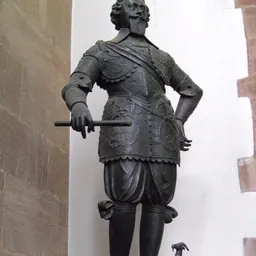
St Peter's Collegiate Church has a striking statue and monument to Leveson. The bronze statue is by Hubert Le Sueur, another Huguenot artist who made a career in England. It originally formed part of a family group in the chancel. After damage during the English Civil War, it was detached and reassembled in the lady chapel. A bronze plaque now recites Leveson's main naval achievements, while another gives details of his family connections. Le Sueur went on to work for Charles I, producing a well-known equestrian statue of him now at Charing Cross.
A portrait of Sir Richard Leveson, said to be by Anthony van Dyck, belongs to the Duke of Sutherland, the head of the Leveson-Gower family. Probably this painting was of the Royalist Member of Parliament, Sir Richard Leveson. This later Sir Richard was the uncle of Lady Christian (Leveson) Temple who had married the Duke of Buckingham and Chandos's ancestor, Sir Peter Temple.
Don’t just read it —
keep it.
Full-length biographies made to live with: read them, listen on the way to work, watch them tonight.
- E-book
- Audio
- Video
Instant download · yours to keep · every purchase keeps this site free
Important facts
People in Richard Leveson's life
Named in this biography and alive at the same time
Related people
Same field, nearest in time
Contemporaries
People whose lives overlapped Richard Leveson's
Frequently asked questions
Who was Richard Leveson?
Vice Admiral of England
When was Richard Leveson born?
Richard Leveson was born in 1570.
When did Richard Leveson die?
Richard Leveson died on 2 August 1605 in London.
What was Richard Leveson's occupation?
Richard Leveson was a politician.
Sources & further reading
· DBpedia: Richard Leveson (admiral)
Cite this page
APA: Biography.guide. (2026). Richard Leveson. https://biography.guide/richard-leveson-politician-1570/
MLA: "Richard Leveson." Biography.guide, https://biography.guide/richard-leveson-politician-1570/.
Chicago: "Richard Leveson." Biography.guide. https://biography.guide/richard-leveson-politician-1570/.
Data last updated: 2026-09-25 · Spot an error? Report a correction.
Portrait: Wikimedia Commons · author & licence
Page generated 2026-10-04 09:27 UTC