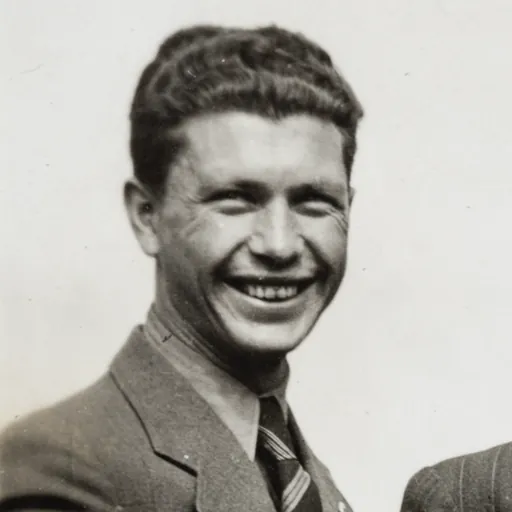
About Richard Kuremaa
Lived 1912 – 1991 (aged 78). Richard Kuremaa was an Estonian association football player.
Richard Kuremaa (1 December 1912 – 1 October 1991) was an Estonian footballer – one of the most famous before World War II. He played 42 times for Estonia national football team, scoring 19 goals. Kuremaa was the Estonian top division's record goalscorer during the country's first period of independence.
After the Soviet Union occupied Estonia in 1940, Kuremaa was sent to hard labour and spent more than a decade in prison camps in Russia, before being released in 1952.
Club career Richard Kuremaa made a name for himself in football already during his school days and after graduating from Jakob Westholm Gymnasium in 1931, he received offers from a number of clubs. He first joined VVS Puhkekodu Tallinn, but moved to Kalev in the following year. In 1933, Kuremaa joined TJK, where he played for three seasons. After stints with Pärnu Tervis and Tartu Olümpia, Kuremaa joined JS Estonia Tallinn and lifted his first Estonian Top Division title in the 1937–38 season.
Kuremaa returned to Tartu and led the club to their first Estonian Championship title in the 1939–40 season. That proved to be the last season before World War II reached Estonia and the country was eventually occupied by the Soviet Union.
Although he never won the top scorer award, Kuremaa remained Estonian top division's record goalscorer until 1995 with 65 goals.
International career Richard Kuremaa made 42 appearances for Estonia national football team and scored 19 goals, making him Estonia's second highest goalscorer during the country's first period of independence. The match took place on 18 July 1940 at the Kadriorg Stadium, where Estonia defeated Latvia 2–1, with Kuremaa scoring both of the goals. Considering the context surrounding the entire match, the fixture has been later interpreted as 'the last breath of free Estonia' due to being one of the very last public events where Estonians were able to express their nationality under the blue-black-white flag, before the Estonian SSR was nominally established three days later, on 21 July 1940.
Life after football In July 1941, 12 months after his last football match for the national team, Richard Kuremaa was sent to hard labour in Kotlas, Russia with fellow Estonian sportsmen Kristjan Palusalu, Gustav Sule and Aksel Kuuse among others. The match was held to commemorate their last meeting exactly half a century earlier in 1940. Estonia regained its independence in the following year, on 20 August 1991. Richard Kuremaa died on 1 October 1991. thumb
Club career statistics
Honours
Club
JS Estonia Tallinn
Estonian champion: 1937–38
Tartu Olümpia
Estonian champion: 1939–40
International
Estonia
Baltic Cup: 1938
Don’t just read it —
keep it.
Full-length biographies made to live with: read them, listen on the way to work, watch them tonight.
- E-book
- Audio
- Video
Instant download · yours to keep · every purchase keeps this site free
Important facts
People in Richard Kuremaa's life
Named in this biography and alive at the same time



Related people
Same field, nearest in time


Contemporaries
People whose lives overlapped Richard Kuremaa's





Frequently asked questions
Who was Richard Kuremaa?
Estonian footballer (1912-1991)
When was Richard Kuremaa born?
Richard Kuremaa was born on 1 December 1912 in Tallinn.
When did Richard Kuremaa die?
Richard Kuremaa died on 1 October 1991 in Tallinn.
What was Richard Kuremaa's occupation?
Richard Kuremaa was an association football player.
What nationality was Richard Kuremaa?
Richard Kuremaa was Estonian.
Sources & further reading
Cite this page
APA: Biography.guide. (2026). Richard Kuremaa. https://biography.guide/richard-kuremaa/
MLA: "Richard Kuremaa." Biography.guide, https://biography.guide/richard-kuremaa/.
Chicago: "Richard Kuremaa." Biography.guide. https://biography.guide/richard-kuremaa/.
Data last updated: 2026-09-20 · Spot an error? Report a correction.
Page generated 2026-09-27 05:10 UTC