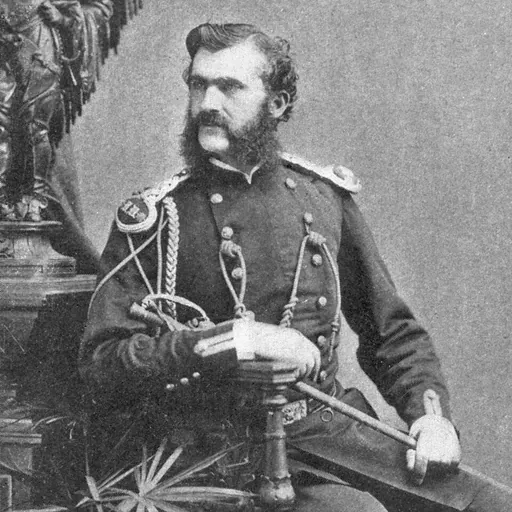
Richard Henry Savage
American military officer and writer
About Richard Henry Savage
Lived 1846 – 1903 (aged 57). Richard Henry Savage was an American writer, novelist and military officer.
Richard Henry Savage (June 12, 1846 – October 11, 1903) was an American military officer and author who wrote more than 40 books of adventure and mystery, based loosely on his own experiences. Savage's life may have been the inspiration for the pulp novel character Doc Savage.
In his youth in San Francisco, Savage studied engineering and law, and graduated from the United States Military Academy. After a few years of surveying work with the Army Corps of Engineers, Savage went to Rome as an envoy following which he sailed to Egypt to serve a stint with the Egyptian Army. Returning home, Savage was assigned to assess border disputes between the U.S. and Mexico, and he performed railroad survey work in Texas. In Washington D.C., he courted and married a widowed noblewoman from Germany.
Savage returned to San Francisco with his wife to stay for ten years, raising a daughter and taking part in a family business. He served at the rank of colonel in the California National Guard, and took part in the social activity of the city. During a period of anti-Chinese race riots, Savage stood up for law and order, and thereby gained the respect of San Francisco's leaders, property holders and middle class residents. Savage traveled to many exotic lands but in 1890 he was struck with jungle fever in Honduras. While recuperating in New York state he wrote his first book: My Official Wife. This very successful action-and-adventure story was followed by more, at the rate of about three per year, written for the general public rather than for literary critics; the latter were charmed by the first book but scathing of many later ones. Savage lived primarily in New York City, and was involved in lawsuits, especially against his New York publisher regarding unpaid royalties.
When the Spanish–American War broke out, Savage volunteered to lead men in battle. Instead, he was given command of an engineering unit which then built a complete base in Havana. Returning to New York, he wrote more books and corresponded with his wife who traveled often to the Russian Empire to visit their daughter and her Russian husband. Four years after mustering out of the Army, Savage was knocked down and mortally wounded at the age of 57 by a horse and carriage on the streets of New York.
Early life and career Savage was born in Utica, New York on June 12, 1846, the son of Jane Moorhead Ewart and Richard Savage (1817–1903), a lawyer and manufacturer whose family had lived in the Utica area for years. The 1848 finding of gold in California, prompted Savage's father to join the California Gold Rush in 1850. Savage and the rest of his family left New York in 1851 to join his father. Savage was among the first boys to attend public school in the new city, along with future poet Charles Warren Stoddard and the brothers Gus, Charles and Harry de Young who would found the San Francisco Chronicle. While the younger Savage was in school, his father helped discover the rich silver deposits of the Comstock Lode.
Savage finished high school at age 15 and began to study law with U.S. Senator James A. McDougall. Later, he studied with the law firm Halleck, Peachy & Billings, while partner Henry Halleck was back East serving as major general in the Union Army.
Government and writing career Savage performed his Army tasks but was unhappy with the narrowly defined role. He tendered his resignation on December 31, 1870.
In 1874, Savage began a ten-year stay in San Francisco. He worked with his father and brother on an iron foundry enterprise, and served two years as colonel of the 2nd Regiment California National Guard. Savage's calm and logical presence was seen by San Franciscans as a rallying point for law and order during the riots.
Savage followed his first book with Delilah of Harlem, The Mask of Venus, Our Mysterious Passenger and Other Stories and In the Shadow of the Pyramids. In addition to his fiction prose output, Savage published collections of his speeches and essays, and in 1895 wrote a book of poetry dedicated to his wife: After Many Years.
Savage's In the Shadow of the Pyramids was reviewed in The Literary World in May 1898. The reviewer said that Savage used "a happy mixture of audacity and ignorance quite untrammeled by facts." The "absurd" main character was criticized as unrealistically exposed to mortal danger almost daily, "just escaping dagger thrusts and pistol shots, with results more favorable to the theatrical progress of the story than to his common sense."
Final decade In 1896, Savage sued his publisher for $12,000 in unpaid royalties. The publisher, Frank Tennyson Neely, who had filed for bankruptcy five years earlier before accepting Savage as a client, argued that he did not owe Savage anything, instead, Savage owed him. Neely's scattered and incomplete accounting books prevented an easy conclusion to the trial. Three years later, Neely once again declared bankruptcy. In 1899, Abraham Lewis of Brooklyn sued Savage for $10,000 in damages, for stealing away the affections of his wife. Savage's own wife and a friend defended him in court, saying Lewis, an informal supplier of food to soldiers under Savage's command, was retaliating for being stopped from the lucrative but illegal act of selling liquor to the troops at Montauk Point.
On January 3, 1898, Savage and his wife celebrated their 25th anniversary, in New York City. On February 16, Savage volunteered for Army duty during the Spanish–American War. Savage would have served as lieutenant colonel of the 1st Tammany Regiment, but New York's Governor Frank S. Black declined the formation. Savage was instead assigned senior major of the 2nd U.S. Volunteer Engineers at the end of May. After stateside training and the building of a complete Army camp at Montauk Point, his unit traveled in November to Havana, Cuba and cleared Marianao to build Camp Columbia for the Army of Occupation. Savage hoisted the first American flag in Havana Province on December 10. He was in command of the battalion at the surrender of Havana on January 1, 1899. Weakened with yellow fever, Savage was mustered out of the Volunteer Engineers in April, 1899, and assigned captain with the 27th Volunteer Infantry. Continuing illness prevented him from traveling with his unit to the Philippines, and he was honorably discharged.
Death and legacy Savage died on October 11, 1903, at Roosevelt Hospital after being knocked down and injured in the ribcage on a New York City street by a horse and wagon on October 3. Savage's wife and daughter were still in Europe at the time of his death. He was buried at the West Point Cemetery on October 14, 1903.
Anna Josephine Savage died at the age of 67 on July 7, 1910, after a long illness in New York City, with her daughter at her side. For 30 years, she had been a noted supporter of women's right to vote.
Author Marilyn Cannaday has suggested that Doc Savage, the pulp hero from the 1930s and 1940s, was based in part on Savage's life, or at least his name. Though he never met Savage, Henry Ralston, one of men who created the pulp character, joined Street and Smith publishers one year after a collection of Savage's short stories were published.
Selected works (1891) My Official Wife, at Google Books (1891) My Official Wife, at Internet Archive (1892) The Little Lady of Lagunitas: A Franco-Californian Romance, at Project Gutenberg (1892) The Little Lady of Lagunitas: A Franco-Californian Romance, at Internet Archive (1892) Prince Schamyl's Wooing: A Story of the Caucasus-Russo-Turkish War (1892), at Internet Archive (1893) Of Life and Love: A Story of the Rio Grande, at Internet Archive (1893) Delilah of Harlem: A Story of the New York City of To-Day, at Internet Archive (1894) The Anarchist: A Story of To-Day, at Internet Archive (1894) The Princess of Alaska: A Tale of Two Countries, at Internet Archive (1894) The Flying Halcyon: a mystery of the Pacific Ocean, at Google Books (1895) Miss Devereux of the Mariquita: A Story of Bonanza Days in Nevada, at Internet Archive (1895) His Cuban Sweetheart, at Internet Archive (1895) After Many Years, at Internet Archive (1896) An Exile from London: A Novel, at Internet Archive (1896) Lost Contessa Falka: A Story of the Orient, at Internet Archive (1896) Checked Through, Missing, Trunk No. 17580: A Story on New York City Life, at Internet Archive (1897) An Awkward Meeting, Fighting the Tiger and other Thrilling Adventures, at Internet Archive (1897) A Fascinating Traitor, at Project Gutenberg (1897) Captain Landon: A Story of Modern Rome, at Internet Archive (1897) A Modern Corsair: A Story of the Levant, at Internet Archive (1898) In The Swim: A Story of Currents and Under-Currents in Gayest New York, at Internet Archive (1899) His Cuban Sweetheart, at Internet Archive (1899) The White Lady of Khaminavatka: A Story of the Ukraine, at Google Books (1900) The Midnight Passenger, at Project Gutenberg (1902) The Mystery of a Shipyard, at Internet Archive (1904) The Last Traitor of Long Island: A Story of the Sea, at Internet Archive (1904) The Last Traitor of Long Island: A Story of the Sea, at Internet Archive
Don’t just read it —
keep it.
Full-length biographies made to live with: read them, listen on the way to work, watch them tonight.
- E-book
- Audio
- Video
Instant download · yours to keep · every purchase keeps this site free
Important facts
People in Richard Henry Savage's life
Named in this biography and alive at the same time


Related people
Same field, nearest in time

Contemporaries
People whose lives overlapped Richard Henry Savage's




Frequently asked questions
Who was Richard Henry Savage?
American military officer and writer (1846–1903)
When was Richard Henry Savage born?
Richard Henry Savage was born on 12 June 1846 in Utica.
When did Richard Henry Savage die?
Richard Henry Savage died on 11 November 1903 in New York City, Mount Sinai West.
What was Richard Henry Savage's occupation?
Richard Henry Savage was a writer, novelist and military officer.
What nationality was Richard Henry Savage?
Richard Henry Savage was American.
Sources & further reading
· Wikipedia: Richard Henry Savage
· DBpedia: Richard Henry Savage
Cite this page
APA: Biography.guide. (2026). Richard Henry Savage. https://biography.guide/richard-henry-savage/
MLA: "Richard Henry Savage." Biography.guide, https://biography.guide/richard-henry-savage/.
Chicago: "Richard Henry Savage." Biography.guide. https://biography.guide/richard-henry-savage/.
Data last updated: 2026-09-21 · Spot an error? Report a correction.
Portrait: Wikimedia Commons · author & licence
Page generated 2026-09-27 05:01 UTC