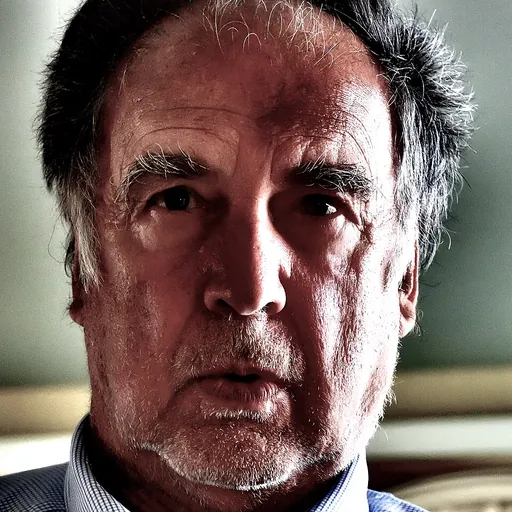
About Richard Fuisz
Born 1939. Richard Fuisz is an American physician and inventor.
Richard Carl Fuisz (born December 12, 1939) is an American physician, inventor, and entrepreneur, with connections to the United States military and intelligence community. He holds more than two hundred patents worldwide, in such diverse fields as drug delivery, interactive media, and cryptography, and has lectured on these topics internationally. Fuisz is a member of the Board of Regents of Georgetown University, where he and his brother created an annual scholarship honoring their deceased elder sibling, and established the first endowed professorship at the Georgetown University School of Medicine.
Early life and education Fuisz was born on December 12, 1939, in Bethlehem, Pennsylvania, to Anton Fujs, a Slovenian immigrant from Murska Sobota and Margaret Matuš, a Slovenian-American whose parents had migrated from Prekmurje. Fuisz completed his internship and residency at the Harvard Medical School's Cambridge Hospital campus.
Career After completing medical school and his residency, Fuisz served as a general physician and lieutenant commander in the U.S. Navy, where he was stationed at the White House during the Johnson administration. In 1971, Medcom acquired California-based Trainex Corporation, which supplied medical personnel training materials to the Middle East and North Africa. when the company was purchased by Baxter International, a supplier of hospital equipment, for $52 million. Fuisz initially offered to stay on for a three-year transition period to introduce the new ownership to his clients, but he was instead fired by Baxter chief executive Vernon Loucks.
After Medcom's sale and Fuisz's removal, business declined dramatically in the company's two biggest markets, the United States and Saudi Arabia, and profits plummeted. With the help of the American Jewish Congress, he brought the anti-boycott charges to the United States Department of Commerce Office of Anti-Boycott Compliance (OAC). In 1991, OAC referred the case to the Justice Department, resulting in the first-ever criminal prosecution of a company for violating anti-boycott laws in the U.S. Working with a young Mikhail Khodorkovsky, then the head of the Young Communist League, Fuisz exported computers and other electronics to the Soviet Union through the Center for Scientific and Technical Creativity of the Youth, and he would later claim that his business helped to supply computers to the KGB.
In 1988, Fuisz was approached by Yuri Dubinin, the Soviet ambassador to the United States, to set up a modeling agency that would prepare young Soviet models for American markets. In the second deposition, held in January 2001, when asked to describe his interactions with high-level Soviet officials, Fuisz claimed to have difficulty separating information gained in his capacity as director of the modeling agency from information gained in "his employment by the government", and that he was "prohibited by a contract with the government" from providing further clarification.
Allegations of arms sales to Iraq In January 1992, The New York Times published an article by journalist Seymour Hersh alleging that U.S. intelligence had helped to arm the Iraqi military during the Gulf War, naming Fuisz as its primary source. The article described an affidavit Fuisz had submitted to the United States House Agriculture Subcommittee on Nutrition, Oversight, and Department Operations, which was investigating American heavy equipment manufacturer Terex Corp. Fuisz, who had been involved in business in the Middle East for many years, was representing a Saudi family interested in purchasing a heavy equipment company when he was given a tour of the Terex plant in Motherwell, Scotland in September 1987. During the tour, Fuisz noticed two large armor-plated vehicles painted in desert camouflage with specially attached steel backs; the plant manager allegedly told Fuisz that the vehicles were Scud missile launchers being manufactured for the Iraqi military, and that they were being smuggled by modifying their serial numbers to disguise them as civilian mining vehicles. When Fuisz questioned Terex Vice President David Langevin about the vehicles, he claims he was told that the shipments had been requested by the CIA, with the cooperation of British intelligence. Fuisz's allegations were corroborated by a former Terex employee also interviewed by the House Committee, who had been fired after raising questions about the company's bookkeeping.
Scud missiles were used extensively by Iraq during the Gulf War to strike coalition forces in Israel and Saudi Arabia. Fuisz claimed that he had attempted to bring Terex's arms deals to the attention of the United States House Energy Subcommittee on Oversight and Investigations in 1987, but committee chairman John Dingell had refused to act. Terex was (at the time) owned by General Motors (GM), a major political constituent in Dingell's home state of Michigan, and Dingell's wife was the granddaughter of a GM founder and a senior officer in the company's governmental relations department. Fuisz did not press the issue again until Charlie Rose of the Agriculture Committee asked him for an affidavit; the Scud launchers were suspected of being funded with ear-marked agriculture money through the Atlanta branch of the Italian Banca Nazionale del Lavoro (BNL) – documents obtained in a 1989 raid on the bank revealed that Terex, through its independent British distributor, had sold dump truck chassis in 1988 to the Iraqi "Technical Corps for Special Projects, Project 395," a code name for Saddam Hussein's missile program. Fuisz speculated that the Terex production was covered up out of fear of backlash from the patriotic demographic of American truck drivers, who drove vehicles manufactured almost exclusively by Fruehauf Corp., a wholly owned subsidiary of Terex. In March 1993, the U.S. Department of Justice filed a Statement of Interest in the trial and invoked the state secrets privilege to bar Fuisz from testifying in his own defense. The gag order claimed that the information Fuisz possessed was vital to the "nation's security or diplomatic relations", and could not be revealed "no matter how compelling the need for, and relevance of, the information", while empowering the government to "protect its interests in this case in the future" (effectively gagging Fuisz permanently). In October 1994, the U.S. District Court for the District of Columbia upheld the Justice Department's claim of state secrets privilege and by 1996 the suit had been dismissed. The retraction noted that a 16-month federal investigation had determined "there is no credible evidence" that Terex supplied military equipment to Iraq, affirming that "The Times has no evidence that contradicts the task force's findings"; this conclusion was supported by a separate investigation by the British House of Commons in 1996. However, in December 2003, a 12,000 page dossier submitted by the Scottish newspaper Sunday Herald to the United Nations revealed that Terex, along with more than twenty other American firms, had in fact supplied Iraq with weapons technology during the 1990s; Scottish Labour MP Tam Dalyell called the document "of huge significance" in exposing "the hypocrisy of Blair and Bush."
Fuisz Technologies Ltd. In June 1988, Fuisz founded Chantilly, Virginia-based medical technology firm Fuisz Technologies Ltd. (FT). FT also agreed to develop food products for British Sugar, ConAgra, General Mills, and Hershey Foods, among others. Despite these lucrative arrangements, aggressive short-sellers began spreading rumors that Fuisz was being imprisoned by the FBI while being investigated by the IRS, and that his pills were so fragile they would disintegrate in shipping; by early 1997, the company's stock had plummeted to $5.62. News of the suit drove the company's share price from a high of $15.62 to $6.12, In July, Canadian drug firm Biovail purchased 49% of outstanding Fuisz Technologies common stock at $7/share, making FT a wholly owned subsidiary of Biovail. By September, McVey, then living in a hotel in the Channel Islands, had filed two complaints of securities fraud with the Securities and Exchange Commission: first, to investigate whether Fuisz had knowingly and wilfully stolen assets from FT through his purchase of the online drugstore, and second, to investigate Patrick Scrivens, the firm's chief financial officer and former CIA public accountant, who had sold all his FT stock at $15/share immediately before its big fall,
Lockerbie bombing case
In 1998, Susan Lindauer submitted an affidavit to the United Nations claiming that she had met with 'a former intelligence operative,' naming Fuisz as her source, who disclosed that the Libyan government was wrongly accused of involvement in the 1988 Lockerbie bombing – she alleged that Fuisz had enlisted her help because he was being harassed by the IRS in retaliation for blowing the whistle on U.S. arms transfers to Iraq during the Gulf War. Although it was initially reported in various international media that a state secrets gag order barred Fuisz from speaking about Lindauer's statement, documents released in December 2013 by a member of Libyan Abdelbaset al-Megrahi's legal team show this to be only partially true. Murtagh replied that although Fuisz was still subject to a gag order related to the Terex libel suit, he was free to speak openly about the Pan Am bombing.
In September, MacKechnie asked Murtagh whether President Bill Clinton or CIA Director George Tenet could personally release Fuisz from his gag order; CIA general counsel Robert Eatinger replied with a letter to Murtagh reaffirming that no court order prohibited Fuisz's testimony. The next day, Fuisz called Eatinger's office seeking clarification of the letter – according to Eatinger, Fuisz described multiple briefings from CIA officers between 1988 and 1989 about various "security matters," in particular that Ahmed Jibril of the Popular Front for the Liberation of Palestine – General Command (PFLP-GC) was the primary suspect in the Lockerbie case; Eatinger responded that Fuisz was free to discuss the security briefings he received, but he was prohibited from revealing the identities of the CIA officers or discussing the purpose for which he received the briefings. Fuisz was deposed first in December 2000, in the presence of a DOJ lawyer and two unnamed CIA officials, and again in January 2001, with three anonymous CIA officials presiding – although U.S. Attorney Anthony Coppolino invoked the state secrets privilege whenever the line of questioning approached details of Fuisz's relationship to the CIA, Fuisz confirmed that he had received multiple briefings from CIA agents in 1989 in which they informed him, among other things, that the PFLP-GC was responsible for the bombings; he further claimed that between 1990 and 1995 he was told separately by 10–15 high level Syrian officials, who were in regular contact with Ahmed Jibril, that the Palestinian group was to blame, though he was prohibited from clarifying the nature of his relationship to these officials.
Susan Lindauer and September 11 attacks After their initial introduction in 1994, Fuisz and Susan Lindauer continued to meet weekly to discuss her diplomatic contacts in the Middle East, including her work related to the lifting of U.S. sanctions against Libya and Iraq. Meanwhile, Fuisz continued to develop and secure patents through his family-owned private company, Fuisz LLC; in addition to health care innovations such as vaginal drug delivery, thin-film-based smokeless tobacco and e-cigarettes, Fuisz LLC also holds patents on wristwatches protected by encryption, computer vision (including face and object recognition) and e-commerce, among other diverse technological fields.
Theranos
In 2011, the blood testing company Theranos and its CEO Elizabeth Holmes sued Fuisz and his sons, alleging that Fuisz had misappropriated a Theranos patent and used that information to file his own medical analyzer patent. Theranos and Holmes were represented in the lawsuit by famed litigator David Boies. Boies alleged that the Fuiszes thought they could take advantage of Holmes because she was "young and female."
Theranos separately made the same claims against its law firm McDermott Will & Emery, in a case that was dismissed. Fuisz vociferously denied the allegations and defended himself pro se. John Carreyrou went on to write a series of articles for The Wall Street Journal, publicly revealing the Theranos fraud and intimidation tactics by Boies. In the 2022 Hulu miniseries The Dropout, Fuisz was portrayed by William H. Macy.
Don’t just read it —
keep it.
Full-length biographies made to live with: read them, listen on the way to work, watch them tonight.
- E-book
- Audio
- Video
Instant download · yours to keep · every purchase keeps this site free
Important facts
Family & relationships
People in Richard Fuisz's life
Named in this biography and alive at the same time






Related people
Same field, nearest in time

Contemporaries
People whose lives overlapped Richard Fuisz's





Frequently asked questions
Who is Richard Fuisz?
American physician
When was Richard Fuisz born?
Richard Fuisz was born on 12 December 1939 in Bethlehem.
What is Richard Fuisz's occupation?
Richard Fuisz is a physician and inventor.
What nationality is Richard Fuisz?
Richard Fuisz is American.
Sources & further reading
Cite this page
APA: Biography.guide. (2026). Richard Fuisz. https://biography.guide/richard-fuisz/
MLA: "Richard Fuisz." Biography.guide, https://biography.guide/richard-fuisz/.
Chicago: "Richard Fuisz." Biography.guide. https://biography.guide/richard-fuisz/.
Data last updated: 2026-09-21 · Spot an error? Report a correction.
Portrait: Wikimedia Commons · author & licence
Page generated 2026-09-27 05:00 UTC