
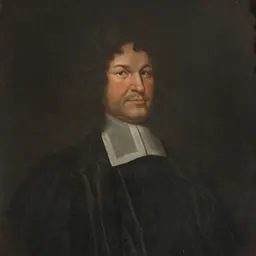
Richard Dummer
American settler
About Richard Dummer
Lived 1589 – 1679 (aged 89–90). Richard Dummer was an American.
Richard Dummer (158914 December 1679) was an early settler in New England.
He made his fortune as a trader, operating in the port of Southampton, England. He was a Puritan, which at times was contrary to the Established Church and the monarch. He emigrated to the Massachusetts Bay Colony, becoming a founding father there, setting up a stock company, acquiring estates, and establishing a milling business. His eldest son was slain by Indians. Another of his sons was the first American-born silversmith. His grandson William was Governor of the Province of Massachusetts Bay and instrumental in bringing to an end the Indian Wars, and bequeathed his estates to trustees for the establishment of what became the Governor Dummer Academy, the first school of its kind in the province. Early life
Dummer was born in Bishopstoke, Hampshire, the son of Thomas and Joane Dummer; as the parish registers have been lost, there is no record of his birth or baptism, although it is likely that he was born at Bishopstoke around 1589.
He trained as an attorney, and was involved with his brothers in maritime import and export from the nearby port of Southampton, becoming a competent seaman and attaining the status of "master".
The Plough Company Dummer became closely associated with the radical Puritan malcontent Stephen Bachiler, who wanted to take his flock at Newton Stacey (near Wherwell, Hampshire) to New England. Bachiler married Helena Mason, the widow of Revd. Thomas Mason of Odiham, and Dummer married Mary Jane, the daughter of Helena and Thomas Mason. Accordingly, he outfitted a small ship, The Plough, which sailed for Massachusetts with 80 people in 1631. He then sailed with his new wife, Mary, for Boston on The Whale, arriving on 24 May 1632.
Upon his arrival he found that the project had collapsed; he set out to salvage the company, and through the Massachusetts courts he seized the remaining material and assets of the whole group, and eventually all the Plough Company's patents, to the anger of some of the investors back in England. In 1643, Dummer sold the patents through George Cleeve to Alexander Rigby, one of Cromwell's commanders; thus Dummer was the only person who derived a profit from the defunct Plough Company.
The next year he built a water-powered gristmill in Roxbury, the first water-powered mill built to grind corn in New England. By order of the General Court on 4 March 1634, the tax on his real estate in Roxbury and Saugus was reduced, probably because of his enterprise for the public good. The same day he contributed £30 toward a fund authorized for the construction of a moveable fort (the Sea Fort) for the defence of the colony. Dummer and several other freemen in the colony were chosen as overseers of the powder and shot and all other ammunition in the several plantations where they lived. It was ordered that Dummer and John Johnson build a bridge over the Muddy River before the next General Court, and that the towns of Boston, Roxbury, Dorchester, New Town and Watertown contribute towards it.
Dummer was attracted to the area around Hampton by the abundance of salt marsh needed for the grazing of his cattle. Spencer was a partner in the cattle importation venture, and they "spotted what an asset to a prosperous settlement would be the several thousand acres of fine salt hay, just waiting to be cut or even fed off in pasture".
Newbury On 6 May 1635, a farm of was allowed to Dummer at the falls in Newbury, and on 8 July, Dummer and Mr. Bartholomew were authorized to set out a convenient quantity of land within the bounds of Newbury for the keeping of sheep and cattle that were to come over in the Dutch ships that year and belong to the owners of those cattle.
Liberty was also granted to Dummer and to John Spencer to build a mill and weir at the falls at Newbury, to enjoy to them and their heirs forever. Following Mary's death, Dummer, having been disenfranchised with many others as result of his support for Williams and Henry Vane, left the province and returned to Southampton.
Return to Newbury On his return to New England, Dummer returned to Newbury where he had previously lived for a little over a year. He had been granted a house lot in the town lots and he also owned land on the Neck, which was afterwards purchased by Rowley when it became a plantation in 1639. In October 1638, Dummer purchased a dwelling house from Thomas Hale, with land on both sides of Merrimack Ridge. Here he lived for several years until he moved to the farm. Dummer received other grants of land until he was the owner of most of the uplands and marshes on the south side of the Parker River to the Rowley line, from Wheelers Brook above the falls of the Parker to the confluence of the Parker and Mill rivers at Oyster Point, except about granted to Henry Sewall (the Hale Farm), and granted to Dr. John Grant (the Buckley, Burnes, and Moynihan farms). Dummer's land embraced the farms later known as the Fatherland, Mrs. Sandford's, Walter Hill's, Ambrose Caldwell's, Coleman's, and most of the Noyes' farms, Capt. Knight's, and the Dummer Academy farms. On 7 October 1640, he bought from Thomas Mayhue of Watertown a farm of ; the north-east corner of this farm he sold on 2 December 1640 to Richard Gale. Dummer married again to Frances Burr, widow of Revd. Jonathon Burr of Dorchester who had died in August 1641. Her late husband had been a rector at Reckingshall in Suffolk, England, but when silenced by Archbishop Laud, had crossed to New England, where he was a colleague of Richard Mather at Dorchester. With Frances, Dummer had a further five children.
Dummer represented Newbury in the General Court of 1640–45 and again in 1647. He was elected Deputy for Salisbury in 1644 and was one of the Associate Justices of the Quarter Court at Ipswich in 1644 and again in 1671–72. With Frances Jeremiah (1643–1718), who became the first American-born silversmith and was the father of William, who became Governor of the Province of Massachusetts Bay, and Jeremiah, who was involved in the foundation of Yale University. Hannah (1647–1668), married Revd. James Allen, former Oxford undergraduate, in 1663. He was minister of the First Church, Boston. She died in March 1668, leaving no children. Richard (1650–1689), who became a captain in the army at the age of 33 and a Justice of the Peace at 37. William (1657–1678), who died of smallpox.
Benevolence In 1631, prior to his first going to New England, he settled a rent-charge of 40 shillings per annum, out of his lands in Bishopstoke, for the use of the poor of the parish at Michaelmas and Lady Day forever.
Dummer's generosity was also noted when he paid the Indian "Old Will" £12 for of land, far in excess of the fair market rate.
Don’t just read it —
keep it.
Full-length biographies made to live with: read them, listen on the way to work, watch them tonight.
- E-book
- Audio
- Video
Instant download · yours to keep · every purchase keeps this site free
Important facts
People in Richard Dummer's life
Named in this biography and alive at the same time






Contemporaries
People whose lives overlapped Richard Dummer's


Frequently asked questions
Who was Richard Dummer?
American settler
When was Richard Dummer born?
Richard Dummer was born in 1589.
When did Richard Dummer die?
Richard Dummer died in 1679.
What nationality was Richard Dummer?
Richard Dummer was American.
Sources & further reading
Cite this page
APA: Biography.guide. (2026). Richard Dummer. https://biography.guide/richard-dummer/
MLA: "Richard Dummer." Biography.guide, https://biography.guide/richard-dummer/.
Chicago: "Richard Dummer." Biography.guide. https://biography.guide/richard-dummer/.
Data last updated: 2026-09-20 · Spot an error? Report a correction.
Page generated 2026-09-27 05:08 UTC