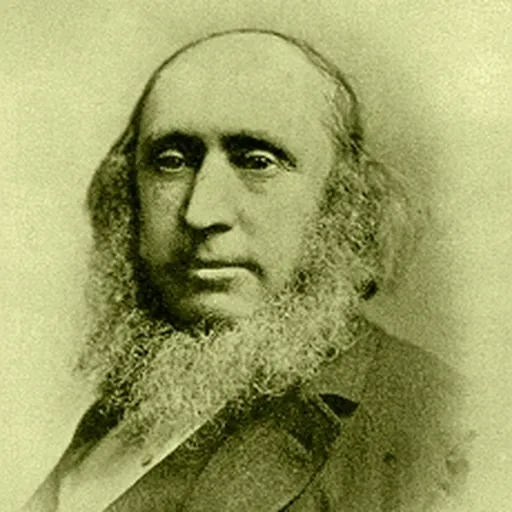
About Richard Doddridge Blackmore
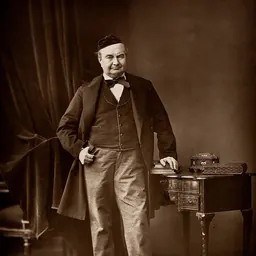
Lived 1825 – 1900 (aged 74). Richard Doddridge Blackmore was a British writer, novelist, prose writer, poet, gardener and fruit grower.
Richard Doddridge Blackmore (7 June 1825 – 20 January 1900), known as R. D. Blackmore, was one of the most famous English novelists of the second half of the nineteenth century. He won acclaim for vivid descriptions and personification of the countryside, sharing with Thomas Hardy a Western England background and a strong sense of regional setting in his works.
Blackmore, often referred to as the "Last Victorian", was a pioneer of the movement in fiction that continued with Robert Louis Stevenson and others. He has been described as "proud, shy, reticent, strong-willed, sweet-tempered, and self-centred." Apart from his novel Lorna Doone, which has enjoyed continuing popularity, his work has gone out of print.
In the 1881 National Census of England and Wales he is recorded as residing in Teddington, Middlesex, occupation Barrister.
Biography
Richard Doddridge Blackmore was born on 7 June 1825 at Longworth in Berkshire (now Oxfordshire), one year after his elder brother Henry (1824–1875), where his father, John Blackmore, was curate-in-charge of the parish. His mother died a few months after his birth—the victim of an outbreak of typhus which had occurred in the village. After this loss John Blackmore moved to Bushey, Herts, then to his native Devon, first to Kings Nympton, then Culmstock, Tor Mohun and later to Ashford, in the same county.
After leaving Oxford and spending some time as a private tutor, Blackmore decided on a career in law. He entered the Middle Temple in 1849 and was called to the Bar in 1852. Ill-health, however, prevented him from continuing legal work as a full-time occupation and in 1854, he took the post of classics master at Wellesley House Grammar School, Hampton Road, Twickenham. In later years this became the Metropolitan and City of London Police Orphanage and then Fortescue House School. Soon after accepting this position, he moved from London to No. 25 Lower Teddington Road, Hampton Wick—where he lived until he moved to his new home in Teddington. However, he is believed to have held the view that he preferred to be remembered as the winner of first prize for swedes than as the author of Lorna Doone.
Fight for environment At the time Blackmore came to Teddington, the railway had not yet disturbed its quiet rural atmosphere. Before long, however, plans were in hand for the purchase of land and the construction of lines. In 1868, Blackmore won a fight against the claims made on his property by the London and South Western Railway Company, but he was unable to prevent the building of the railway station almost directly opposite his house.
His works, his reputation, and death Blackmore began a career as writer by publishing collections of poetry, before turning to novel-writing. His third novel, which became his best known and most successful, Lorna Doone (1869), established him in the front rank of British novelists of that time. With it, he pioneered a new romantic movement in English fiction. The novel's overwhelming popularity was only secured when it appeared as a one-volume edition, as distinct from the unsuccessful three-volume form in which it was originally published. However, Blackmore was of the view that it had become popular quite by accident when a book reviewer had incorrectly stated that the book was about the forefathers of Lord Lorne who had recently married Princess Louise. Hardy would write to Blackmore expressing his appreciation of the book; but the two men were divided by a certain rivalry as well as differences in temperament and opinions. Various attempts were made to dramatise Lorna Doone, but Blackmore only authorised one and that was from the pen of Horace Newte.
Blackmore followed Sir Walter Scott in often setting his characters against a significant historical background, as with Springhaven (1887) and the Napoleonic Wars; his descriptive powers perhaps exceeded his narrative structures. A reduced copy of the memorial was also mounted in Oare Church in Somerset, where Lorna Doone was married; above it in the cathedral was a stained glass window depicting David, Jonathan, and Samson—the archetypes of courage, love, and strength, respectively. John Ridd and Lorna Doone are cast at the top of the window, not far from Carver Doone.
After death Blackmore's two nieces continued to live in Gomer House; Amelia died in 1911 and was also buried in the Blackmore grave. Then in October 1938 there was an auction of all its contents, which included Blackmore's own library containing first editions of his works. The house itself was later demolished and Doone Close, Blackmore's Grove and Gomer Gardens were built, referencing the novelist's associations with Teddington. The end of Doone Close marks the approximate site of Gomer House. Blackmore's market garden covered the area between the present Station Road and Field Lane.
Works
Don’t just read it —
keep it.
Full-length biographies made to live with: read them, listen on the way to work, watch them tonight.
- E-book
- Audio
- Video
Instant download · yours to keep · every purchase keeps this site free
Important facts
People in Richard Doddridge Blackmore's life
Named in this biography and alive at the same time





Related people
Same field, nearest in time

Contemporaries
People whose lives overlapped Richard Doddridge Blackmore's




Frequently asked questions
Who was Richard Doddridge Blackmore?
English novelist (1825-1900)
When was Richard Doddridge Blackmore born?
Richard Doddridge Blackmore was born on 7 June 1825 in Longworth.
When did Richard Doddridge Blackmore die?
Richard Doddridge Blackmore died on 20 January 1900 in Teddington.
What was Richard Doddridge Blackmore's occupation?
Richard Doddridge Blackmore was a writer, novelist, prose writer, poet, gardener and fruit grower.
What nationality was Richard Doddridge Blackmore?
Richard Doddridge Blackmore was British.
Sources & further reading
· Wikipedia: Richard Doddridge Blackmore
Cite this page
APA: Biography.guide. (2026). Richard Doddridge Blackmore. https://biography.guide/richard-doddridge-blackmore/
MLA: "Richard Doddridge Blackmore." Biography.guide, https://biography.guide/richard-doddridge-blackmore/.
Chicago: "Richard Doddridge Blackmore." Biography.guide. https://biography.guide/richard-doddridge-blackmore/.
Data last updated: 2026-09-23 · Spot an error? Report a correction.
Portrait: Wikimedia Commons · author & licence
Page generated 2026-09-27 05:05 UTC