About Richard de Clare, 2nd Earl of Pembroke
Lived 1130 – 1176 (aged 45–46). Richard de Clare, 2nd Earl of Pembroke was an English statesperson.
Richard de Clare (c. 1130 Like his father, Richard is commonly known by his nickname, Strongbow .
After his son and heir, Gilbert, died childless before 1189, the earldom passed through Richard's daughter Isabel de Clare and to her husband, William Marshal.
In reality, Stranghose is probably a different spelling of Striguil. In the 14th century, the nickname was finally rendered as "Strongbow".
Early life Richard de Clare was the son of Gilbert de Clare, the first Earl of Pembroke and his wife, Isabel de Beaumont, daughter of Robert de Beaumont, Earl of Leicester and mistress of King Henry I. Richard also had a sister, Basilea de Clare.
Gilbert died in about 1148, and Richard inherited his father’s possessions when he was roughly 18 years old. for his marcher Lordship of Striguil, where he had a castle.
Career Background
In 1167, Dermot MacMurrough was deposed as King of Leinster by Rory O'Connor, the High King of Ireland. To recover his kingdom, Dermot went to Aquitaine to ask Henry II of England for assistance, but Henry limited his help to permitting the recruitment of English mercenaries. Dermot failed to recruit in Wales but did meet Richard De Clare and the other lords of the Welsh Marches.
Dermot came to an agreement with Richard: If the latter helped the deposed king in the retaking of Leinster, he could have Aoife, Dermot's eldest daughter, in marriage, along with the succession to the crown if it was regained. Since Henry II's letter to Dermot was general in nature, Richard wanted to obtain the king's specific consent to travel to Ireland. In 1168, he raised the issue at court and was granted permission.
Campaign in Ireland
Dermot and Richard raised a large army, commanded by Raymond FitzGerald, which included Welsh archers. The army sailed in Ireland and took the Ostman towns of Wexford, Waterford and Dublin between 1169 and 1170. On 23 August 1170, Richard embarked on his ships at Milford Haven to join the force; however, a royal messenger arrived to forbid him to go. Richard sailed anyway and ignored the king's wishes.
Dermot died in May 1171, and his son Donal MacMurrough claimed the kingdom of Leinster in accordance to the Brehon laws. Richard, in turn, claimed the kingship in the right of his wife. At the same time, he sent his uncle, Hervey de Montmorency, on an embassy to Henry II to appease the king, who was growing worried with Richard's increasing power. Henry offered to return Richard's lands in France, England and Wales (which he had confiscated) in exchange for the conquered possessions in Ireland. Richard accepted and surrendered Dublin, Waterford and other fortresses to the English king, only keeping Kildare.
Henry crossed over to Ireland in October 1172 and stayed there for six months, stationing his own men where needed. His rule in Ireland was accepted by both the Gaelic and the Norman lords, and the relationship between him and Richard was restored. Richard, in fact, also agreed to help Henry with the revolt in France in 1173, and, as a reward, he was given his possession of Leinster back. In 1174, he tried to advance into Munster but was defeated in the battle of Thurles. When Gilbert died, still a minor, the inheritance passed onto Richard's daughter Isabel. Isabel, on the wishes of Henry II and his son Richard the Lionheart, was given in spouse to William Marshal, who became the Earl of Pembroke for jure uxoris.
Marriage and issue
By an unknown mistress, Richard de Clare fathered two daughters: Aline de Clare, married William FitzMaurice FitzGerald, baron of Naas Basilia de Clare, married Robert de Quincy, Constable of Leinster. Their children were:
Gilbert de Clare, 3rd Earl of Pembroke, who died a minor in 1185 Isabel de Clare, 4th Countess of Pembroke, who became Countess of Pembroke in her own right in 1185 (on the death of her brother) until her own death in 1220.
Legacy
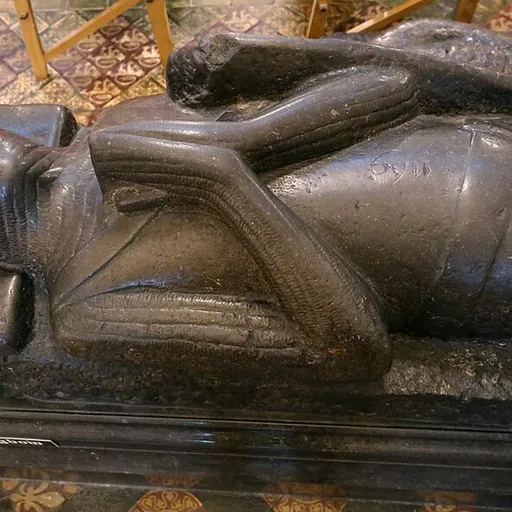
Richard de Clare was first interred in Dublin's Christ Church Cathedral, where a purported tomb effigy is located. Next to it lies a "smaller half-sized monument" which Richard Stanyhurst claimed was "that of Strongbow’s son, whom his father had cleft in twain for cowardice in battle", Marc Marie, Marquis de Bombelles "described Strongbow’s tomb astutely as ‘the least authentic and the most remarkable’." Christ Church Cathedral, Waterford or Dominican priory, Kilkenny. References to "de Clare" being buried in Gloucester Cathedral refer to his father, while those to "Strongbow" in Tintern abbey refer probably to Walter or Anselm Marshall, both of whom died in 1245.
In popular culture The English cider brand Strongbow is named after him.
Don’t just read it —
keep it.
Full-length biographies made to live with: read them, listen on the way to work, watch them tonight.
- E-book
- Audio
- Video
Instant download · yours to keep · every purchase keeps this site free
Important facts
Family & relationships
People in Richard de Clare, 2nd Earl of Pembroke's life
Named in this biography and alive at the same time

Related people
Same field, nearest in time



Contemporaries
People whose lives overlapped Richard de Clare, 2nd Earl of Pembroke's
Frequently asked questions
Who was Richard de Clare, 2nd Earl of Pembroke?
Cambro-Norman lord in Ireland
When was Richard de Clare, 2nd Earl of Pembroke born?
Richard de Clare, 2nd Earl of Pembroke was born in 1130 in Tonbridge.
When did Richard de Clare, 2nd Earl of Pembroke die?
Richard de Clare, 2nd Earl of Pembroke died on 20 April 1176 in Dublin.
What was Richard de Clare, 2nd Earl of Pembroke's occupation?
Richard de Clare, 2nd Earl of Pembroke was a statesperson.
What nationality was Richard de Clare, 2nd Earl of Pembroke?
Richard de Clare, 2nd Earl of Pembroke was English.
Sources & further reading
· Wikipedia: Richard de Clare, 2nd Earl of Pembroke
· DBpedia: Richard de Clare, 2nd Earl of Pembroke
Cite this page
APA: Biography.guide. (2026). Richard de Clare, 2nd Earl of Pembroke. https://biography.guide/richard-de-clare-2nd-earl-of-pembroke/
MLA: "Richard de Clare, 2nd Earl of Pembroke." Biography.guide, https://biography.guide/richard-de-clare-2nd-earl-of-pembroke/.
Chicago: "Richard de Clare, 2nd Earl of Pembroke." Biography.guide. https://biography.guide/richard-de-clare-2nd-earl-of-pembroke/.
Data last updated: 2026-09-27 · Spot an error? Report a correction.
Portrait: Wikimedia Commons · author & licence
Page generated 2026-10-04 12:18 UTC