About Richard Baier
Born 1926. Richard Baier is a German journalist, news presenter and radio personality.
Richard Baier (born 27 November 1926) is a German former journalist and radio presenter.
Life Provenance and early years Richard Baier was born in Kassel where Ludwig Baier, his father, as "Kapellmeister", was in charge of music at the local theatre. Because of this connection Richard Baier found himself playing several child roles in local drama productions, but what he really wanted was to become a physician. The outbreak of war a couple of months before his thirteenth birthday made that impossible. However, as a teenager he received a Medical corps training in nearby Hofgeismar which involved four days of theoretical instruction and three days serving in an anti-aircraft unit.
US occupation zone Military defeat, in May 1945, left the western two thirds of Germany divided into four military occupation zones. The area surrounding Berlin (though only the eastern part of Berlin itself) was now administered as the Soviet occupation zone. In the chaos of the collapsing state, on 3 June 1945. Baier made his way on foot out of Berlin in a south-westerly direction along the road towards Kassel, as far as Bad Sooden-Allendorf which was on the frontier between the part of Germany administered by the Soviets and that administered by the United States. Here he was reunited with his mother and sister. His father had disappeared in southern Poland during 1944. His mother and sister had thought Richard Baier had been killed in Berlin and were delighted that he was alive. The local town hall issued him with identity papers and a ration card. A few weeks later, at the start of July, the local US commander, Cecil Fischer, gave him his first postwar job, as a simultaneous translator. After just six months he managed to increase the circulation to more than 50,000 copies.
Although the political division of Berlin had been evident from a map back in 1945, at that time the divisions had been easy to ignore. After the currency reforms, the Berlin Blockade, and other events of 1948, the political division was increasingly mirrored by economic and social division, and during the 1950s those divisions were increasingly reflected by physical divisions in the form of check points. Nevertheless, even in 1955 it was perfectly possible for German residents to live in East Berlin (where rents and goods, if available, were far cheaper) and work in West Berlin (where rents and wages were higher). There were still plenty of people, including Richard Baier, who found it convenient and indeed interesting to do just that. During the early 1950s he became one of the best known presenters working on the RIAS.
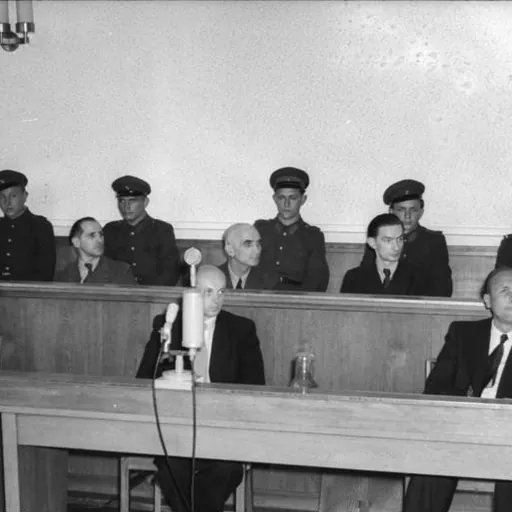
In June 1953 Baier was able to report on the East German uprising. The events were little reported at the time in the west and only very selectively in East German media. But East Germans nevertheless enjoyed a fuller awareness of the uprising than most, partly on accounts of the RIAS news reports. RIAS reporter Richard Baier knew what was happening because he was there. Nevertheless, when Richard Baier returned to his East Berlin apartment on 19 June 1953, his personal situation appeared to have returned to normal. Not quite two years later, as he left for work on 13 April 1955 at around 07.30, the RIAS reporter was grabbed by two Stasi officers and bundled into a "waiting Wartburg". As Baier later remembered it "I had become engaged to be married on 11 April and on 13 April at 07.30 in the morning I was arrested in the Marienstraße". He was taken to the ministry's infamous investigation centre at Berlin-Hohenschönhausen. In the "submarine", as the interrogation rooms in the basement of the building were informally known, he was introduced for himself to a range of the Stasi's perfidious interrogation techniques. Sessions were held only at night. Detainees were handcuffed to heating pipes for several days on end. Baier was locked for six hours in a "standing only" cell the size of a broom cupboard. He was, however, spared the notorious "water cell" in which victims must stand up to their necks in water. "After a few weeks ... you're ready to say whatever they want to hear" ("Nach einigen Wochen bist du so weit, daß du alles sagst, was die hören wollen") he recalled, decades later. Many of his fellow internees were destroyed by the mental torture, and it would be many years before Baier was able to sleep through a night without suffering nightmares. "Only the gas chambers were missing" ("Es fehlten eigentlich nur die Gaskammern."). The nation's leader, Walter Ulbricht took a close personal interest in the show trial. Instructions to the court included a hand-written correction by Ulbricht in which he wrote "Proposal: Death sentence" ("Vorschlag: Todesurteil") by the name of Wolfgang Wiebach. Wiebach was guillotined at the National Execution Facility in Dresden on 13 September 1955. Richard Baier, still aged only 29, was given a 13-year jail term for "espionage". After six years and nine months in prison, on 21 August 1961, and eight days after the erection of the Berlin Wall finally sealed off West Berlin from the eastern part of the city, Baier was released from jail as part of an amnesty. He was ordered to live in Potsdam: a Stasi officer drove him from the jail to the town hall and then came in with him in order to provide assistance with registration of his new domicile. in which his part is played by Marek Harloff.
Don’t just read it —
keep it.
Full-length biographies made to live with: read them, listen on the way to work, watch them tonight.
- E-book
- Audio
- Video
Instant download · yours to keep · every purchase keeps this site free
Important facts
People in Richard Baier's life
Named in this biography and alive at the same time

Related people
Same field, nearest in time




Contemporaries
People whose lives overlapped Richard Baier's

Frequently asked questions
Who is Richard Baier?
1926-, journalist
When was Richard Baier born?
Richard Baier was born on 27 November 1926 in Kassel.
What is Richard Baier's occupation?
Richard Baier is a journalist, news presenter and radio personality.
What nationality is Richard Baier?
Richard Baier is German.
Sources & further reading
Cite this page
APA: Biography.guide. (2026). Richard Baier. https://biography.guide/richard-baier/
MLA: "Richard Baier." Biography.guide, https://biography.guide/richard-baier/.
Chicago: "Richard Baier." Biography.guide. https://biography.guide/richard-baier/.
Data last updated: 2026-09-22 · Spot an error? Report a correction.
Portrait: Wikimedia Commons · author & licence
Page generated 2026-09-27 05:00 UTC