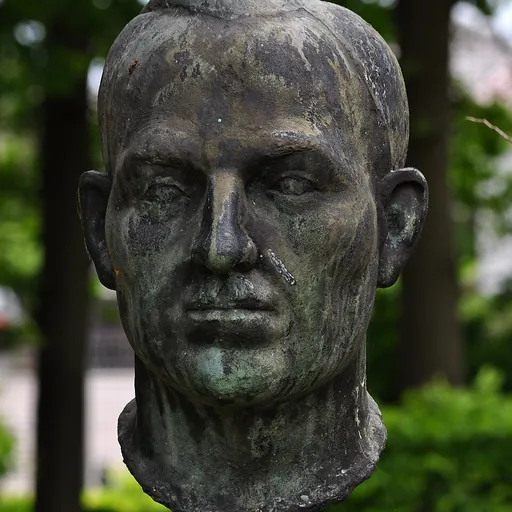
Richard Aßmann
District leader of the "Reichsbanner Schwarz-Rot-Gold" SPD organization
About Richard Aßmann
Lived 1875 – 1933 (aged 57). Richard Aßmann was a German politician, trade unionist and works council, known for Köpenick's week of bloodshed and Sturmabteilung.
Richard Aßmann (16 December 187521 June 1933) became a works council chairman with the national Health Insurance provider in Berlin. He also involved himself in politics and was a member of the centre-left Social Democratic Party (; SPD).
On 20 June 1933 he was forcibly removed from a tram by Nazi paramilitaries and taken away. His body was found, badly degraded, in a sack in the Dahme river on 11 July 1933. His daughter, Hilde Aßmann, was required to identify the body, which she was able to do because she recognised his wrist watch. Although the precise date of his death was never established, Richard Aßmann is generally seen as the first of an estimated 500 victimsat least 23 of whom were murdered while in detention and subsequently identifiedof Köpenick's week of bloodshed , one of the first recorded mass-atrocities carried out by the Nazis after they took power in January 1933.
Life Richard Aßmann was a clerical worker employed by the AOK in Berlin. During Germany's inter-war democratic period his fellow workers elected him as an employee representative to the organisation's works council . Subsequently, they elected him to the chairmanship of it. At the start of 1933 the Nazis took power and lost no time in transforming Germany into a one-party dictatorship. Directly after the Reichstag fire, at the end of February 1933, arrests began of people who had been active in the Communist Party before 1933. Throughout the twelve Nazi years, official persecution would be focused most intensely on citizens identified as "Communists" and / or "Jews". But citizens with records of political activism in other parties were also at heightened risk. His home was on one side of the market place in Friedrichshagen which was at that time administered as part of the Berlin suburb of Köpenick. Köpenick was believed by the new government (and others) to contain particularly large numbers of Communists and Jews. Richard Aßmann had always been particularly trenchant in his criticism of Adolf Hitler and was a known "anti-fascist". He was a local leader in the pro-democracy Reichsbanner Schwarz-Rot-Gold organisation. On the early morning of 21 June 1933 several Nazi "SA" paramilitaries boarded a tram on which Aßmann was travelling and forcibly removed him from it. The body had been placed in a sack before apparently being thrown into the river. Aßmann's widow was invited to identify the body but it was badly mutilated and she was unable to do so. A researcher was told in 1992 by a contemporary witness called Hildegard Feil that her father had therefore accompanied Hildegard Aßmann-Abusch, Richard Aßmann's recently married daughter, to try and identify the body. They had been able to do so, but only because they had recognised his wrist watch.
The body was buried at the Friedrichsfelde Municipal Cemetery.
Celebration and commemoration Since 1951 there has been a memorial tablet to Richard Aßmann at Graal-Müritz complemented, since 1978, by a memorial bust by . The tablet was placed in the grounds of what is now known as the "" ('Rehabilitation Clinic') when a hospital and rehabilitation facility that had been commandeered after 1945 and used by the Soviet army was handed back to the municipal authorities and converted into a sanatorium. At this point the facility was renamed after Richard Aßmann as a high-profile victim of Nazi atrocities. There is otherwise no identified connection between Richard Aßmann and the coastal resort of Graal-Müritz.
In Berlin-Friedrichshagen, near where the murder is believed to have taken place, was renamed after Richard Aßmann in 1947. It had previously been known as Friedrich-Straße. The street also features a memorial tablet and, added in 2013, a "Stolperstein" commemorating Aßmann.
Don’t just read it —
keep it.
Full-length biographies made to live with: read them, listen on the way to work, watch them tonight.
- E-book
- Audio
- Video
Instant download · yours to keep · every purchase keeps this site free
Important facts
Related people
Same field, nearest in time





Contemporaries
People whose lives overlapped Richard Aßmann's


Frequently asked questions
Who was Richard Aßmann?
district leader of the "Reichsbanner Schwarz-Rot-Gold" SPD organization
When was Richard Aßmann born?
Richard Aßmann was born on 16 December 1875 in Berlin.
When did Richard Aßmann die?
Richard Aßmann died on 20 June 1933 in Köpenick.
What was Richard Aßmann's occupation?
Richard Aßmann was a politician, trade unionist and works council.
What was Richard Aßmann known for?
Richard Aßmann was known for Köpenick's week of bloodshed and Sturmabteilung.
What nationality was Richard Aßmann?
Richard Aßmann was German.
Sources & further reading
· DBpedia: Richard Aßmann (works council chairman)
Cite this page
APA: Biography.guide. (2026). Richard Aßmann. https://biography.guide/richard-assmann-politician/
MLA: "Richard Aßmann." Biography.guide, https://biography.guide/richard-assmann-politician/.
Chicago: "Richard Aßmann." Biography.guide. https://biography.guide/richard-assmann-politician/.
Data last updated: 2026-09-22 · Spot an error? Report a correction.
Page generated 2026-09-27 05:10 UTC