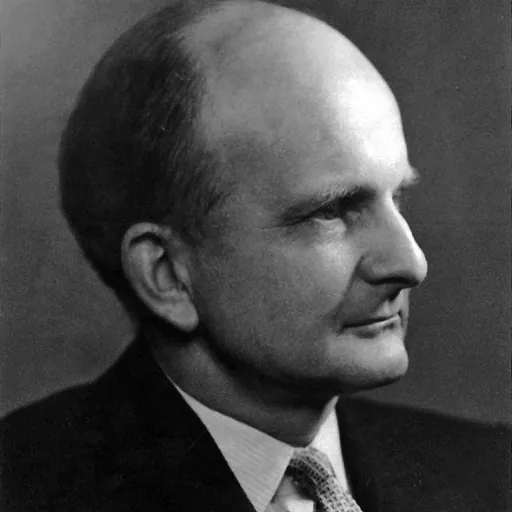
About Richard Asher
Lived 1912 – 1969 (aged 57). Richard Asher was a British physician, internist, writer, endocrinologist and hematologist.
Richard Alan John Asher (3 April 1912 – 25 April 1969) was a British endocrinologist and haematologist. he described and named Munchausen syndrome in a 1951 article in The Lancet.
Personal life Richard Asher was born to the Reverend Felix Asher and his wife Louise (née Stern). He married Margaret Augusta Eliot at St Pancras' Church, London on 27 July 1943, whereupon his father-in-law gave him a complete set of the Oxford English Dictionary, which doctor and medical ethicist Maurice Pappworth alleged was the source of Asher's "accidental" reputation as a medical etymologist. They had three children: Peter Asher (born 1944), a member of the pop duo Peter & Gordon and later record producer; Jane Asher (born 1946), a film and TV actress and novelist; and Clare Asher (born 1948), a radio actress. Richard Asher's brother Thomas married Margaret's sister, Susan.
The Asher family home above his private consulting rooms at 57 Wimpole Street was briefly notable when Paul McCartney of The Beatles lived there in 1964–66, at the height of "Beatlemania", during his relationship with Jane Asher.
In 1964, Asher suddenly gave up his hospital post and perhaps all medical activities. His death took place at 57 Wimpole Street, and he left a will and an estate valued at £35,937.
Ideas and reputation Asher was regarded as "one of the foremost medical thinkers of our times", who emphasised the need "to be increasingly critical of our own and other people's thinking". Asher was particularly concerned that "many clinical notions are accepted because they are comforting rather than because there is any evidence to support them".
Asher was hailed as a pioneer in challenging the value of excessive bed rest following treatment, and argued that the Pel–Ebstein fever (a fever characteristic for Hodgkin's disease) was an example of a condition that exists only because it has a name. Asher's 1949 paper "Myxoedematous Madness" alerted a generation of physicians to the interaction between the brain and the thyroid gland. As a result, young and elderly psychiatric patients are now screened for thyroid malfunction. Some of the 'madness' cases are now thought to be the early descriptions of Hashimoto's encephalopathy, a rare neuroendocrine syndrome sometimes presenting with psychosis.
Notable articles Asher is remembered today mostly for his "refreshingly provoking" He thought that medical writing should provide "useful, understandable, and practical knowledge instead of allotov-words-2-obscure-4-any-1,2-succidin-understanding-them." Anthologies of his articles were well-received, with the Talking Sense collection being described as "still the best advice on medical writing." Notable articles include: The Dangers of Going to Bed (1947) - "one of the most influential medical papers ever written" The Seven Sins of Medicine (1949, in Lancet 1949 Aug 27;2(6574):358-60) Myxoedematous Madness (1949) Munchausen's syndrome (1951, in Lancet 1951 Feb 10;1(6650):339-41) Straight and Crooked Thinking in Medicine (1954) Respectable Hypnosis (1956) Why Are Medical Journals So Dull? (1958) The Talking Sense trilogy: Clinical Sense (1959) with a rueful correction in The Dog in the Night-time (1960) Making Sense (1959, in Lancet, 1959, 2, 359) Talking Sense (1959, in Lancet, 1959, 2, 417)
"Seven Sins of Medicine"
The "Seven Sins of Medicine" The most recent prize was presented to Hugo Farne, Edward Norris-Cervetto and James Warbrick-Smith for their book "Oxford Cases in Medicine and Surgery" at the Royal Society of Medicine, 27 October 2010.
Don’t just read it —
keep it.
Full-length biographies made to live with: read them, listen on the way to work, watch them tonight.
- E-book
- Audio
- Video
Instant download · yours to keep · every purchase keeps this site free
Important facts
Family & relationships
People in Richard Asher's life
Named in this biography and alive at the same time




Related people
Same field, nearest in time

Contemporaries
People whose lives overlapped Richard Asher's






Frequently asked questions
Who was Richard Asher?
British endocrinologist and haematologist (1912-1969)
When was Richard Asher born?
Richard Asher was born on 3 April 1912 in Brighton.
When did Richard Asher die?
Richard Asher died on 25 April 1969 in Marylebone, London.
What was Richard Asher's occupation?
Richard Asher was a physician, internist, writer, endocrinologist and hematologist.
What nationality was Richard Asher?
Richard Asher was British.
Sources & further reading
Cite this page
APA: Biography.guide. (2026). Richard Asher. https://biography.guide/richard-asher/
MLA: "Richard Asher." Biography.guide, https://biography.guide/richard-asher/.
Chicago: "Richard Asher." Biography.guide. https://biography.guide/richard-asher/.
Data last updated: 2026-09-23 · Spot an error? Report a correction.
Portrait: Wikimedia Commons · author & licence
Page generated 2026-09-27 05:08 UTC