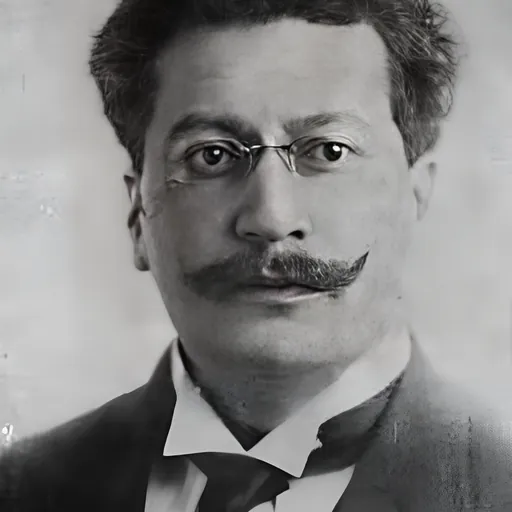
Ricardo Flores Magón
Mexican anarchist and social reform activist
About Ricardo Flores Magón
Lived 1874 – 1922 (aged 48). Ricardo Flores Magón was a Mexican journalist, writer, trade unionist, anarchist, military personnel and politician, known for Mexican Revolution.
Cipriano Ricardo Flores Magón (; known as Ricardo Flores Magón; September 16, 1874 – November 21, 1922) was a Mexican anarchist and social reform activist. His brothers Enrique and Jesús were also active in politics. Followers of the Flores Magón brothers were known as Magonistas. He has been considered an important participant in the social movement that sparked the Mexican Revolution. The couple met each other in 1863 during the Siege of Puebla when both were carrying munitions to the Mexican troops.
Flores Magón explored the writings and ideas of many early anarchists, such as Mikhail Bakunin and Pierre-Joseph Proudhon, but was also influenced by anarchist contemporaries Élisée Reclus, Charles Malato, Errico Malatesta, Anselmo Lorenzo, Emma Goldman, and Fernando Tarrida del Mármol. He was most influenced by Peter Kropotkin. He also read from the works of Karl Marx and Henrik Ibsen.
He was one of the major thinkers of the Mexican Revolution and the Mexican revolutionary movement in the Partido Liberal Mexicano. Flores Magón organised with the Industrial Workers of the World (IWW) and edited the Mexican anarchist newspaper Regeneración, which aroused the workers against the dictatorship of Porfirio Díaz.
Kropotkin's The Conquest of Bread, which Flores Magón considered a kind of anarchist bible, served as basis for the short-lived revolutionary communes in Baja California during the Magonista Revolt of 1911.
The Flores Magón brothers were from a family of modest means in Oaxaca and all three studied law at the Escuela Nacional de Jurisprudencia (today Faculty of Law of the UNAM). Ricardo initially attended the Escuela Nacional Preparatoria. During this time, he participated in student opposition to President Porfirio Diaz and was jailed for five months. Nevertheless, he graduated and then transferred to the National School of Law. While there, he worked as a proofreader for the student newspaper El Demócrata and narrowly escaped arrest when the entire staff was arrested by the police. He was in hiding for three months but continued his studies and received his law degree in 1895. He passed the examination of the Barra Mexicana-Colegio de Abogados (Mexican Bar and Advocate's College), In February 1901, Flores Magón attended the first congress of Liberal Clubs, was employed by Enrique Creel, at that time governor of Chihuahua, to locate Mexican dissidents in the U.S. The American headquarters of the PLM was in St. Louis, Missouri, at that time. There were a large number of expatriates who knew of its whereabouts and as a result, Furlong had no difficulty locating the dissidents in the city. Flores Magón, however, was living in great secrecy in Los Angeles. He used a pseudonym, and only two other persons in the city knew his real identity. If they needed to see him, they did so between midnight and dawn. The dissidents in St. Louis soon became aware that they were being sought by agents working for the Mexican government. Librado Rivera left the city in order to evade capture and although he was constantly on alert for agents who might be shadowing him, he failed to elude them. He was followed to Los Angeles and to Flores Magón's place of residence. Furlong kept the house under surveillance for some time. Finally, on August 23, 1907, Flores Magón, Rivera and Antonio Villarreal were taken into custody by Furlong, two of his assistants and some officers from the Los Angeles police department. In late 1910, the Mexican Revolution began to take off with the leadership of Francisco I. Madero, a landowner with whom Flores Magón disagreed. Even with the revolution against the dictator whom Magon wanted out of government, he continually spoke out against Madero and his beliefs: “Do not expect then, that Madero will attack the right of property in favor of the proletariat. Open your eyes. Remember a phrase, simple and true and as truth indestructible, the emancipation of the workers must be the work of the workers themselves.” He continued publishing Regeneración and making speeches in the region. One of the places Flores Magón stayed was in the city of El Monte, part of the San Gabriel Valley in Los Angeles County. During his time in El Monte, Flores Magón wrote letters to comrades in Mexico, as well as being involved in local anarchist activities, while supporting himself and his family by picking up work in local ranches in the area. He was again arrested in 1916, accused of sending "indecent materials" through the U.S. Mail. With the help of Emma Goldman, he made bail. Following his potential imprisonment, a new leader had come to power in Mexico by the name of Venustiano Carranza, a powerful land owner and revolutionary who had come to power after Madero has been assassinated. Having the funds, Regeneracion would be able to be published again. In the following publications, Flores Magón wrote “scathing articles criticizing the Carranza regime.” Specifically, he criticized Carranza's use of the “Red Battalions," urban workers who were set out to fight the Zapatistas specifically. The Wilson administration conducted what were called the Palmer Raids, a wholesale crackdown on war dissidents and leftists that also swept up notable socialists such as Eugene V. Debs. In November 1922, Flores Magón died at Leavenworth Penitentiary in Kansas. He had been suffering from diabetes for many years and was losing his eyesight by the time of his death. He had earlier predicted his impending demise in a letter to a friend:
The exact cause of Flores Magón's death has been disputed. Some believe he was deliberately murdered by prison guards. Others contend that he died as a result of deteriorating health caused by his long imprisonment, possibly exacerbated by medical neglect by Leavenworth Penitentiary officials and staff. Flores Magón wrote several letters to friends complaining of debilitating health problems and of what he perceived to be purposeful neglect by the prison staff.
The Mexican Chamber of Deputies adopted a resolution requesting the repatriation of Magón's body. It stated:
The U.S. authorities denied the request and Flores Magón was buried in Los Angeles. His remains were finally repatriated in 1945 and interred at the Rotunda of Illustrious Persons in Mexico City.
In 1997, an organization of indigenous peoples in the state of Oaxaca formed the Ricardo Flores Magón Popular Indigenous Council of Oaxaca (Consejo Indígena Popular de Oaxaca "Ricardo Flores Magón", or CIPO-RFM), based on the philosophy of Flores Magón.
Playwright In his work of popular education, Ricardo Flores Magón also used the theater to denounce the faults of society and outline the main lines of the libertarian "program". He is the author of two plays: Verdugos et victimas and Tierra y Libertad. He is also the author of numerous tales, published in the newspaper Regeneración.
Don’t just read it —
keep it.
Full-length biographies made to live with: read them, listen on the way to work, watch them tonight.
- E-book
- Audio
- Video
Instant download · yours to keep · every purchase keeps this site free
Important facts
People in Ricardo Flores Magón's life
Named in this biography and alive at the same time



Related people
Same field, nearest in time


Contemporaries
People whose lives overlapped Ricardo Flores Magón's

Frequently asked questions
Who was Ricardo Flores Magón?
Mexican anarchist and social reform activist (1874–1922)
When was Ricardo Flores Magón born?
Ricardo Flores Magón was born on 16 September 1874 in Eloxochitlán de Flores Magón.
When did Ricardo Flores Magón die?
Ricardo Flores Magón died on 21 November 1922 in United States Penitentiary, Leavenworth.
What was Ricardo Flores Magón's occupation?
Ricardo Flores Magón was a journalist, writer, trade unionist, anarchist, military personnel and politician.
What was Ricardo Flores Magón known for?
Ricardo Flores Magón was known for Mexican Revolution.
What nationality was Ricardo Flores Magón?
Ricardo Flores Magón was Mexican.
Sources & further reading
· Wikipedia: Ricardo Flores Magón
· DBpedia: Ricardo Flores Magón
Cite this page
APA: Biography.guide. (2026). Ricardo Flores Magón. https://biography.guide/ricardo-flores-magon/
MLA: "Ricardo Flores Magón." Biography.guide, https://biography.guide/ricardo-flores-magon/.
Chicago: "Ricardo Flores Magón." Biography.guide. https://biography.guide/ricardo-flores-magon/.
Data last updated: 2026-09-22 · Spot an error? Report a correction.
Portrait: Wikimedia Commons · author & licence
Page generated 2026-09-27 05:02 UTC