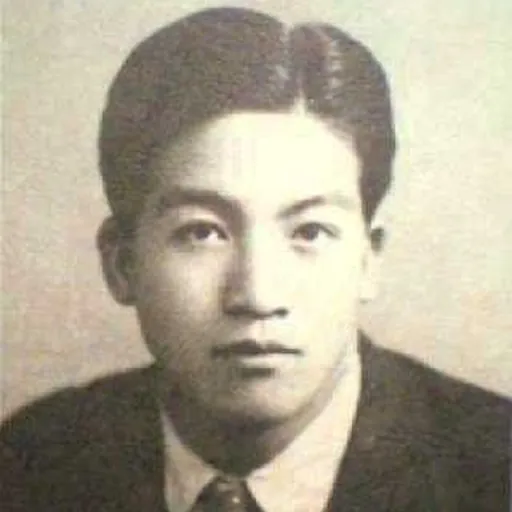
About Rentaro Kita
Lived 1920 – 1940 (aged 20). Rentaro Kita was a Japanese singer.
(also known as ; born ; March 20, 1920 – September 16, 1940) was a Japanese ryūkōka singer. He was popularly known as .
Tending towards delinquency in adolescence, Kita dropped out of school in 1936 and began to train as a boxer. His father's death soon after, as well as encouragement from , caused him to pursue singing as a vocation instead. In 1937, Kita made his recording debut on Taihei Records; he moved to the Japanese branch of Polydor Records the following year. After initial success, his career stalled. He died from leukemia in 1940 after a rapid decline in his health.
Life Youth Kita was born on March 20, 1920, in the Ōkubo neighborhood of Tokyo. Erroneous reports of his birth in Tsuruoka, Yamagata Prefecture are attributed to the fact that his parents had registered their home there.
As an adolescent, Kita developed a strong interest in sports, as well as a reputation for being short-tempered and aggressive. He turned to delinquency and spent much of his time with similar peers in Shinjuku. During this period, he learned judo and eventually earned the rank of 4th dan. In 1936, he dropped out of school. Considered to be taller in height than the average Japanese male of the time and promisingly athletic, he began to train as a professional boxer. Shortly after starting his training, his father died; Kita abandoned boxing as a result. Instead, he decided to pursue a career in music after he was encouraged to do so by the shakuhachi player, , who admired Kita's voice.
Career In November 1936, Kita made his recording debut on Taihei Records. His first 78 RPM disc, wherein he used the pseudonym "Kita Kan", included the songs and . After recording twenty songs for Taihei, Kita left the label to join the Japanese branch of Polydor Records, where he was promoted as the next Shōji Tarō and Uehara Bin. Thereafter, Kita used the name "Kita Rentarō" professionally for the rest of his life.
Kita's first song for Polydor, , composed and arranged by , was released in late 1938. The song was part of a minor genre of songs about the Izu Peninsula which were popular in Japan at the time. Polydor arranged for an extensive marketing campaign, which included an amateur singing contest that led to the start of Tabata Yoshio's career. This was followed by , a song composed by that the music historian described as a "masterpiece" that "displays the real measure of [Kita's] talent". In January 1939, Kita and Kurawaka collaborated on another hit. Its "apparent nihilistic tone", according to Hori, "is a reflection of its times".
By 1940, Kita had become disenchanted with Polydor. After initial success, he had difficulty establishing a niche for himself, especially after Tabata's fame began to overwhelm his own. Kita often expressed to his friends his dissatisfaction with Polydor and his desire to move to another label. Still under contract to Polydor, Kita secretly visited the studios of Television Records, a new label that had emerged at the time. Evidence indicates that he may also have visited Taihei. The matrix numbers on the song , Hori said, suggest that Kita recorded for Taihei in June 1940.
Aside from difficulties at Polydor, Kita had told friends in 1940 that his potential draft into the Second Sino-Japanese War would likely require a break from his career. That same year, he also began to manifest the symptoms of leukemia. Although he seemed to be in good health at one of his final public appearances in Shinjuku in July 1940, his health quickly deteriorated.
Death Kita died at Keio University Hospital in Tokyo on September 16, 1940.
Legacy The singer recalled Kita as "an absolutely kind youth, who could never say 'no' whenever he was asked to do something". Another singer, , described Kita as having a "wayward charm" and that he was "a little on the cynical side". Tabata remained an admirer of Kita, despite their rivalry, and continued into his later career to sing the songs that the latter had first popularized.
In an essay summing up Kita's life and career, Hori said that he regarded the singer as the forerunner of postwar Japanese teen singers and idols.
Don’t just read it —
keep it.
Full-length biographies made to live with: read them, listen on the way to work, watch them tonight.
- E-book
- Audio
- Video
Instant download · yours to keep · every purchase keeps this site free
Important facts
Related people
Same field, nearest in time




Contemporaries
People whose lives overlapped Rentaro Kita's



Frequently asked questions
Who was Rentaro Kita?
Japanese singer (1920-1940)
When was Rentaro Kita born?
Rentaro Kita was born on 20 March 1920 in Tsuruoka.
When did Rentaro Kita die?
Rentaro Kita died on 15 September 1940.
What was Rentaro Kita's occupation?
Rentaro Kita was a singer.
What nationality was Rentaro Kita?
Rentaro Kita was Japanese.
Sources & further reading
Cite this page
APA: Biography.guide. (2026). Rentaro Kita. https://biography.guide/rentaro-kita/
MLA: "Rentaro Kita." Biography.guide, https://biography.guide/rentaro-kita/.
Chicago: "Rentaro Kita." Biography.guide. https://biography.guide/rentaro-kita/.
Data last updated: 2026-09-22 · Spot an error? Report a correction.
Portrait: Wikimedia Commons · author & licence
Page generated 2026-09-27 05:04 UTC