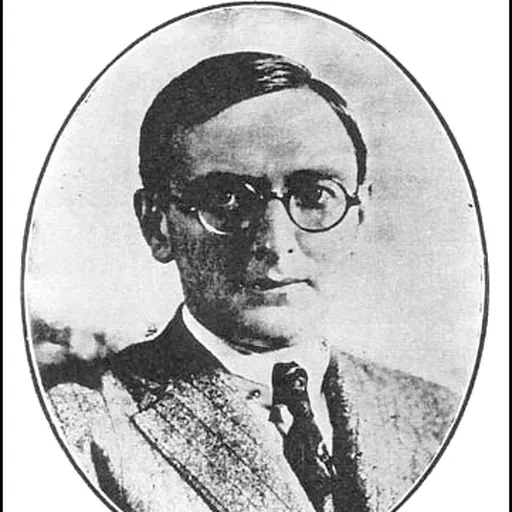
Renato Ferraz Kehl
Brazilian physician, author and eugenetist
About Renato Ferraz Kehl
Lived 1889 – 1974 (aged 84–85). Renato Ferraz Kehl was a Brazilian physician writer, physician, eugenicist and pharmazeut.
Renato Ferraz Kehl (August 22, 1889 – August 14, 1978) was a Brazilian pharmacist, physician, writer and eugenicist from the early 20th century.
Career Graduated from the Rio de Janeiro School of Medicine in 1915, Renato Kehl, of Germanic origin, worked at the beginning of his career at the National Department of Public Health (DNSP), carrying out activities focused on rural sanitation and hygiene and sanitary education. From the end of the 1920s, he became a businessman in the pharmaceutical industry, standing out as Director of Bayer in Brazil. His name would become best known for his tireless dedication to eugenics, which he called "the religion of humanity". For the writer Monteiro Lobato, who attended the Eugenics Society meetings to oppose Kehl´s ideas, Kehl should be considered the "father of eugenics in Brazil", given his commitment to organizing the Brazilian eugenics movement. . Monteiro Lobato joined this scientific debate institution, as an opponent to Renato Kehl´s views, as he was then a pioneer in denouncing racism in Brazil. The correspondence between the two is dedicated to the debate of their differences (Zöhler, Beti. Monteiro Lobato e a eugenia. ZolerZoler (blog), 17 de março de 2019. Disponível em: https://zolerzoler.wordpress.com/2019/03/17/monteiro-lobato-e-a-eugenia/)
He was elected member of the Academia Nacional de Medicina in 1932, succeeding in Chair 93, which has Belisário Penna as its patron.
Renato Kehl and eugenics in Brazil Renato Kehl's adherence to the ideas formulated by Francis Galton, the founder of the eugenics doctrine, allowed him to dedicate his career to organizing the Brazilian eugenics movement, especially between the 1910s and 1930s, a period in which racial theories and discussions about Brazilian nationality structured the way travelers, writers, intellectuals, and scientists interpreted Brazil.
In 1918, with the collaboration of a group of Brazilian doctors, he founded the Eugenics Society of São Paulo, an institution that had more than a hundred members, including Monteiro Lobato, Arnaldo Vieira de Carvalho, Afrânio Peixoto, Artur Neiva, Vital Brazil, Belisário Penna, Juliano Moreira, and other important intellectual leaders of the time. A decade later, he created the Boletim de Eugenia, a periodical that circulated between 1929 and 1933 and which became known for its dissemination of eugenic measures among Brazilians. During this same period, in addition to collaborating with the organization of the First Brazilian Congress of Eugenics, held in Rio de Janeiro in 1929, he also founded the Brazilian Central Commission of Eugenics, whose objective was to assist the Brazilian government in matters related to the eugenic improvement of the country.
Between 1910 and 1930, Renato Kehl published more than a dozen books on eugenics, notably Lições de Eugenia (1929) and Sexo e cidadania - aparas eugénias (1933), works that would be characterized by the author's greater proximity to 'negative eugenics', a radical model of eugenics that was characterized by the defense of extreme measures, such as the eugenic sterilization of "degenerates", marital and reproductive control and the racial selection of immigrants. During the 1930s, his adherence to this more radical eugenics led the Brazilian eugenicist to publicly praise the Nazi eugenics policy launched in Germany by Adolf Hitler.
His activism in favor of eugenics science, although it brought him to the forefront, making him relevant for the understanding of this movement in Brazilian social and scientific history, was not capable of producing, absolutely, a consensus in the understanding of the bases and proposals for the application of eugenics in the intellectual environment of the time.
Don’t just read it —
keep it.
Full-length biographies made to live with: read them, listen on the way to work, watch them tonight.
- E-book
- Audio
- Video
Instant download · yours to keep · every purchase keeps this site free
Important facts
People in Renato Ferraz Kehl's life
Named in this biography and alive at the same time




Related people
Same field, nearest in time




Contemporaries
People whose lives overlapped Renato Ferraz Kehl's




Frequently asked questions
Who was Renato Ferraz Kehl?
Brazilian physician, author and eugenetist
When was Renato Ferraz Kehl born?
Renato Ferraz Kehl was born in 1889 in Limeira.
When did Renato Ferraz Kehl die?
Renato Ferraz Kehl died in 1974 in São Paulo.
What was Renato Ferraz Kehl's occupation?
Renato Ferraz Kehl was a physician writer, physician, eugenicist and pharmazeut.
What nationality was Renato Ferraz Kehl?
Renato Ferraz Kehl was Brazilian.
Sources & further reading
· Wikipedia: Renato Ferraz Kehl
Cite this page
APA: Biography.guide. (2026). Renato Ferraz Kehl. https://biography.guide/renato-ferraz-kehl/
MLA: "Renato Ferraz Kehl." Biography.guide, https://biography.guide/renato-ferraz-kehl/.
Chicago: "Renato Ferraz Kehl." Biography.guide. https://biography.guide/renato-ferraz-kehl/.
Data last updated: 2026-09-20 · Spot an error? Report a correction.
Page generated 2026-09-27 05:09 UTC