
About Réka Albert
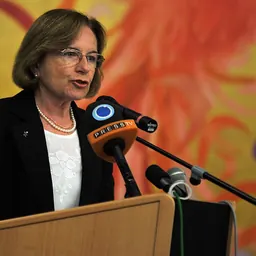
Born 1972. Réka Albert is a Romanian, American and Hungarian physicist and biologist, known for Barabási–Albert model and Scale-free network.
Réka Albert (born 2 March 1972 ) is a Romanian-Hungarian scientist. She is a distinguished professor of physics and adjunct professor of biology at Pennsylvania State University and is noted for the Barabási–Albert model and research into scale-free networks and Boolean modeling of biological systems. She was elected a Member of the National Academy of Sciences in 2025.
Education Albert was born in Reghin, a city in Mureș County, located in the historical region of Transylvania, in the north-central part of Romania. She obtained her B.S. and M.S. degrees from Babeș-Bolyai University in Cluj-Napoca, Romania, in 1995 and 1996, respectively. She earned her Ph.D. at the University of Notre Dame in 2001. and its applications to the vulnerability of the North American power grid.
Her current research focuses on dynamic modeling of biological networks and systems biology.
Awards Albert was selected as a Sloan Research Fellow in 2004 and was awarded a National Science Foundation CAREER Award in 2007. She was named Fellow of the American Physical Society in 2010. One year later she received the Maria Goeppert-Mayer Award. In 2016 she was inducted as an external member of the Hungarian Academy of Sciences. She was elected Fellow of the Network Science Society in 2018 and a Fellow of the American Association for the Advancement of Science in 2019.
Selected publications Albert R., Barabási A.-L.: Statistical mechanics of complex networks, Reviews of Modern Physics, Vol. 74, Nr. 1, pp. 47–97, 2002, , arXiv:cond-mat/0106096v1 (submitted 6 June 2001) Jeong H., Tombor B., Albert R., Oltvai Z.N., Barabási A.-L.: The large-scale organization of metabolic networks, Nature 407, pp. 651–654, 2000, arXiv:cond-mat/0010278 (submitted 19 October 2000) Albert R., Jeong H., Barabási A.-L.: Error and attack tolerance of complex networks, Nature 406, pp. 378–382, 2000, , arXiv:cond-mat/0008064v1 (submitted 3 August 2000) Barabási A.-L., Albert R.: Emergence of scaling in random networks, Science, Vol. 286, Nr. 5439, pp. 509–12, 15 October 1999, , arXiv:cond-mat/9910332v1 (submitted 21 October 1999)
Don’t just read it —
keep it.
Full-length biographies made to live with: read them, listen on the way to work, watch them tonight.
- E-book
- Audio
- Video
Instant download · yours to keep · every purchase keeps this site free
Important facts
Related people
Same field, nearest in time



Contemporaries
People whose lives overlapped Réka Albert's


Frequently asked questions
Who is Réka Albert?
Hungarian scientist (1972–)
When was Réka Albert born?
Réka Albert was born on 2 March 1972 in Reghin.
What is Réka Albert's occupation?
Réka Albert is a physicist and biologist.
What is Réka Albert known for?
Réka Albert is known for Barabási–Albert model and Scale-free network.
What nationality is Réka Albert?
Réka Albert is Romanian, American and Hungarian.
Sources & further reading
Cite this page
APA: Biography.guide. (2026). Réka Albert. https://biography.guide/reka-albert/
MLA: "Réka Albert." Biography.guide, https://biography.guide/reka-albert/.
Chicago: "Réka Albert." Biography.guide. https://biography.guide/reka-albert/.
Data last updated: 2026-09-20 · Spot an error? Report a correction.
Page generated 2026-09-27 05:09 UTC