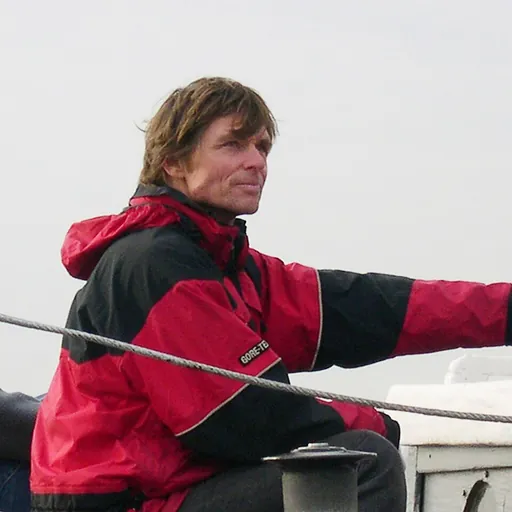
About Reid Stowe
Born 1952. Reid Stowe is an American explorer and artist.
William Reid Stowe (born January 6, 1952) is an American visual artist and mariner. Stowe grew up around sailboats on the East Coast, sailing on the Pacific and Atlantic Oceans in his late teens and early twenties. By age 26, he had built two of his own sailboats with the help of his family and friends. Stowe subsequently sailed to the Antarctic with his schooner Anne in 1986 and completed a 194-day journey without touching land in 1999.
In 2010 Stowe completed a more extensive ocean voyage, entitled 1000 Days at Sea: The Mars Ocean Odyssey—a journey that commenced on April 21, 2007, from the 12th St. Pier, Hoboken, New Jersey. Stowe was the principal designer and builder of the Anne, a 70 ft (21.3 m), 60-ton (54,400 kg) gaff-rigged schooner which he sailed on this voyage. The purpose of the enterprise was to remain on the open ocean, without resupply or pulling into any harbor, for a period of one thousand days, along with some other goals that were not met, such as circumnavigating the globe four times. The single circumnavigation involved active management of a sailboat under varying weather conditions, with continuous wear and tear of equipment on the schooner, although the schooner was not always under full sail.
On June 17, 2010, Stowe sailed the schooner Anne up the Hudson River, accompanied by Sail Magazine's Executive Editor Charles Doane, and docked in New York. The total voyage duration claimed by Stowe was 1,152 days, a potential record for the longest continuous sea voyage without resupply or stepping on land. Upon landing at Pier 81 in Manhattan, he was met by family and friends, by his then girlfriend Soanya Ahmad—who had accompanied him for the first quarter of the journey—and their toddler son, as well as by the press.
Childhood Reid Stowe was born January 6, 1952, near Moses Lake, Washington to Harry and Anne Stowe; and is the oldest of six siblings. His father, an officer in the United States Air Force, was posted to many parts of the world during that time and usually his family travelled with him. Growing up, Reid spent three years in Germany, two years in the Philippines, plus state-side tours in Mississippi, Illinois, Arizona, and Virginia. Traveling notwithstanding, the family generally spent summers with Anne Stowe's father, who had constructed a beach cottage on the Intracoastal Waterway near Ocean Isle Beach, North Carolina.
Early voyages Reid Stowe initially pursued studies in the arts, enrolling in the University of Arizona, where he took up painting and sculpture. who had invested some of his college funds to purchase a small sailing vessel. Invited to accompany him on an extended sail through the South Pacific to New Zealand,
Following his South Pacific voyage, Stowe returned to his grandfather's residence in Ocean Isle Beach, North Carolina, where he spent eight months constructing a and catamaran named Tantra, The two embarked on their journey to the Netherlands in June, 1973. After their arrival, Reid Stowe continued on a solo voyage which took him to Africa, a second Atlantic crossing, a trip to Brazil and the Amazon, returning to the United States in 1976. In his 2003 interview with Harold Channer, Stowe claimed that the catamaran Tantra was "the smallest boat to cross the Atlantic Ocean twice,"
Construction of the Anne (originally named Tantra Schooner) Following his return to the United States, Stowe's thoughts turned to the construction of a vessel well suited to extended voyages. He was particularly impressed with gaff-rigged schooners, which he felt represented a culmination of craft and technique for sailing vessels. with interior spaces finished in Caribbean hardwood supplied largely from debris thrown up by Hurricane David. In an interview with Harold Channer, Stowe likened the hull to a sealed steel and fiberglass bottle. Stowe established the ship as his home, sailing it originally to the Caribbean with his then wife, Iris and baby daughter Viva, " finishing the interior en route and in the islands." Author Jill Bobrow, in her 1982 Classic Yacht Interiors attributed some of the interior handiwork to Iris: "a beautiful walnut inlaid with enamel." Stowe navigated into ice packs and claimed winds of up to . Later, Stowe told Nik Kleinberg of ESPN: "You're geared up like an ice man, goggles, everything, not a bit of skin exposed. We had a gust of wind that blew the boat completely over."
It was during this voyage that Stowe began seriously considering a trip of extremely long duration. and displacing sixty tons, would set forth with a crew of six to eight (the same size as an initial Mars crew under some scenarios) and three years worth of provisions. For a thousand days they would sail outside of normal trade routes and without entering port. The crew would consist of scientists who would study weather, water, and atmospheric pollution, and ozone depletion in remote and little-documented regions of the world. Stowe hoped to conduct field tests of communication satellites, water purification systems and other equipment potentially useful for exploring Mars." Later, Stowe, with Harrison, authored the paper, "One thousand days non-stop at sea – Lessons for a mission to Mars" outlining a "1000-day voyage without touching land or receiving supplies from other craft. The goals of this expedition include the evaluation of equipment, supplies, and humans under conditions of isolation and confinement that will resemble some of those of the initial Mars voyage."
The Port of New York In the fall of 1997, Stowe began using Pier 63 as a base of operations, located in the Chelsea section of Manhattan, New York City at a marina operated by John Krevey. He promoted his one thousand days voyage in earnest, calling it the "1000 Days at Sea: The Mars Ocean Odyssey," and one news article at the time suggested a launch date of 1999. It would be eight years, and one marriage later, before Stowe found sufficient funding and media support for the project.
In 2006, the construction of a new park along the Hudson River forced the owner of the maritime barge at Pier 63—where Reid had kept his schooner Anne—to relocate to Pier 66. This caused the move of the schooner Anne to the 12th St. Pier across the river in Hoboken, on the New Jersey side, from which Reid eventually embarked on his epic voyage.
Voyage of the Turtle: Prelude to '1000 Days at Sea' Stowe's prelude to the present voyage was undertaken in 1999, when he and his new bride, Laurence Guillem, voyaged the South Atlantic Ocean for 194 days on the Anne, an expedition which Guillem dubbed "The Odyssey of the Sea Turtle." Stowe's intent during this preliminary voyage was to shape a course literally in the shape of a turtle, as a form of GPS art. Of this choice, Stowe said: "There's also something to be said about not racing around all the time. So this voyage was sort of an antidote to our speed-obsessed society. And the turtle is also a reminder about endangered species and the environment. I'm sure it's going to be interpreted in different ways." The voyage lasted from June 4, to December 17, 1999, with no major mishap, though it had its tribulations. The Anne suffered engine failure under the Verrazano-Narrows Bridge, The ship knocked over on its side once (although local papers incorrectly reported three knockdowns) in high seas, but righted itself. Having injured her jaw in the mishap, it was the last significant voyage that Guillem undertook with Stowe.
The 1000-day voyage Stowe and Ahmad departed on the 1000-day voyage on April 21, 2007, at 3:00 PM EDT from the 12th St. Pier in Hoboken, New Jersey, witnessed by about 100 well-wishers, including his parents and his former wife, Laurence Guillem. The heavily laden schooner passed through New York Harbor and into the open ocean by the evening of April 21. thumb
The departure put into execution plans that, in some respects, closely resembled those put forth by Stowe and Harrison in a 1992 paper. The scientific goals that had been outlined in the departure press release—the study of weather, water, atmospheric pollution and ozone depletion in little-documented regions of the world—have not been fully realized due to lack of proper equipment, as indicated by periodic entries in the voyage's log.
An article at the MarineBuzz website explained some of the technical aspects of the schooner's supplies, and summarized Soanya's role in the expedition up to the point where she had to depart the schooner and hand over her tasks to Reid (see below).
Several unexpected events occurred during the course of this voyage, two of them near the outset. On April 25, 2007, the schooner ventured near a US Navy missile firing trial that was being conducted off the New Jersey coast. After United States Coast Guard personnel alerted the schooner, the crew diverted their course with no further mishap. A second, more serious mishap occurred on May 6, 2007, when the schooner ran into a container ship that left the schooner's bowsprit heavily damaged, though the hull and the remainder of the boat was unscathed. Stowe was able to make a replacement, albeit shortened, bowsprit from less-damaged portions. Following these incidents, the vessel spent much of the second half of 2007 in the Southern Atlantic, passing the tip of Africa in mid December, 2007.
Soanya leaves the journey One significant incident occurred on February 22, 2008, when Stowe's companion, Soanya Ahmad decided to leave the voyage. After 306 days spent on board the schooner Anne, Ahmad had to disembark due to what later was discovered to be morning sickness. She disembarked from the schooner off Rottnest Island, near Perth, Western Australia. Members from the Royal Perth Yacht Club, including Jon Sanders, rendezvoused with the Anne around 1800 local time (+9 UTC) and assisted with Ms. Ahmad's departure. She arrived in Perth around 2100 local time. Ms. Ahmad's departure left Stowe without a crew and compromised an original tenet of the voyage, "...to leave the land and all support, sail for 1,000 days, non-stop at sea without receiving help, to live at sea, to be healthy, to send back good messages and have the whole world follow the voyage and understand the importance of it..."
Completion of the voyage On Day 658, Reid Stowe broke the world record for the longest non-stop ocean voyage, previously held by Jon Sanders, if one disregards Nansen's Fram expedition, during which the schooner Fram lay trapped on ice for nearly three years, and the crew was away from land for at least 1067 days. while March 24, 2010, equalled the 1067-day mark. Subsequent to the first 306 days with Soanya Ahmad, Reid Stowe also broke the record for the longest solo sea voyage without resupply, on Day 964 (Dec. 11, 2009). Furthermore, as a two-member male-and-female crew, Stowe and Ahmad could also lay claim to the longest non-stop voyage on the ocean by a man and a woman since Bernard Moitessier and his wife Françoise completed a 126-day voyage in 1966, from Tahiti to Spain.
None of the records claimed by Stowe were ever officially recognized. The World Sailing Speed Record Council explains on their website: "We concentrate on speed record attempts and claims, and no longer recognize "human condition" categories which can expand to such an extent that almost anyone would be able to claim a record of some sort."
Throughout the journey, Stowe maintained contact with the New York City–based support team via an Iridium phone. Stowe employed a VHF marine transceiver for ship-to-ship communications. Volunteers maintained a web site so that the general public could follow the progress of the voyage. The entire route of the schooner Anne was verified daily by GPS tracking, and the manufacturer of the equipment has made the database available online.
Until the computers broke down in December, 2009, there were also almost daily logs—with a photo—sent as email via the satellite telephone. These missives were originally contributed by Soanya and Reid, until Soanya's departure from the schooner, when Reid took over the role of sole communicator.
Reid Stowe saw his son for the first time, after landing his 70-foot schooner 'Anne' in New York and reuniting with girlfriend Soanya Ahmad on Thursday, June 17, 2010. The couple hadn't seen each other since Soanya had to leave the voyage in February, 2008.
Don’t just read it —
keep it.
Full-length biographies made to live with: read them, listen on the way to work, watch them tonight.
- E-book
- Audio
- Video
Instant download · yours to keep · every purchase keeps this site free
Important facts
People in Reid Stowe's life
Named in this biography and alive at the same time




Related people
Same field, nearest in time





Contemporaries
People whose lives overlapped Reid Stowe's

Frequently asked questions
Who is Reid Stowe?
American artist and mariner
When was Reid Stowe born?
Reid Stowe was born on 6 January 1952.
What is Reid Stowe's occupation?
Reid Stowe is an explorer and artist.
What nationality is Reid Stowe?
Reid Stowe is American.
Sources & further reading
Cite this page
APA: Biography.guide. (2026). Reid Stowe. https://biography.guide/reid-stowe/
MLA: "Reid Stowe." Biography.guide, https://biography.guide/reid-stowe/.
Chicago: "Reid Stowe." Biography.guide. https://biography.guide/reid-stowe/.
Data last updated: 2026-09-22 · Spot an error? Report a correction.
Portrait: Wikimedia Commons · author & licence
Page generated 2026-09-27 04:57 UTC