
About Reginald E. Beauchamp
Lived 1910 – 2000. Reginald E. Beauchamp was an American sculptor.
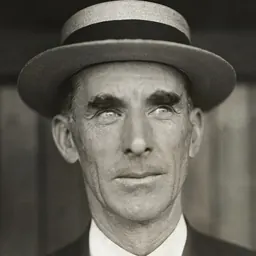
Beauchamp's 1976 Living Flame Memorial to the city's police officers and firefighters in Philadelphia's Franklin Square. Location: Reginald E. Beauchamp (December 8, 1910 – December 20, 2000) was an American sculptor whose works include Penny Franklin (1971), Whispering Bells of Freedom (1976), and a bust of Connie Mack that sits in the Baseball Hall of Fame.
Born in London, Beauchamp immigrated to the United States at age 2 with his family, who lived for five years in Rensselaer, New York, before settling in Philadelphia. He worked as the director of special events and then the head of public relations and personnel at the Philadelphia Bulletin newspaper from 1945 to 1975. He was also involved in various community groups, including Rotary International, the Philadelphia Sketch Club, the Poor Richard Club, and the Philadelphia Public Relations Association, which named him the first member of its hall of fame in 1972.
Artworks Beauchamp created 25 works of public art, most of which were installed in Philadelphia. Among them are: The Living Flame Memorial, erected in 1976 in Franklin Square as the city's monument to honor city police and firefighters fallen in the line of duty. The Hero Mosaic in Philadelphia City Hall. The Vietnam Bronze War Memorial at Edison High School. The North Philly school lost 66 former students in the Vietnam War, more than any other U.S. high school. Tony Burgee, class of 1961, led the effort to create the memorial. The Signing of the Declaration of Independence painting at the Mellon Independence Center mall. A bronze of Dave Zinkoff, a veteran announcer of Philadelphia sporting events, at the Philadelphia Spectrum arena. A "plastic glass spire" at Mercy Philadelphia Hospital.
Beauchamp once hung colored ribbons from the statue of William Penn atop Philadelphia City Hall to nearby buildings, creating the look of a maypole more than 500 feet tall.
In 1967, he unsuccessfully proposed a $5 million, 14-story bust of Benjamin Franklin to be mounted on Belmont Plateau in the city's Fairmount Park. It was to be made of vertical stainless-steel tubes, six inches in diameter and one inch apart, that would have been lit from the interior of the sculpture.
Among the privately held works by Beauchamp is a sculptural rendition of John Trumbull's painting of the signing of the Declaration of Independence, installed at the Philadelphia Protestant Home in the Lawndale neighborhood.
Another is "Philadelphia Then & Now", a 53-by-68-inch painting commissioned by the Philadelphia Bulletin in 1947 to commemorate the newspaper's 100th anniversary. It depicts the city as it appeared in 1847, with the contemporary skyline floating in the clouds above. The painting was exhibited at Newman Gallery, hung for 25 years at the Poor Richard Club, shifted into private hands in the mid-1970s, and was offered at auction in 2009.
Penny Franklin Beauchamp's favorite of his public works was Penny Franklin, a bust of Ben Franklin that was covered with 80,000 pennies collected from local schoolchildren. The work was conceived as a commemoration of the 100th anniversary of the Philadelphia Fire Department, the professional descendant of the Franklin-founded Union Fire Company, and an homage to the man who coined the phrase "a penny saved is a penny earned."
Using clay, Beauchamp modeled an adult-sized bust of a long-haired, gentle-eyed fellow — the Franklin of the history books, wise and timeless. Then he reached into his penny supply and covered the entire thing with coins, creating a sort of chain-mail effect. Beauchamp completed it with a quarter-inch coating of fiberglass. "It was a hit ... a favorite of tourists and passersby on Arch Street for 25 years", The Philadelphia Inquirer wrote.
The sculpture took a beating from children who climbed on it and vandals who pried off chunks of coins. In 1982, the city coated it with a defensive layer of epoxy "All those pennies don't do wonders for his complexion. But there are plenty of young adults in Philadelphia today who can remember donating their pennies to the cause", the Inquirer wrote.
Over a quarter-century, the work deteriorated, "began to lean precariously and became a hazard to pedestrians." In August 1996, it was removed and placed in a municipal warehouse in South Philadelphia. City officials contemplated restoring it, but the cost, estimated in the tens of thousands of dollars, was deemed prohibitive. "I've done a lot of things for this city, but that was my favorite", Beauchamp said.
Family Beauchamp's wife of 64 years, Elizabeth Sarah "Betty" Beauchamp, died January 9, 1999, of leukemia. She had helped create many of his public art works. An obituary noted:
In her earlier years, the former Elizabeth Brown worked for the Curtis Publishing Co. in the subscription department. Because the company would not employ married women, she and her future husband drove about 100 miles to Pottsville to be married. She kept her name out of the license columns of the Philadelphia newspapers and kept her marital status secret until she left Curtis to raise a family.
The Beauchamps had two sons, Ronald and Roy; and a daughter, Irene B. Brooks.
Don’t just read it —
keep it.
Full-length biographies made to live with: read them, listen on the way to work, watch them tonight.
- E-book
- Audio
- Video
Instant download · yours to keep · every purchase keeps this site free
Important facts
People in Reginald E. Beauchamp's life
Named in this biography and alive at the same time







Related people
Same field, nearest in time

Contemporaries
People whose lives overlapped Reginald E. Beauchamp's




Frequently asked questions
Who was Reginald E. Beauchamp?
American artist (1910–2000)
When was Reginald E. Beauchamp born?
Reginald E. Beauchamp was born in 1910.
When did Reginald E. Beauchamp die?
Reginald E. Beauchamp died in 2000.
What was Reginald E. Beauchamp's occupation?
Reginald E. Beauchamp was a sculptor.
What nationality was Reginald E. Beauchamp?
Reginald E. Beauchamp was American.
Sources & further reading
· Wikipedia: Reginald E. Beauchamp
· DBpedia: Reginald E. Beauchamp
Cite this page
APA: Biography.guide. (2026). Reginald E. Beauchamp. https://biography.guide/reginald-e-beauchamp/
MLA: "Reginald E. Beauchamp." Biography.guide, https://biography.guide/reginald-e-beauchamp/.
Chicago: "Reginald E. Beauchamp." Biography.guide. https://biography.guide/reginald-e-beauchamp/.
Data last updated: 2026-09-20 · Spot an error? Report a correction.
Page generated 2026-09-27 05:14 UTC