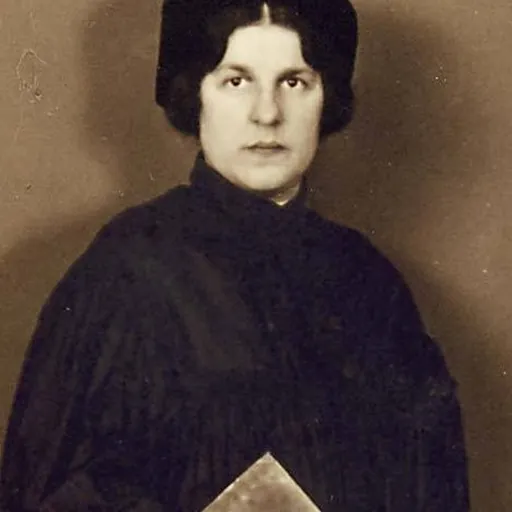
About Regina Jonas
Lived 1902 – 1944 (aged 42). Regina Jonas was a rabbi.
Early life
Regina Jonas was born into a "strictly religious" household in the Berlin Scheunenviertel, the second child of Wolf Jonas and Sara Hess. Wolf, who was probably Regina's first teacher, died when she was 13. Like many women at that time, she intended to make a career as a teacher. After graduating from the local Höhere Mädchenschule, she became disillusioned with the idea of becoming a teacher. Instead, she enrolled at the Hochschule für die Wissenschaft des Judentums (Higher Institute for Jewish Studies), in the Academy for the Science of Judaism, and took seminary courses for liberal rabbis and educators for 12 semesters. While not the only woman attending the university, Regina sent ripples through the institution with her stated goal of becoming a rabbi.
To this end, Jonas wrote a thesis that would have been an ordination requirement. Her topic was "Can a Woman Be a Rabbi According to Halachic Sources?" Her conclusion, based on Biblical, Talmudic, and rabbinical sources, was that she should be ordained. The Talmud professor responsible for ordinations, Eduard Baneth, accepted Jonas' thesis; however, his sudden death squashed any hope Jonas may have had in receiving an official ordination. Jonas graduated in 1930, her diploma only naming her as an "Academic Teacher of Religion". Jonas then applied to Rabbi Leo Baeck, spiritual leader of German Jewry, who had taught her at the seminary. Baeck, while acknowledging Jonas as a "thinking and agile preacher", refused to make her title official, because the ordination of a female rabbi would have caused massive intra-Jewish communal problems with the Orthodox rabbinate in Germany.
For nearly five years, Jonas taught religious studies in a series of both public and Jewish schools, and also performed a series of 'unofficial' sermons. Her lectures on religious and historical topics for various Jewish institutions often included questions about the importance of women in Judaism. This eventually caught the attention of the liberal Rabbi Max Dienemann, who was the head of the Liberal Rabbis' Association in Offenbach am Main,
Jonas worked in the Theresienstadt camp for two years. Records of some 23 sermons written by Jonas survive, including What Is Power Nowadays - Jewish Religion, the Power Source for Our Ego Ethics and Religion. During her two-year internment, Jonas was also a member of a group that organized concerts, lectures and other performances to distract others from events around them.
Upon passing the June 1944 inspection, a number of summer months would pass at relative ease, until almost all of the Jewish Council, including Jonas, were then deported amongst the majority of the town, to Auschwitz in mid-October 1944, where she was murdered either less than a day or two months later. She was 42 years old.
Rediscovery From Jonas' death until 1972 there is at least one brief mention in the Jewish press of her status as rabbi. In 1967, The Australian Jewish News reported on a conference of Liberal Judaism and their discussions of equality for women. The paper reported that a Rabbi Sanger of Berlin spoke of Jonas as an ordained rabbi.
Following the ordination of Rabbi Sally Priesand in 1972, The American Israelite reported in July 1973 that the only other known Jewish woman to receive ordination was Regina Jonas of Berlin. Also mentioned was that Jonas' thesis was titled "Can a Woman Become a Rabbi?"
Pnina Navè Levinson, a student of Jonas, mentions her story in a 1981 paper and subsequently, in a 1986 paper, Levinson notes that Jonas' story was never mentioned by notable individuals who were in Theresienstadt at the same time as Jonas. Jonas is also discussed briefly in a 1984 paper by Robert Gordis who notes Jonas was an early example of the ordination of a woman as rabbi.
Jonas's literary work was rediscovered in 1991 by Dr. Katharina von Kellenbach, a researcher and lecturer in the department of philosophy and theology at St. Mary's College of Maryland, who had been born in Germany. In 1991 she traveled to Germany to research material for a paper on the attitude of the religious establishment (Protestant and Jewish) to women seeking ordination in 1930s Germany. It is largely due to von Kellenbach's discovery that Jonas is now widely known. The biography, translated into English in 2004 under the title Fräulein Rabbiner Jonas – The Story of the First Woman Rabbi, gives voice to witnesses who knew or met Jonas personally as rabbi in Berlin or Theresienstadt. Klapheck also described Jonas' love relationship with Rabbi Josef Norden.
Legacy
Though there had been some women before Jonas who made significant contributions to Jewish thought, such as the Maiden of Ludmir, Asenath Barzani, and Lily Montagu, who acted in similar roles without being ordained, Jonas remains the first woman in Jewish history to have become a rabbi.
A hand-written list of 24 of her lectures entitled "Lectures of the One and Only Woman Rabbi, Regina Jonas", still exists in the archives of Theresienstadt. Five lectures were about the history of Jewish women, five dealt with Talmudic topics, two dealt with biblical themes, three with pastoral issues, and nine offered general introductions to Jewish beliefs, ethics, and the festivals.
A large portrait of Regina Jonas was installed on a kiosk that tells her story; it was placed in Hackescher Market in Berlin, as part of a citywide exhibition titled "Diversity Destroyed: Berlin 1933–1938–1945," to commemorate the 80th anniversary of the National Socialists' rise to power in 1933 and the 75th anniversary of the November pogrom, or Kristallnacht, in 1938.
In 1995, Bea Wyler, who had studied at the Jewish Theological Seminary of America in New York, became the first female rabbi to serve in postwar Germany, in the city of Oldenburg.
In 2001, during a conference of (European women rabbis, cantors and rabbinic scholars) in Berlin, a memorial plaque was revealed at Jonas' former living place in Krausnickstraße 6 in Berlin-Mitte.
In 2003 and 2004, Gesa Ederberg and Elisa Klapheck were ordained in Israel and the US, later leading egalitarian congregations in Berlin and Frankfurt. Klapheck is the author of Fräulein Rabbiner Jonas – The Story of the First Woman Rabbi (2004).
In 2010, Alina Treiger, who studied at the Abraham Geiger College in Potsdam, became the first female rabbi to be ordained in Germany since Regina Jonas.
In 2011, Antje Deusel became the first German-born woman to be ordained as a rabbi in Germany since the Nazi era. She was ordained by Abraham Geiger College. a British, Hungarian, and German co-production directed by Diana Groo. The film concerns Jonas's struggle to be ordained and her romance with Hamburg rabbi Josef Norden.
On 5 April 2014, an original chamber opera, also titled "Regina" and written by composer Elisha Denburg and librettist Maya Rabinovitch, premiered in Toronto, Ontario, Canada. It was commissioned and performed by the independent company Essential Opera and featured soprano Erin Bardua in the role of Regina, and soprano Maureen Batt as the student who uncovers her forgotten legacy in the archives of East Berlin in 1991. The opera is scored for five voices, clarinet, violin, accordion, and piano.
On 17 October 2014, which was Shabbat Bereishit, communities across America commemorated Jonas's yahrzeit (anniversary of death).
In 2014, a memorial plaque to Jonas was unveiled at the former Nazi concentration camp Theresienstadt in the Czech Republic, where she had been deported to and worked in for two years. There is a short documentary about the trip on which this plaque was unveiled, titled In the Footsteps of Regina Jonas.
In 2015, Abraham Geiger College and the School of Jewish Theology at the University of Potsdam marked the 80th anniversary of Jonas's ordination with an international conference, titled "The Role of Women's Leadership in Faith Communities."
In 2017, Nitzan Stein Kokin, who was German, became the first person to graduate from Zecharias Frankel College in Germany, which also made her the first Conservative rabbi to be ordained in Germany since before World War II.
In August 2022, The New York Times featured Jonas in their obituary feature Overlooked.
In December 2025, the city of her birth, Berlin, renamed a street in the Kreuzberg district to Regina-Jonas-Straße.
Don’t just read it —
keep it.
Full-length biographies made to live with: read them, listen on the way to work, watch them tonight.
- E-book
- Audio
- Video
Instant download · yours to keep · every purchase keeps this site free
Important facts
People in Regina Jonas's life
Named in this biography and alive at the same time



Related people
Same field, nearest in time





Contemporaries
People whose lives overlapped Regina Jonas's



Frequently asked questions
Who was Regina Jonas?
first woman to be ordained as a rabbi (1902–1944)
When was Regina Jonas born?
Regina Jonas was born on 3 August 1902 in Berlin.
When did Regina Jonas die?
Regina Jonas died on 12 December 1944 in Auschwitz.
What was Regina Jonas's occupation?
Regina Jonas was a rabbi.
What nationality was Regina Jonas?
Regina Jonas's recorded nationality: German Reich, German language.
Sources & further reading
Cite this page
APA: Biography.guide. (2026). Regina Jonas. https://biography.guide/regina-jonas/
MLA: "Regina Jonas." Biography.guide, https://biography.guide/regina-jonas/.
Chicago: "Regina Jonas." Biography.guide. https://biography.guide/regina-jonas/.
Data last updated: 2026-09-21 · Spot an error? Report a correction.
Portrait: Wikimedia Commons · author & licence
Page generated 2026-09-27 04:59 UTC