
Raymond of Penyafort
Dominican Master General, archbishop and saint, catholic jurist from Catalonia
About Raymond of Penyafort
Lived 1175 – 1275 (aged 99–100). Raymond of Penyafort was a university teacher, canon law jurist, theologian, catholic priest, confessor and friar.
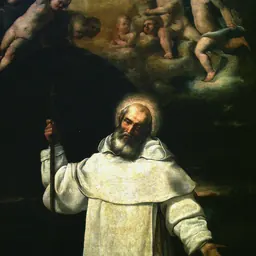
Raymond of Penyafort (, ; 1175 – 6 January 1275) was a Catalan friar with the Dominicans who was a canon lawyer. He compiled the Decretals of Gregory IX, a collection of canonical laws that remained a major part of Church law until the 1917 Code of Canon Law abrogated it. He was canonized by Pope Clement VIII in 1601 and is the patron saint of canon lawyers.
He wrote one of the first manuals for user of the inquisitors, the Directorium inquisitoriale (1242).
Life Raymond of Penyafort was born in Santa Margarida i els Monjos, a small town near Barcelona, Principality of Catalonia. Descended from a noble family with ties to the royal house of Aragon, he was educated in Barcelona and at the University of Bologna, where he received doctorates in both civil and canon law. From 1195 to 1210, he taught canon law. In 1210, he moved to Bologna, where he remained until 1222, including three years occupying the Chair of canon law at the university. He came to know the newly founded Dominican Order there. Raymond was attracted to the Dominican Order by the preaching of Blessed Reginald, prior of the Dominicans of Bologna, and received the habit at the age of 47, in the Dominican Convent of Barcelona, to which he had returned from Italy in 1222.
Mercedarians Raymond was instrumental in the founding of the Mercedarian friars. When approached by Peter Nolasco, Raymond encouraged and assisted him in obtaining the consent of King James I of Aragon for the foundation of the Order.
The need to study Semitic languages was affirmed by the General Chapter of the Dominican Order in Paris in 1236. Raymond established the first school of the Studia Linguarum in Tunis, where it was known as the Studium arabicum. The objective of the schools was to help the Dominicans liberate Christian captives in Islamic lands.
Summa de casibus poenitentiae
Raymond had written for confessors a book of cases, the Summa de casibus poenitentiae. More than simply a list of sins and suggested penances, it discussed pertinent doctrines and laws of the Church that pertained to the problem or case brought to the confessor, and is widely considered an authoritative work on the subject.
In 1229 Raymond was appointed theologian and penitentiary to the Cardinal Archbishop of Sabina, John of Abbeville, and was summoned to Rome in 1230 by Pope Gregory IX, who appointed him chaplain and grand penitentiary.
Later life Having reached his 60th year, Raymond retired to a reclusive life in Barcelona. Within the year, however, Raymond was appointed to the position of Archbishop of Tarragona, the ecclesiastical capital of the Principality of Catalonia and the Crown of Aragon, but declined. Raymond approved of conjugal visits for those imprisoned so that the spouse should not be exposed to the risk of possible adultery.
Conversion of Jews and Muslims Rejoicing to see himself again free of office, he applied himself with fresh vigor to the Christian ministry, especially working for the conversion of the Moors. To this end he encouraged Thomas Aquinas to write his work Against the Gentiles. He instituted the teaching of Arabic and Hebrew in several houses of the friars. He also founded priories in Murcia (then still ruled by Arabs) and in Tunis. Additionally he went to help establish the Church in the recently conquered island of Mallorca.
Disputation of Barcelona
He exercised great influence over King James of Aragon and succeeded in persuading him to order a public debate, concerning Judaism and Christianity, between Moshe ben Nahman, a rabbi in Girona, and Paulus Christiani, a baptized Jew of Montpellier who belonged to the Dominicans. In this debate, which took place in the royal palace and other venues at Barcelona from 20–31 July 1263, in the presence of the king and of many of the higher clergy, Raymond took an important part. He was at the head of the theologians present, and in agreement with the king gave the rabbi perfect freedom of speech. Raymond simply observed to Moses ben Nachman that he must not allow himself to blaspheme Christianity, to which Moses replied that he knew what the laws of propriety demanded. On the Jewish Sabbath following the close of the debate, the king, together with many preaching friars and other clergy, visited the synagogue.
Raymond died at the age of 100 in Barcelona in 1275 and was canonized by Pope Clement VIII in 1601. He was buried in the Cathedral of Santa Eulalia in Barcelona.
Feast day St. Raymond of Peñafort's feast day was inserted in the General Roman Calendar in 1671 for celebration on 23 January. In 1969 it was moved to 7 January, the day after that of his death. He is the patron saint of canon lawyers, specifically, and also of lawyers in general.
Influence and legacy
The St. Raymond Peñafort Building at the University of Santo Tomas in Manila, which houses the College of Commerce and Business Administration and the Faculty of Arts and Letters, is named in his honor.
Don’t just read it —
keep it.
Full-length biographies made to live with: read them, listen on the way to work, watch them tonight.
- E-book
- Audio
- Video
Instant download · yours to keep · every purchase keeps this site free
Important facts
People in Raymond of Penyafort's life
Named in this biography and alive at the same time

Related people
Same field, nearest in time





Contemporaries
People whose lives overlapped Raymond of Penyafort's



Frequently asked questions
Who was Raymond of Penyafort?
Dominican Master General, archbishop and saint, catholic jurist from Catalonia
When was Raymond of Penyafort born?
Raymond of Penyafort was born in 1175 in Santa Margarida i els Monjos.
When did Raymond of Penyafort die?
Raymond of Penyafort died on 6 January 1275 in Barcelona.
What was Raymond of Penyafort's occupation?
Raymond of Penyafort was a university teacher, canon law jurist, theologian, catholic priest, confessor and friar.
What nationality was Raymond of Penyafort?
Raymond of Penyafort's recorded nationality: Crown of Aragon.
Sources & further reading
· Wikipedia: Raymond of Penyafort
· DBpedia: Raymond of Peñafort
Cite this page
APA: Biography.guide. (2026). Raymond of Penyafort. https://biography.guide/raymond-of-penyafort/
MLA: "Raymond of Penyafort." Biography.guide, https://biography.guide/raymond-of-penyafort/.
Chicago: "Raymond of Penyafort." Biography.guide. https://biography.guide/raymond-of-penyafort/.
Data last updated: 2026-09-26 · Spot an error? Report a correction.
Page generated 2026-09-27 05:15 UTC