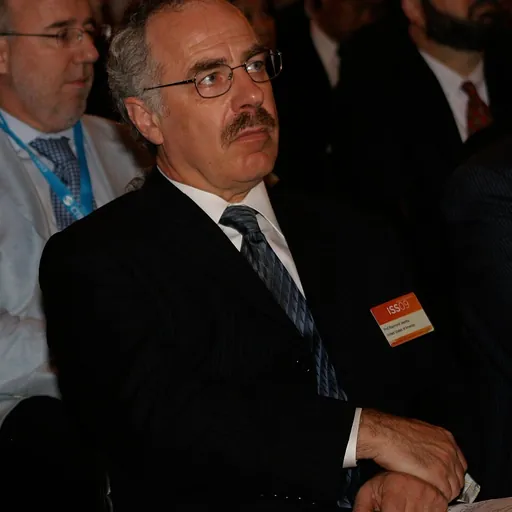
About Raymond Jeanloz
Born 1952. Raymond Jeanloz is an American physicist, astronomer, geophysicist and university teacher.
Raymond Jeanloz is a professor of Earth and planetary science (EPS) and Astronomy at the University of California, Berkeley. Educated at the California Institute of Technology, Amherst College and at Deep Springs College, and serves on the Board of Directors of Annual Reviews.
Jeanloz is also active in connecting science and policy in areas including international policy, resources and the environment, and science education. chairing the Committee on International Security and Arms Control at the National Academy of Sciences.
Education Raymond Jeanloz is one of four children of Roger W. Jeanloz, a professor in biological chemistry and molecular pharmacology at Harvard Medical School, and his wife Dorothea. Raymond Jeanloz grew up in Massachusetts and spent two years at Deep Springs College, located in the Deep Springs Valley between the White Mountains and Inyo Mountains in California. His initial interests were in comparative literature and music. While he had some early exposure to geology, his interest in that field developed late in his undergraduate program.
Jeanloz applied to the California Institute of Technology (Caltech) in part because of the Caltech Seismological Laboratory. His thesis advisor at Caltech was Thomas J. Ahrens. Jeanloz credits Ahrens and others for their mentorship and support, in helping him to learn about areas where he lacked scientific background and in encouraging him to explore new areas of research.
Career Jeanloz joined the faculty at Harvard University in 1979, In 1982, he moved to the University of California, Berkeley where he became a professor of Earth and planetary science and of Astronomy.
Jeanloz is a member of the National Academy of Sciences. He advises the US Government, the University of California and its national laboratories on a wide variety of issues including national security. He has chaired the Committee on International Security and Arms Control, and has been recognized by the Federation of American Scientists and the American Physical Society for shaping government policy. His work has connected mineral physics, chemistry, and materials science. He has created impact waves by shooting projectiles at high speeds, and generated high-energy laser pulses.
His research has led to greater understanding of how planets form, the composition of their interiors, and how those interiors behave. His research group is best known for experiments documenting that bridgmanite, a high-pressure form of , is the primary material making up Earth's interior.
Jeanloz' group and their collaborators have modeled processes of diamond formation, indicating that diamonds may be hailing inside "icy" giant planets like Neptune. They have helped characterize the primary constituents of giant planets and stars, the high-pressure fluid-metal forms of hydrogen and helium. They have determined that helium and hydrogen can form a metallic liquid alloy at the extreme pressures that occur at the cores of Jupiter and Saturn. They have studied pressurized hydrogen and documented an insulator-to-metal transition in fluid hydrogen, identifying the conditions under which it turns into a metal. Their research also suggests that helium separates out of fluid metallic hydrogen inside Jupiter and Saturn, creating an immiscibility region in Jupiter and a four-layered planetary structure.
In another collaboration Jeanloz has studied the behavior of a novel superionic form of water ice, one that is simultaneously liquid and solid and can conduct electricity as if it was a metal. The mantles of ice giant planets like Uranus and Neptune may contain superionic ice, possibly explaining some odd behaviors of their magnetic fields. His group's experiments have also pioneered the discovery of crystal instabilities causing strain-induced amorphization and fracture-like processes, leading to new insights on how materials break.
Awards and honors 1984, James B. Macelwane Medal, American Geophysical Union 1988, MacArthur Fellow, MacArthur Foundation 1990, Fellow, American Association for the Advancement of Science 1992, Fellow, American Academy of Arts and Sciences 2004, Member, National Academy of Sciences, Geology Section. 2008, Cozzarelli Prize, National Academy of Sciences 2008, Hans Bethe Award, Federation of American Scientists 2012-2013, Annenberg Distinguished Visiting Fellow in Environmental Policy and International Security, Hoover Institution, Stanford University
Selected publications Materials science and physics
Nuclear policy
Don’t just read it —
keep it.
Full-length biographies made to live with: read them, listen on the way to work, watch them tonight.
- E-book
- Audio
- Video
Instant download · yours to keep · every purchase keeps this site free
Important facts
People in Raymond Jeanloz's life
Named in this biography and alive at the same time
Related people
Same field, nearest in time


Contemporaries
People whose lives overlapped Raymond Jeanloz's

Frequently asked questions
Who is Raymond Jeanloz?
American astronomer
When was Raymond Jeanloz born?
Raymond Jeanloz was born on 18 August 1952 in Winchester.
What is Raymond Jeanloz's occupation?
Raymond Jeanloz is a physicist, astronomer, geophysicist and university teacher.
What nationality is Raymond Jeanloz?
Raymond Jeanloz is American.
Sources & further reading
Cite this page
APA: Biography.guide. (2026). Raymond Jeanloz. https://biography.guide/raymond-jeanloz/
MLA: "Raymond Jeanloz." Biography.guide, https://biography.guide/raymond-jeanloz/.
Chicago: "Raymond Jeanloz." Biography.guide. https://biography.guide/raymond-jeanloz/.
Data last updated: 2026-09-23 · Spot an error? Report a correction.
Portrait: Wikimedia Commons · author & licence
Page generated 2026-09-27 05:06 UTC