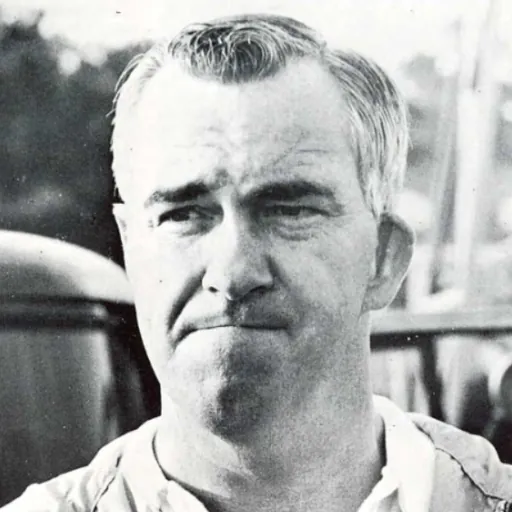
Ray Graves
American football player, coach, athletic director, College Football Hall of Fame
About Ray Graves
Lived 1918 – 2015 (aged 96). Ray Graves was an American american football player and coach.
Samuel Ray Graves (December 31, 1918 – April 10, 2015) was an American professional football player and college football coach. He was a native of Tennessee and a graduate of the University of Tennessee, where he was the starting center and team captain for the Volunteers under head coach Robert Neyland. After playing in the National Football League (NFL) for three seasons, he returned to Tennessee to serve as an assistant football coach, then left for a longer stint as an assistant at Georgia Tech under head coach Bobby Dodd. He was the head football coach at the University of Florida from 1960 until 1969, where he led the Gators to their most successful decade in program history up to that point. While at Florida, he recruited and coached Heisman Trophy-winning quarterback Steve Spurrier, who often praised Graves as a role model and mentor during his own successful coaching career. Graves also served as Florida's athletic director from 1960 until his retirement in 1979.
Early life and education
Graves was born in Knoxville, Tennessee, on December 31, 1918. He was the son of a Methodist minister, and the Graves family often moved as his father took various pastorships in eastern Tennessee. In high school, he realized that his best (and perhaps only) opportunity to attend college would be to earn an athletic scholarship, so he worked hard at both football and academics while attending Central High School in Dayton, Tennessee.
Playing career
College Upon graduation from high school, Graves earned a scholarship at from Tennessee Wesleyan Junior College, a small Methodist-affiliated institution in Athens, Tennessee. Graves attended Wesleyan for a year, then received a scholarship offer from Duke University coach Wallace Wade, which he accepted.
Graves would later credit Neyland's insistence that all players learn the assignments of every position on the field for helping him to understand the game and become a better coach, though he did not try to imitate Neyland's aloof and highly disciplined coaching style.
The Philadelphia Eagles selected Graves in the ninth round (seventy-third pick overall) of the 1942 NFL draft, and he ended a brief stint as a high school football coach to play professionally. He played offensive line and linebacker for the Eagles during the 1942 and 1943 seasons, including the temporary merger of the Eagles and the Pittsburgh Steelers known as the "Steagles." (The Steagles were formed when the league had to limit rosters and cut back to eight teams in 1943 because of manpower shortages during World War II. After two seasons in the NFL, Graves returned to Knoxville to become the Volunteers' line coach in 1944.
In 1946, Graves returned to the Eagles to serve as a scout and assistant line coach, though he was pressed back into action as a player due to a rash of injuries. Under Dodd, Graves and offensive coach Frank Broyles, the Yellow Jackets won Southeastern Conference championships in 1951 and 1952, the 1951 Orange Bowl, the 1952 Sugar Bowl and the 1952 national championship. Graves is widely credited with creating what was then known as the "monster defense"—the modern alignment of the free safety and strong safety in the defensive backfield—while coaching under Dodd. In turn, Graves credited Dodd with serving as his role model of a "player's coach" who built relationships with players and coaches to get the most out of his team. He served as the Gators' head coach for ten years from 1960 to 1969. Graves led Florida to five bowl appearances and he coached several outstanding players, including quarterback and Heisman Trophy recipient Steve Spurrier (1964–1966), running back and future NFL first-round draft pick Larry Smith (1966–1968) and defensive end and Pro Football Hall of Fame inductee Jack Youngblood (1968–1970).
Among the many highlights of the Graves era was the 1963 Gators' 10–6 upset victory over coach Bear Bryant's 1963 Alabama Crimson Tide in Tuscaloosa, Alabama. In one of the more interesting footnotes to his football legacy, Graves allowed Dr. Robert Cade, a professor in the University of Florida College of Medicine, to conduct dehydration analysis and rehydration experiments using team members which led to the formulation of Gatorade in 1965. After seeing the formula's potential in an intrasquad scrimmage, Graves asked Cade to make enough for the entire team for the next game against Louisiana State; the LSU Tigers wilted in the 102-degree game-day heat, and the Gators came from behind to win in the second half. and were ranked fourteenth in the final AP Poll. After achieving an all-time win–loss record at Florida of 70–31–4 (.686) and four final top-twenty poll rankings (1960, 1965, 1966, 1969), Graves stepped down to make room for former Gators quarterback Doug Dickey to return to his alma mater as the new head coach of the 1970 Gators. Graves remained the winningest coach in Gators football history until his former quarterback, Steve Spurrier, surpassed him in 1996.
Graves' Gators are remembered for their remarkable academic success as much as their athletic success. Ninety-three percent of his players graduated, and more than half of the graduates ultimately earned law or medical degrees. His remaining tenure as athletic director was notable for the University of Florida embracing the challenges and opportunities in women's college sports presented by Title IX. After he was approached by Professor Dr. Ruth H. Alexander and other female coaches to fund women's athletics, their proposal was brought to the Faculty Committee on Intercollegiate Athletics who approved their budgeting plan for the 1972–73 season. Under Graves' guidance, Florida's women's sports program began its climb to become one of the top ten women's programs in Division I sports. After he retired as athletic director in 1979, he worked for another year as a special assistant for fundraising in the office of the university president. the University of Florida Athletic Hall of Fame in 1981, the Tennessee Sports Hall of Fame in 1990, and the College Football Hall of Fame in 1990. When Steve Spurrier returned to Gainesville as the Gators' head coach in 1990, he created the Ray Graves Trophy, an annual team MVP award selected by the players. The Steelers recreated the era in their "Turn Back the Clock" ceremonies, including broadcasting in black and white on the Jumbotron and airing World War II footage during the national anthem. All live entertainment was done to reflect the 1940s.
Graves was on hand as six of the nine surviving members of that Steagles team were honored by the Steelers during halftime. During the festivities, the Steelers gave each of the six members a replica Steagles jersey. The jersey worn by Graves was returned to the team after the festivities. It was sold by the Steelers a month later to Bill Ponko, a private collector of sports memorabilia, to benefit a local charity.
Later life
After resigning as the University of Florida's athletic director in 1980, Graves became vice president of Steinbrenner Enterprises in Tampa, Florida. He also served as a consultant to the Jacksonville Bulls of the United States Football League (USFL).
Head coaching record
Don’t just read it —
keep it.
Full-length biographies made to live with: read them, listen on the way to work, watch them tonight.
- E-book
- Audio
- Video
Instant download · yours to keep · every purchase keeps this site free
Important facts
People in Ray Graves's life
Named in this biography and alive at the same time






Related people
Same field, nearest in time



Contemporaries
People whose lives overlapped Ray Graves's



Frequently asked questions
Who was Ray Graves?
American football player, coach, athletic director, College Football Hall of Fame (1918-2015)
When was Ray Graves born?
Ray Graves was born on 31 December 1918 in Knoxville.
When did Ray Graves die?
Ray Graves died on 10 April 2015 in Clearwater.
What was Ray Graves's occupation?
Ray Graves was an american football player and coach.
What nationality was Ray Graves?
Ray Graves was American.
Sources & further reading
Cite this page
APA: Biography.guide. (2026). Ray Graves. https://biography.guide/ray-graves/
MLA: "Ray Graves." Biography.guide, https://biography.guide/ray-graves/.
Chicago: "Ray Graves." Biography.guide. https://biography.guide/ray-graves/.
Data last updated: 2026-09-21 · Spot an error? Report a correction.
Portrait: Wikimedia Commons · author & licence
Page generated 2026-09-27 04:59 UTC