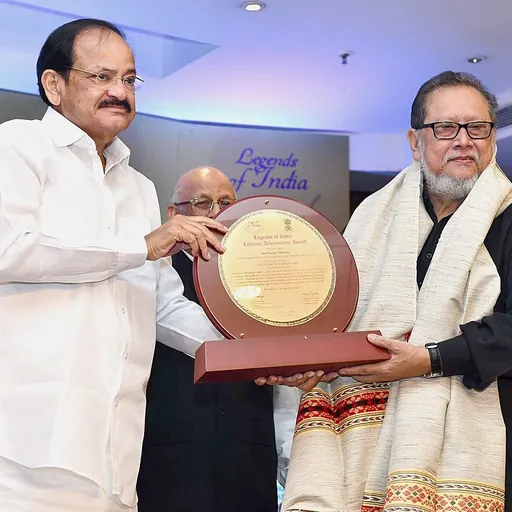
About Ratan Thiyam
Lived 1948 – 2025 (aged 77). Ratan Thiyam was an Indian theatre director, choreographer, writer and composer, known for Chorus Repertory Theatre.
Early life and education Thiyam parents, Thiyam Tarun Kumar and Bilasini Devi, were noted Manipuri dancers and teachers. It was during a tour in Nabadwip, West Bengal, when Thiyam was born. He grew up in Imphal and often travelled with them in their troupe. During this period, he acted in Alkazi’s noted production, Andha Yug, done in kabuki style at the Purana Qila open-air theatre, where he played the role of Yuyutsu. in Imphal, Manipur in 1976. He was also briefly the director of National School of Drama (NSD), New Delhi (1987–88). His production of Ajneya's Uttar Priyadarshi in Meitei was staged at the 1st Bharat Rang Mahotsav (BRM), the annual theatre festival of National School of Drama (NSD), Delhi in 1999, his presentation of Kalidasa's epic poem Ritusamharam was closing production of 4th BRM in 2002, subsequently the 10th BRM in 2008, which also marked the golden jubilee of NSD, opened at Kamani Auditorium, New Delhi, with a performance was Prologue, the first part of his Manipur Trilogy, when all past alumni have gathered for the festival. The 12th BRM in January 2010 featured Ratan Thiyam's When we Dead Awaken.
The plays of Ratan Thiyam
His works express a deep concern for social welfare and spiritual yearnings amidst the political chaos of the modern world. His plays infuse rationalised and multifaceted analysis of myriad perspectives. Using ingenious theatrical stagecraft, his plays are marked by literary beauty and profound meaning. Most of Ratan Thiyam's plays are thematically Indianized and are profound, with universal appeal. Most of his plays were in his native Manipuri language (Meitei). They incorporated indigenous traditions like the Wari Liba, a Manipuri storytelling form, Thang-Ta, a martial arts style, and Pung, the Manipuri drum. In 1986, he adapted Jean Anouilh's "Antigone" as Lengshonnei, a comment on the personal behaviour of politicians, failing to handle political situation in the state.
His play Andha Yug (The Blind Age), known for creating an intense and intimate experience, around the epochal theme, was famously staged in an open-air performance, at Tonga, Japan, on 5 August 1994, a day before the forty-ninth anniversary of Atomic Holocaust in Hiroshima.
His major plays include Ritusamharam: The work seeks solace and sanity amidst the chaos and violence of today's world. In 2014, Thiyam opened a Manipuri adaptation of Macbeth, translocated to a historical Meitei context, with names of characters unchanged. It was the opening act at the 2019 inaugural Bangladesh International Theatre Festival.
Death Thiyam died at the Regional Institute of Medical Sciences (RIMS), Lamphelpat, Imphal, on 23 July 2025, at the age of 77, after a prolonged illness of post-COVID health complications. Upon his death, the Manipur state government declared a day of state mourning, and in its message called him, "a towering figure in Indian theatre and a cultural icon of Manipur." His son, Thawai Thiyam, is also theatre actor and director, and a part Chorus Repertory Theatre; he has directed plays like Bacchae, a Meitie adaption of Greek tragedy by same name. Imphal Imphal (1982) Chakravyuha (1984) (Army Formation) Lengshonnei (1986) (An adaptation of Jean Anouilh's Antigone) Uttar Priyadarshi (The Final Beatitude, by Hindi playwright Agyeya) (1996) Chinglon Mapan Tampak Ama (Nine Hills One Valley) Ritusamharam (Ritusamharam by Sanskrit playwright Kalidasa) Andha Yug (The Blind Age, by Hindi playwright Dharamvir Bharati) Wahoudok (Prologue) Ashibagee Eshei (based on When We Dead Awaken, by Norwegian playwright Henrik Ibsen) (2008) Lairembigee Eshei (Song of the Nymphs) The King of Dark Chamber (Raja, 2012), based on a play Raja (1910) by Rabindranath Tagore.
Awards
1984: Indo-Greek Friendship Award, 1984 (Greece) 1987: Sangeet Natak Akademi Award 1987: Fringe Firsts Award, from Edinburgh International Festival 1990: Diploma of Cervantino International Festival, (Mexico) 2005: Kalidas Samman 2008: John D. Rockefeller Award 2011: Bharat Muni Samman 2012: Sangeet Natak Akademi Fellowship (Akademi Ratna) 2013: Bhupen Hazarika Foundation Award 2016: K.C. Das Commerce College National Achiever Award
In popular culture Some Roots Grow Upwards a 2003 documentary by Kavita Joshi and Malati Rao, was based on the life and work of Ratan Thiyam, especially his political ideologies, and his use of theatre as medium of political protest.
Don’t just read it —
keep it.
Full-length biographies made to live with: read them, listen on the way to work, watch them tonight.
- E-book
- Audio
- Video
Instant download · yours to keep · every purchase keeps this site free
Important facts
People in Ratan Thiyam's life
Named in this biography and alive at the same time


Related people
Same field, nearest in time

Contemporaries
People whose lives overlapped Ratan Thiyam's


Frequently asked questions
Who was Ratan Thiyam?
Indian theatre director
When was Ratan Thiyam born?
Ratan Thiyam was born on 20 January 1948 in Manipur.
When did Ratan Thiyam die?
Ratan Thiyam died on 23 July 2025.
What was Ratan Thiyam's occupation?
Ratan Thiyam was a theatre director, choreographer, writer and composer.
What was Ratan Thiyam known for?
Ratan Thiyam was known for Chorus Repertory Theatre.
What nationality was Ratan Thiyam?
Ratan Thiyam was Indian.
Sources & further reading
Cite this page
APA: Biography.guide. (2026). Ratan Thiyam. https://biography.guide/ratan-thiyam/
MLA: "Ratan Thiyam." Biography.guide, https://biography.guide/ratan-thiyam/.
Chicago: "Ratan Thiyam." Biography.guide. https://biography.guide/ratan-thiyam/.
Data last updated: 2026-09-23 · Spot an error? Report a correction.
Portrait: Wikimedia Commons · author & licence
Page generated 2026-09-27 05:06 UTC