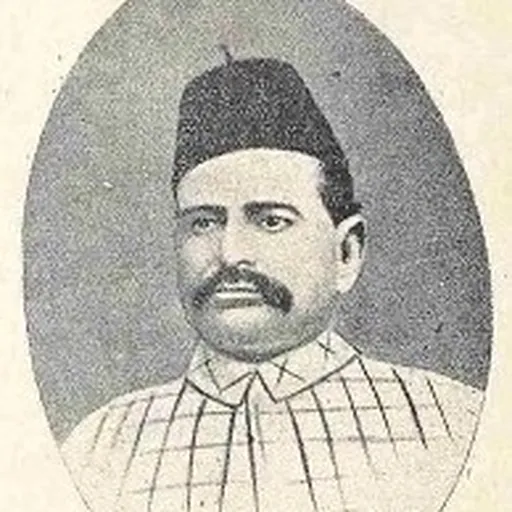
About Ratan Nath Dhar Sarshar
Lived 1846 – 1903 (aged 56–57). Ratan Nath Dhar Sarshar was an Indian poet.
Ratan Nath Dhar Sarshar (; 1846 or 1847 – 21 January 1903) was an Indian Urdu novelist, columnist and editor from British India. Born into a Kashmiri Brahmin family which settled in Lucknow, he received his education at Canning College and later took up employment as a schoolteacher. In August 1878, he was appointed editor of the Lucknow-based newspaper Avadh Akhbar, in which his most famous work Fasana-e-Azad was published serially.
Biography Sarshar's date of birth is uncertain. Most probably he was born in 1846 or 1847. He was born in a Kashmiri Brahmin (a group well known for their proficiency in Persian and Urdu) family. His father, Pandit Bej Nath Dhar, a trader who immigrated from Kashmir to Lucknow, died when Sarshar was four years old; thereafter Sarshar was brought up by his mother. Sarshar was initially schooled in the traditional way by learning Arabic and Persian at a local maktab (primary school).
Sarshar joined, for his schooling, the Canning College (which later migrated into University of Lucknow), but left without taking a degree. In 1878, he joined Avadh Akhbar as its editor.
In 1895, Sarshar moved to Hyderabad where he was engaged by Maharaja Sir Kishen Pershad to correct and improve upon his prose writings and poetic composition. Sarshar also edited a journal, Dabdaba-e-Asifi.
His serialized novel Fasana-e-Azad (The Tale of Azad), which appeared between 1878 and 1883 as a regular supplement in his paper, was influenced by novels like The Pickwick Papers and Don Quixote, as well as the epic romances (dastan) of Persian and Urdu. Spanning over three thousand pages, the novel narrates the adventures of the protagonist, Azad, through the streets of Lucknow to the battlefields of the Russo-Turkish War (1877–1878). A Hindi TV serial Wah Janaab by satirist Sharad Joshi, based on Fasana-e-Azad, ran successfully on the state-run television channel Doordarshan in the 1980s.
His other novels are Sair-i-Kohsar and Jam-i-Sarshar. His novel Gor-i-Ghariban remained unpublished due to his accidental death. His novel Khuda-e-Foujdar is an Urdu translation of Don Quixote.
Don’t just read it —
keep it.
Full-length biographies made to live with: read them, listen on the way to work, watch them tonight.
- E-book
- Audio
- Video
Instant download · yours to keep · every purchase keeps this site free
Important facts
People in Ratan Nath Dhar Sarshar's life
Named in this biography and alive at the same time

Related people
Same field, nearest in time

Contemporaries
People whose lives overlapped Ratan Nath Dhar Sarshar's




Frequently asked questions
Who was Ratan Nath Dhar Sarshar?
Indian writer and magazine editor (1846–1903)
When was Ratan Nath Dhar Sarshar born?
Ratan Nath Dhar Sarshar was born in 1846.
When did Ratan Nath Dhar Sarshar die?
Ratan Nath Dhar Sarshar died on 21 January 1903 in Hyderabad.
What was Ratan Nath Dhar Sarshar's occupation?
Ratan Nath Dhar Sarshar was a poet.
What nationality was Ratan Nath Dhar Sarshar?
Ratan Nath Dhar Sarshar was Indian.
Sources & further reading
· Wikipedia: Ratan Nath Dhar Sarshar
· DBpedia: Ratan Nath Dhar Sarshar
Cite this page
APA: Biography.guide. (2026). Ratan Nath Dhar Sarshar. https://biography.guide/ratan-nath-dhar-sarshar/
MLA: "Ratan Nath Dhar Sarshar." Biography.guide, https://biography.guide/ratan-nath-dhar-sarshar/.
Chicago: "Ratan Nath Dhar Sarshar." Biography.guide. https://biography.guide/ratan-nath-dhar-sarshar/.
Data last updated: 2026-09-22 · Spot an error? Report a correction.
Portrait: Wikimedia Commons · author & licence
Page generated 2026-09-27 05:04 UTC