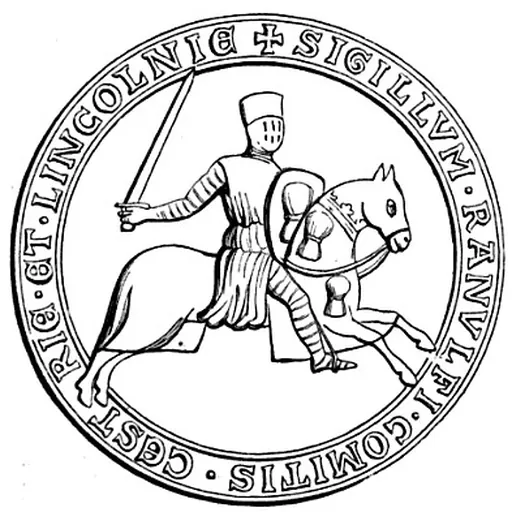
Ranulf de Blondeville, 6th Earl of Chester
Anglo-Norman baron born in Wales
About Ranulf de Blondeville, 6th Earl of Chester
Lived 1170 – 1232 (aged 61–62). Ranulf de Blondeville, 6th Earl of Chester was an English military personnel.
Ranulf de Blondeville, 6th Earl of Chester and 1st Earl of Lincoln (1170 – 26 October 1232), known in some references as the 4th Earl of Chester (in the second lineage of the title after the original family line was broken after the 2nd Earl), was one of the "old school" of Anglo-Norman barons whose loyalty to the Angevin dynasty was consistent but contingent on the receipt of lucrative favours. He has been described as "almost the last relic of the great feudal aristocracy of the Conquest".
Early life Ranulf, born in 1170, in Montgomeryshire, Powys, Wales
The reality was that when called for campaign he was asked not to bring so many knights (usually he was asked to bring between seven and 20) as it would have been too much of a financial burden. Constance successfully petitioned for the dissolution of the marriage on the grounds of desertion.
In 1200 Ranulf cemented his power in Normandy by marrying Clemence of Fougères; she was the daughter of William of Fougères, widow of Alan de Dinant, and sister of Geoffrey of Fougères. He had opposed John's attempted coup of 1193–4, and retained many contacts with partisans of his former stepson Arthur. He spent most of 1199–1204 in France and his continued loyalty was bought by John with further patronage. However, the King was suspicious of the Earl, perhaps with some reason. In the winter of 1204–5, Ranulph, suspected of dealings with the rebellious Welsh and of contemplating revolt himself, had extensive estates temporarily confiscated by the king. This episode apparently convinced Ranulph to show loyalty in future. Thereafter he was showered with royal favours. In return he fought John's Welsh wars 1209–12; helped secure the peace with the pope in 1213–14, and was with the king in Poitou in 1214.
Loyal to the king in 1215–16, he was one of the few magnates to witness Magna Carta of 1215, which he would later adapt to appease his own barons in the form of the Magna Carta of Chester. He played a leading military role in the civil war by virtue of his extensive estates and numerous castles. Ranulf stood with William Marshal and the earls of Derby and Warwick with the king, whilst the other nobility of the land stood with the enemy or remained aloof from the conflict.
Regency Chester was appointed in 1215 Lord of the County of Lancashire with the power to appoint sheriffs. He was also High Sheriff of Lancashire, High Sheriff of Staffordshire and High Sheriff of Shropshire in 1216. On John's death in 1216, Ranulf's influence increased further. There was an expectation at Gloucester that Ranulf would contend the regency for the young Henry III. Events moved quickly at Gloucester, where William Marshal and the young king were, in Ranulf's absence. The Marshal was put forward and offered the regency by the nobility and clerics gathered at Gloucester before the arrival of Ranulf. There was concern that Ranulf might object to the decision, but when he arrived (29 October 1216) he stated that he did not want to be regent, so any potential conflict vanished.
Campaign of 1217 Before John's death, rebel barons had offered the throne of England to Louis, the dauphin. Louis had invaded the country during the summer of 1216 and had taken Winchester. De Blondeville put his political weight behind re-issuing Magna Carta in 1216 and 1217; his military experience was used in defeating the rebels at Lincoln in 1217. Ranulf was based in the north midlands and was charged with stopping the northern barons from linking up with Louis in the south.
The Earl chose to combine personal concerns with those of the country by attacking Saer de Quincy, 1st Earl of Winchester's castle at Mountsorrel in Leicestershire—from which the Earl of Winchester's predecessors had ousted Ranulf's grandfather, Ranulf de Gernon. Louis was persuaded by the Earl of Winchester to send a relief force to the castle. When they arrived, de Blondeville and the Royalist force were gone. In fact, they had headed to Lincoln to deal with a French force besieging the castle there.
William Marshal with his main army at Northampton also made for the city, and at Lincoln a battle was fought between the Royalists headed by William Marshal and de Blondeville and the French forces and their allies. The battle went in favour of the Royalists, and they captured forty-six Barons and the Earls of Winchester and Hereford and the Earl of Lincoln, recently created by Louis the French king. Following the battle in recognition of his support, Ranulf was created Earl of Lincoln by King Henry III of England on 23 May 1217.
Fifth Crusade In 1218, de Blondeville decided to honour the crusading vow he had made three years previously, and he journeyed eastwards. He met up with the counts of Nevers and La Marche in Genoa, accompanied by the earls of Derby, Arundel and Winchester. They then sailed on towards Egypt and the Nile. An icy winter in camp was followed by a burning summer which affected the morale of the crusaders greatly.
During September 1219, the Sultan, wary of the conflict outside Damietta, offered the crusaders a startling bargain—Bethlehem, Nazareth, Jerusalem, and central Palestine and Galilee, so long as the Crusaders gave up their war in Egypt. Ranulf was one of many voices in support of taking the offer, and was supported by his English peers.
However, Bishop Pelagius, the Patriarch of Jerusalem and the military orders would have none of it. They finally refused the offer and on 5 November they found the walls of Damietta poorly manned, so they attacked and secured the city. When winter came the army was smouldering with discontent. Ranulf left Damietta in September 1220, with his fellow English earls, leaving behind an indecisive force under the command of Bishop Pelagius and the Military Orders. Upon the crusade's failure, he returned to England to find his rival, William Marshal dead and the government in the hands of Hubert de Burgh.
Final years
From 1220 to 1224, tensions grew between government officials and old loyalists of King John. This flared into open conflict in the winter of 1223–4 when Ranulf among others briefly tried to resist de Burgh's policy of resumption of sheriffdoms and royal castles. Ranulf built Bolingbroke Castle near Spilsby in Lincolnshire around 1220, later the birthplace of King Henry IV, as well as Chartley Castle in Staffordshire, and Beeston Castle in Cheshire. Ranulf was briefly made castellan of Wallingford Castle. He made an alliance with Llywelyn the Great, whose daughter Elen married Ranulf's nephew and heir, John the Scot, in about 1222.
De Blondeville's final years saw him acting as an elder statesman, witnessing the 1225 re-issue of Magna Carta, playing a prominent role in the dispute in 1227 over Forest Laws and, as a veteran, leading Henry III's army on the ill-fated Poitou expedition of 1230–1. He came to lead the campaign after the death of William Marshal (the younger). He showed vigour and made a thrust into Anjou, but by the end of June, the French had reached the Breton border. Ranulf concluded the campaign with a truce with the King of France for three years, to end in 1234.
Ranulf kept in sight his personal advantage. In 1220 some of his estates avoided carucage; in 1225 aid was not levied in Cheshire; and in 1229 he successfully resisted the ecclesiastical tax collector. His only major failure, in old age, was not avoiding the 1232 levy of the fortieth on his lands.
Ranulf's death
Ranulf died at Wallingford on 26 October 1232,
Ranulf's second sister Mabel and his eldest sister Matilda (Maud) shared the estates with their other sisters. Ranulf's third sister Agnes (Alice) inherited, along with a share in other estates with her sisters, lands between the Ribble and the Mercy rivers, Powis Castle near Welshpool in Wales, Chartley Castle, Staffordshire, and land at Bugbrooke, Northamptonshire. Ranulf's youngest sister Hawise inherited the honour and castle of Bolingbroke, other large estates such as Lindsey and Halland in Lincolnshire, and a share of other estates with her sisters.
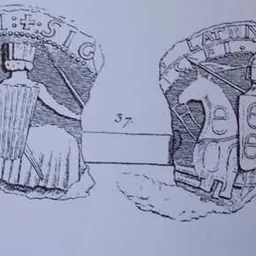
Prior to Ranulf's death, however, he had also made Hawise, his youngest sister, an inter vivos gift, after receiving dispensation from the Crown, of the Earldom of Lincoln. In April 1231 he granted her the title by a formal charter under his seal which was confirmed by King Henry III. She was formally invested as suo jure 1st Countess of Lincoln on 27 October 1232, the day after Ranulf's death. She held the Earldom of Lincoln until less than a month later with the consent of the king she likewise gifted the earldom inter vivos to her daughter Margaret de Quincy and her son-in-law, John de Lacy, 2nd Earl of Lincoln. They were formally invested by King Henry III as Countess and Earl of Lincoln on 23 November 1232.
After his death, his nephew, John the Scot (son of his eldest sister Matilda (Maud) of Chester), was formally invested by King Henry III as Earl of Chester on 21 November 1232, which suggests a prior agreement.
As an important figure in the reigns of kings Richard I and John, Ranulf appears in novels set in the period.
Ranulf de Blondeville is a supporting character in James Goldman's 1979 novel Myself as Witness set in the reign of King John. Goldman's narrator describes Ranulf as the "only living Visigoth" and condemns him for killing many Welshman in his capacity as an Anglo-Norman lord of the Welsh Marches. He is represented as a brutal and aggressive opponent of all things, and people, Welsh.
He appears early in Sharon Kay Penman's novel Falls the Shadow, on the life and career of Simon de Montfort, 6th Earl of Leicester, when he promises to personally support Simon's appeal to the king to recognise his right to the impoverished Leicester earldom.
Ranulf makes a brief appearance in Lauren Johnson's 2013 novel The Arrow of Sherwood participating in the siege of Nottingham in 1194.
Ranulf is mentioned several times over the course of the 1980s television series Robin of Sherwood.
Don’t just read it —
keep it.
Full-length biographies made to live with: read them, listen on the way to work, watch them tonight.
- E-book
- Audio
- Video
Instant download · yours to keep · every purchase keeps this site free
Important facts
Family & relationships
People in Ranulf de Blondeville, 6th Earl of Chester's life
Named in this biography and alive at the same time

Related people
Same field, nearest in time

Contemporaries
People whose lives overlapped Ranulf de Blondeville, 6th Earl of Chester's




Frequently asked questions
Who was Ranulf de Blondeville, 6th Earl of Chester?
Anglo-Norman baron born in Wales
When was Ranulf de Blondeville, 6th Earl of Chester born?
Ranulf de Blondeville, 6th Earl of Chester was born in 1170 in Montgomeryshire.
When did Ranulf de Blondeville, 6th Earl of Chester die?
Ranulf de Blondeville, 6th Earl of Chester died on 26 October 1232 in Wallingford.
What was Ranulf de Blondeville, 6th Earl of Chester's occupation?
Ranulf de Blondeville, 6th Earl of Chester was a military personnel.
What nationality was Ranulf de Blondeville, 6th Earl of Chester?
Ranulf de Blondeville, 6th Earl of Chester was English.
Sources & further reading
· Wikipedia: Ranulf de Blondeville, 6th Earl of Chester
· DBpedia: Ranulf de Blondeville, 6th Earl of Chester
Cite this page
APA: Biography.guide. (2026). Ranulf de Blondeville, 6th Earl of Chester. https://biography.guide/ranulf-de-blondeville-6th-earl-of-chester/
MLA: "Ranulf de Blondeville, 6th Earl of Chester." Biography.guide, https://biography.guide/ranulf-de-blondeville-6th-earl-of-chester/.
Chicago: "Ranulf de Blondeville, 6th Earl of Chester." Biography.guide. https://biography.guide/ranulf-de-blondeville-6th-earl-of-chester/.
Data last updated: 2026-09-23 · Spot an error? Report a correction.
Portrait: Wikimedia Commons · author & licence
Page generated 2026-09-27 05:05 UTC