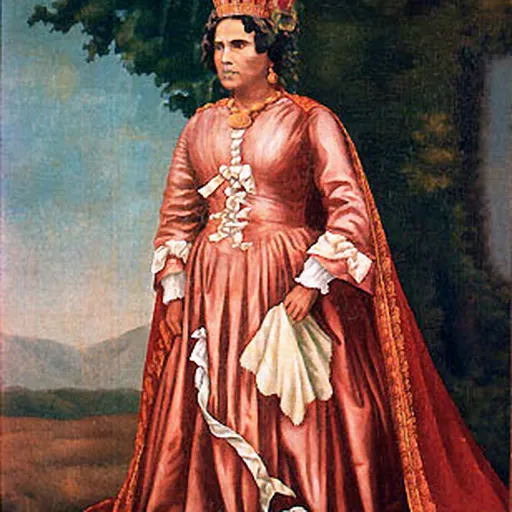
About Ranavalona I
Lived 1788 – 1861 (aged 72–73). Ranavalona I was a politician and head of state.
Ranavalona I (born Rabodonandrianampoinimerina; 177816 August 1861), also known as Ramavo or Ranavalo-Manjaka I or Ranavalona reniny, was the sovereign of the Kingdom of Madagascar from 1828 to 1861. After positioning herself as queen following the death of her young husband Radama I, she pursued a policy of isolationism and self-sufficiency. She sought reduced economic and political ties with European powers and took vigorous measures to eradicate the small but growing Malagasy Christian movement initiated under Radama I by members of the London Missionary Society.
Ranavalona used the traditional practice of fanompoana (forced labor as tax payment) to complete public works projects and develop an army. She had a standing army of between 20,000 and 30,000 Merina soldiers, whom she deployed to pacify outlying regions of the island and expand the realm. The combination of regular warfare, slavery, disease, difficult forced labor and the practice of tangena (a harsh trial by ordeal using a poisonous nut from the Cerbera manghas tree) resulted in a high mortality rate among both soldiers and civilians during her 33-year reign; by some estimates, the country's population may have declined by as much as half.
Although greatly obstructed by Ranavalona's policies, foreign political interests in Madagascar remained undiminished. Divisions between traditionalist and pro-European factions at the queen's court created opportunities that European intermediaries leveraged in an attempt to hasten the succession of her son Radama II. The young prince disagreed with many of his mother's policies and was amenable to French proposals for the exploitation of the island's resources, as expressed in the Lambert Charter he concluded with a French representative in 1855. However, these plans were not successful and Radama II did not take the throne until Ranavalona's death in 1861 at the age of 83.
Ranavalona's European contemporaries generally condemned her policies and characterized her as a tyrant at best and insane at worst. These negative characterizations, earning her the epithet of the "Mad Monarch of Madagascar", persisted in Western scholarly literature until the mid-1970s. Later academic research recast Ranavalona's actions as those of a queen attempting to expand her empire while protecting Malagasy sovereignty against the encroachment of European cultural and political influence. In present-day Madagascar, she remains a controversial figure and is largely viewed negatively.
Early life Princess Ramavo was born in 1778 at the royal residence at Ambatomanoina, about east of Antananarivo, to Prince Andriantsalamanjaka and Princess Rabodonandriantompo. When Ramavo was still a young girl, her father alerted King Andrianampoinimerina to an assassination plot planned by Andrianjafy, the king's uncle, whom Andrianampoinimerina had forced from the throne at the royal city of Ambohimanga. In return for saving his life, Andrianampoinimerina betrothed Ramavo to his son, Prince Radama, whom the king designated as his heir. He furthermore declared that any child from this union would be first in the line of succession after Radama.
Accession to the throne When Radama died without leaving any descendants on 27 July 1828, according to local custom, the rightful heir was Rakotobe, the eldest son of Radama's eldest sister. An intelligent and amiable young man, Rakotobe was the first pupil to have studied at the first school established by the London Missionary Society in Antananarivo on the grounds of the royal palace. Radama died in the company of two trusted courtiers who were favorable to the succession of Rakotobe. However, they hesitated to report the news of Radama's death for several days, fearing possible reprisals against them for having been involved in denouncing one of the king's rivals, whose family had a stake in the succession after Radama. During this time, another courtier, a high-ranking military officer named Andriamamba, discovered the truth and collaborated with other powerful officers – Andriamihaja, Rainijohary and Ravalontsalama – to support Ramavo's claim to the throne.
Queen Ranavalona I with her son and heir Prince Rakoto. Posthumous circa 1875
These officers hid Ramavo and one of her friends in a safe location, then secured the support of several influential power-brokers, including judges and the keepers of the sampy (royal idols). The officers then rallied the army behind Ramavo,
By succeeding her husband, Ranavalona became the first female sovereign of the Kingdom of Imerina since its founding in 1540. Her rise to power occurred in a cultural milieu that favored men over women in the political sphere. In the traditional culture of Imerina, rulers were specially endowed with the power to innovate in circumvention of established norms and customs. Sovereigns often mobilized innovation through the creation of new forms of kinship, the traditional basis of the political order. Women, however, were associated with the household, a rigid kinship unit in opposition to the innovating role and power of the sovereign, and so were not viewed as suited to rule.
Reign Ranavalona traveling on her filanzana (palanquin), accompanied by her son Rakoto on horseback and a retinue of slaves and soldiers. Posthumous, 1895
Ranavalona's 33-year reign was characterized by her effort to strengthen the domestic authority of the Kingdom of Imerina over subjugated provinces and preserve the political and cultural sovereignty of Madagascar. These policies were enacted in a context of increasing European influence within her kingdom and competing European bids for domination over the island. Early in her reign, the queen took incremental steps to distance Madagascar from the purview of European powers, first putting an end to a friendship treaty with Britain, then placing increasing restrictions on the activities of the missionaries of the London Missionary Society, who operated schools where basic education and trade skills were taught in addition to the Christian religion. In 1835 she forbade the practice of Christianity among the Malagasy population, and within a year nearly all foreigners had left her territory. These statistics have contributed to a strongly unfavorable view of Ranavalona's rule in historical accounts.
Government Ranavalona built a wooden palace (upper right) called Manjakamiadana, the largest structure in the Rova compound of Antananarivo. It was later encased in stone during Ranavalona II's reign.
In the tradition of many of her royal Merina predecessors, the queen ruled from the royal Rova compound in Antananarivo. Between 1839 and 1842, Jean Laborde built the queen a new residence called Manjakamiadana, which became the largest structure on the Rova grounds. The residence was made entirely from wood and bore most of the features of a traditional home of the Merina andriana (aristocratic class), including a central pillar (andry) to support the roof. In other ways it showcased distinctly European innovations, as it contained three floors entirely surrounded by wooden verandas and incorporated dormers in the shingled roof. The palace was eventually encased in stone in 1867 by James Cameron of the London Missionary Society during the reign of Ranavalona II. The original wooden palace of Ranavalona and virtually all other structures of the historic Rova compound were destroyed in a 1995 fire, leaving only the stone shell to mark where her palace had once stood.
In many respects, Ranavalona's rule was a continuation of precedent established under Radama I. Both monarchs encouraged the introduction of new technologies and forms of knowledge from abroad, supported the establishment of an industrialized economy, and adopted measures to professionalize the army. Both viewed foreigners with ambivalence, establishing close personal relationships and drawing upon their expertise while enforcing restrictions on their activities to avert destabilizing changes to existing cultural and political systems. In addition, both contributed to the further development of a complex political bureaucracy that enabled the Merina court to govern remote provinces across an island larger than metropolitan France. In the early years of Ranavalona's reign, Andriamihaja was the leader of her court's progressive faction, who favored maintaining the relations with Europe initiated under Radama. The conservative faction was led by the brothers Rainimaharo and Rainiharo, the latter being the official guardian of one of the most powerful royal sampy. These talismans were believed to embody and channel the supernatural powers of the kingship and had played a major role in the spiritual life of the Merina people since at least the 16th century reign of Ralambo. The conservative faction conspired to reduce Andriamahaja's progressive influence over the queen, and in September 1830 they managed to persuade her while highly intoxicated to sign his death warrant for charges of witchcraft and treason. He was immediately captured in his home and killed.
Following Andriamihaja's death, the influence of Radama's old guard of progressives was eclipsed by that of conservative advisers at court, who grew ever closer to the queen, eventually resulting in Ranavalona's marriage to sampy guardian and conservative figurehead Field Marshal Rainiharo (also called Ravoninahitriniarivo) of Ilafy in 1833. Rainiharo gained initial access to the court through his father, Andriantsilavonandriana, a hova (commoner) who had exceptionally been accorded the privilege of joining King Andrianampoinimerina's inner circle of noble advisers. Field Marshal Rainiharo served as the queen's First Minister from 1830 to 1832, then Prime Minister and Commander-in-Chief from 1832 to 1852. Upon Rainiharo's death, the queen wed another conservative, Field Marshal Andrianisa (also called Rainijohary), who remained Ranavalona's husband until her death in 1861. He served as Prime Minister from 1852 to 1862 before being exiled to the royal city of Ambohimanga for his part in a plot against the queen's son, Radama II.
This army, which was sent on repeated expeditions into neighboring provinces, exacted harsh penalties against communities resistant to Merina domination. Mass executions were common, and those who were spared were commonly brought back to Imerina as slaves (andevo), and their valuables seized as booty to increase the wealth of the Crown. Approximately one million slaves entered Imerina from coastal areas between 1820 and 1853, constituting one-third of the total population in the central highlands and two-thirds of all residents in Antananarivo.
According to Madagascar historian Gwyn Campbell, the number of non-Merina who died in violent conflict during the military campaigns of Ranavalona and her predecessor Radama from 1816 to 1853 was estimated at 60,000. Additionally, a considerable proportion of the population not killed in battle in the subjugated provinces eventually died from famine as a consequence of scorched earth policies. According to 19th-century Malagasy historian Raombana, in the eyes of the greater populace, the tangena ordeal was believed to represent a sort of celestial justice in which the public placed their unquestioning faith, even to the point of accepting a verdict of guilt in a case of innocence as a just but unknowable divine mystery. LMS missionaries established workshops in Antananarivo to teach brick-making, European carpentry and other practical skills, and developed a network of public schools where numeracy and English were taught alongside literacy using portions of the Malagasy language Bible. Despite high attendance at the schools, the LMS were initially unsuccessful in converting pupils to Christianity. Near the end of Radama's reign, the king came to regard the few Malagasy who had been converted as irreverent toward royal authority. He forbade Malagasy people from being baptized or attending Christian services.
Ranavalona's succession initially resulted in a relaxation of state control over Christianity. A printing press, which was imported by LMS missionaries at the end of Radama's reign, was only effectively put into operation in 1828. The press was in heaviest use during the first several years of Ranavalona's reign, when thousands of hymnals and other materials were transcribed and printed. Translation of the New Testament was completed in the second year of her reign, and 3,000 copies were printed and distributed between 1829 and 1830.
From the beginning of her reign, Ranavalona forbade the distribution of books within the military to prevent subversion and preserve discipline. She allowed missionaries free rein in operating the printing press, however, and exempted from military service all Malagasy personnel trained to operate the press. In 1835, translation of the Old Testament was completed and the first copies were printed. Within a year, hundreds of Malagasies were baptized; these converts were drawn from all social classes, including slaves, commoners, respected elders, court officials and even sampy guardians, who were considered the bulwarks of traditional culture.
The conversion of major religious, political and social leaders sparked a backlash In October and November 1831 the queen enacted a ban on Christian marriages, baptisms, and church services for soldiers and members of government studying in the Missionary schools, and in December extended the ban on church service attendance to all Malagasy. From 1832 to 1834, baptisms and church services continued, increasingly in secret. and Ranavalona requested the departure of three missionaries, retaining only those whose particular technical skills she viewed as valuable to the state. In 1835, the queen attempted to shut down the press without directly targeting the LMS by banning Malagasy personnel from working at the printing house. The LMS missionaries, capitalizing on the absence of legal decrees against their own work at the press, managed to continue independently printing and distributing materials.
"To the English or French strangers: I thank you for the good that you have done in my land and my kingdom, where you have made known European wisdom and knowledge. Do not worry yourselves—I will not change the customs and rites of our ancestors. Nevertheless, whoever breaks the laws of my kingdom will be put to death—whoever he may be. I welcome all wisdom and all knowledge which are good for this country. It would be a waste of time and effort to grab the customs and rites of my ancestors. Concerning religious practice—baptism or assemblies—it is forbidden for my people who inhabit this land to take part whether on Sunday or during the week. Concerning you, foreigners, you can practice according to your own manners and customs. Nevertheless, if skilled handiwork and other practical skills exist, which can profit our people, exercise these skills that good will come. These are my instructions which I make known to you." — Ranavalomanjaka, Kabary, February 26, 1835
Pursuant to the 26 February decree, those who possessed a Bible, worshiped in congregation or continued to profess adherence to Christianity were fined, jailed, manacled, subjected to trial by ordeal, or executed. Lurid accounts of the execution and torture of Christians were reported by missionaries with informants on the island who placed emphasis on what they perceived as the savagery of the Queen's actions. The precise number of Malagasy citizens put to death for religious reasons during Ranavalona's reign is difficult to state with certainty. British missionary to Madagascar W.E. Cummins (1878) places the number executed at between 60 and 80. Far more were required to undergo the tangena ordeal, condemned to hard labor, or stripped of their land and property, and many of these died. Persecution of Christians intensified in 1840, 1849 and 1857; in 1849, deemed the worst of these years by Cummins, 1,900 people were fined, jailed or otherwise punished for their Christian faith, and 18 were executed. The French, who held several small islands off Madagascar, were interested in gaining control over the main island but this move was opposed by the British who had an interest in maintaining a secure passage to India. Ranavalona pursued a policy of self-reliance to limit the influence of foreign powers.
Shortly after taking the throne, Ranavalona annulled the Anglo-Merina treaty that had been concluded between Radama and British envoys, and refused to continue receiving annual payments from Britain in exchange for adherence to the stipulations of the treaty. The most significant of these conditions was the kingdom's non-participation in the international slave trade, which had historically been a major source of revenue for the kingdoms of Imerina, Betsimisaraka, Sakalava and others across the island. One consequence of the termination of the Anglo-Merina friendship treaty was an end to the delivery of modern weaponry, which rendered the queen vulnerable to designs against her from foreign powers and pockets of local resistance.
It came to the Queen's attention that Frenchman Jean Laborde, who had been shipwrecked off Madagascar in 1832, was knowledgeable in the production of cannons, muskets and gunpowder. Ranavalona provided him with the labor and materials to establish factories that met the material needs of her army, thereby ending the kingdom's dependence on Europe for modern weaponry.
Foreign plots Ranavalona's son and heir, Prince Rakoto (later King Radama II).
The French were eager to hasten Radama II's succession in the interest of capitalizing on the Lambert Charter, an 1855 agreement between French representative Joseph-François Lambert and Radama that could only come into effect upon the prince's succession. The charter guaranteed Lambert and his business associates first rights to the exploitation of many of the island's commodities and natural resources. According to a British account, Lambert conspired with Jean Laborde and local leaders to persuade Radama II to sign a document written in French—a language in which the prince was not fluent—which Lambert orally translated as containing only an account of the excessive pressures the Queen's policies were placing on her subjects. Radama, who was sympathetic toward the commoners and interested in easing their burden but suspicious about the letter's true purpose, reluctantly signed the document under intense pressure from the French. He was not told the letter included a request for French military intervention that could have potentially brought Madagascar under French rule. France did not however intend to take such an action without the accord of Britain, whose influence had been well-established on the island, and refused to intercede on behalf of the prince. In the meantime, Radama, who had been made to swear on the Bible not to speak of the letter to anyone, had grown concerned enough to contact a British diplomat, thereby revealing the true circumstances under which the letter had been signed. The British refused to cooperate in the French plot, and an attack was averted. According to Lambert, however, the prince had indeed been an enthusiastic partner in the bid to end Ranavalona's reign, and his own true feelings about the endeavor had been misrepresented by the British diplomats.
Having failed to gain the backing of a European state power to place Radama on the throne and bring the treaty into effect, Lambert decided to instigate a coup d'état independently. He traveled to Ranavalona's court in May 1857 in the company of the celebrated 19th-century Austrian globetrotter Ida Pfeiffer, who became an unwitting participant in the plot. She documented her perspective on these events in one of her late works. According to Pfeiffer, Radama and Lambert had planned to dethrone the queen on 20 June, when ministers and soldiers loyal to Radama would infiltrate the Rova grounds and declare loyalty to the prince and support for a political transition. Pfeiffer blamed the failure of the plot on Rainilaiarivony, then Commander-in-Chief of the army who reportedly had been unable to ensure the presence of soldiers in the courtyard who were loyal to Radama. According to a British account, however, Radama himself was credited with warning the queen of the plot, in which his cooperation was merely a ploy to entrap the conspirators. The account claimed that Ranavalona deliberately allowed the plot to unfold almost to its conclusion in order to ascertain the loyalties of her members of government.
Succession and death
While the queen had designated her son, Radama II, as her successor, Rainimaharo and the conservative faction knew of his progressive leanings and tried instead to ensure the queen's nephew, Ramboasalama, would come to power and maintain loyalties to them and their political agenda. The progressive brothers Rainivoninahitriniony and Rainilaiarivony, who were the queen's co-prime minister and head of the army respectively at the time of her death, supported the succession of Radama and were able to exercise greater influence than Ramboasalama, particularly in ensuring the support of the army for the prince's claim to the throne. As Ranavalona lay on her death bed, Radama took precautions to ensure his succession would be uncontested, surrounding his residence at the Rova of Antananarivo with several hundred soldiers and sending a member of Ramboasalama's family to bring him to the Rova to swear a public oath of allegiance to the new king, to whom he submitted.
On 16 August 1861, Ranavalona died in her sleep at the Manjakamiadana palace in the Rova of Antananarivo. In 1897, French colonial authorities disinterred and moved the queen's body and the remains of other Merina sovereigns to the tombs at the Rova of Antananarivo in an attempt to desanctify Ambohimanga. Her bones were placed within the tomb of Queen Rasoherina. Her son, Prince Rakoto, succeeded her as King Radama II.
Physical appearance and photography No authentic portrait of Queen Ranavalona I exists, the commonly seen painting of her was created decades after her death by the artist Ramanakirahina Philippe (1860–1916) based on a photograph of her niece Rabodo (later known as Queen Rasoherina) taken by Reverend William Ellis.
Ranavalona rejected European influences and believed that photography and representations of people could steal the soul and harm the subject. This conviction had been reinforced by the death of her husband Radama I, who died in 1826 shortly after the artist Coppalle painted a portrait of him. She strictly forbade photographs of herself and viewed photography as a spiritual and political threat, banning her advisors from associating with Ellis because of his photographic equipment.
Two European eyewitnesses provided physical descriptions of Ranavalona. Ida Pfeiffer, an Austrian traveller who met her in person, wrote that the queen was of the Malay race, with "a rather dark complexion and a strong build". Reverend Ellis described her as "not tall, but rather stout," with "a round face, a well-formed forehead, small eyes, a short but not broad nose, well-defined and small lips, and a slightly rounded chin." He noted that her "head and face [were] small, compact, and well proportioned," and that her expression was "rather agreeable than otherwise, though at times indicating great firmness".
Legacy Ranavalona's traditionalist policies were abruptly reversed under the reign of her son, King Radama II. A widespread epidemic of "spirit possession" throughout Imerina followed Radama's public conversion to Christianity and was popularly attributed to the outraged spirit of Ranavalona I.
The queen's foreign contemporaries strongly condemned her policies and viewed them as the actions of a tyrant or even a madwoman, a characterization that persisted in Western historical literature until the 1970s. In Madagascar today, the Malagasy of the central highlands hold complex and diverse views ranging across this spectrum. Most condemn her reign, in line with negative depictions of Ranavalona in current Malagasy history textbooks; this view is most common among Malagasy Christians. Others admire her effort to preserve Malagasy traditions and independence. The majority, regardless of their feelings toward her domestic policies, consider her a remarkable figure in Malagasy history and commend her strength as a ruler in a period of tension with European powers.
Madagascar historian Gwyn Campbell has argued against European character assassination attempts, stating that Ranavalona I's economic and military policies were rational approaches to safeguarding Madagascar from European imperial domination.
A fictionalized account of Ranavalona and her court appears in the novel Flashman's Lady by George MacDonald Fraser. The main character, a soldier and secret agent named Harry Paget Flashman, becomes Ranavalona's military adviser and lover.
Don’t just read it —
keep it.
Full-length biographies made to live with: read them, listen on the way to work, watch them tonight.
- E-book
- Audio
- Video
Instant download · yours to keep · every purchase keeps this site free
Important facts
Family & relationships
People in Ranavalona I's life
Named in this biography and alive at the same time



Related people
Same field, nearest in time


Contemporaries
People whose lives overlapped Ranavalona I's


Frequently asked questions
Who was Ranavalona I?
queen of Imerina (1828-1861)
When was Ranavalona I born?
Ranavalona I was born in 1788 in Ambatomanoina.
When did Ranavalona I die?
Ranavalona I died on 16 August 1861 in Rova of Antananarivo.
What was Ranavalona I's occupation?
Ranavalona I was a politician and head of state.
What nationality was Ranavalona I?
Ranavalona I's recorded nationality: Merina Kingdom.
Sources & further reading
Cite this page
APA: Biography.guide. (2026). Ranavalona I. https://biography.guide/ranavalona-i/
MLA: "Ranavalona I." Biography.guide, https://biography.guide/ranavalona-i/.
Chicago: "Ranavalona I." Biography.guide. https://biography.guide/ranavalona-i/.
Data last updated: 2026-09-23 · Spot an error? Report a correction.
Portrait: Wikimedia Commons · author & licence
Page generated 2026-09-27 05:06 UTC