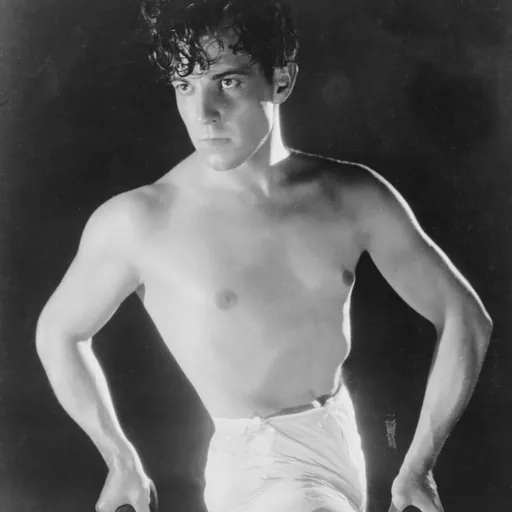
About Ramón Novarro
Lived 1899 – 1968 (aged 69). Ramón Novarro was a Mexican actor, film director, screenwriter, television actor, film actor and stage actor.
Ramón Gil Samaniego Novarro's direct ancestors came from the Castilian town of Burgos, whence two brothers emigrated to the New World in the seventeenth century.
Allan Ellenberger, Novarro's biographer, writes:
The family estate was called the "Garden of Eden". Thirteen children were born there: Emilio; Guadalupe; Rosa; Ramón; Leonor; Mariano; Luz; Antonio; José; a stillborn child; Carmen; Ángel and Eduardo. He was a second cousin of the Mexican actresses Dolores del Río and Andrea Palma.
Career Silent films
Novarro began his film career in 1917, playing bit parts, supplementing his income by working as a singing waiter, a taxi dancer and as a dancer in revues choreographed by Ernest Belcher (father of Marge Champion). His friends, actor and director Rex Ingram and his wife, actress Alice Terry, began to promote him as a rival to Rudolph Valentino, and Ingram suggested he change his name to "Novarro". From 1923, he began to play more prominent roles. His role in Scaramouche (1923) brought him his first major success.
Novarro achieved his greatest success in 1925, in Ben-Hur. His revealing costumes caused a sensation. He was elevated into the Hollywood elite. As did many stars, Novarro engaged Sylvia of Hollywood as a physical therapist (although in her tell-all book, Sylvia erroneously claimed that Novarro slept in a coffin). With Valentino's death in 1926, Novarro became the screen's leading Latin actor, though ranked lower than his MGM contemporary John Gilbert as a leading man. Novarro was popular as a swashbuckler in action roles, and considered one of the great romantic lead actors of his day. He appeared with Norma Shearer in The Student Prince in Old Heidelberg (1927) and with Joan Crawford in Across to Singapore (1928).
Talking films He made his first talking film, starring as a singing French soldier, in Devil-May-Care (1929). He starred with Dorothy Janis in The Pagan (1929), with Greta Garbo in Mata Hari (1931), with Myrna Loy in The Barbarian (1933) and opposite Lupe Vélez in Laughing Boy (1934).
When his contract with MGM Studios expired in 1935 and the studio did not renew it, Novarro continued to act sporadically, appearing in films for Republic Pictures, a Mexican religious drama, and a French comedy. In January 1936 he even appeared for a week in a variety show at the Birmingham Hippodrome theatre in England, doing a song and dance act with his sister Carmen. In the 1940s, he had several small roles in American films, including We Were Strangers (1949), directed by John Huston and starring Jennifer Jones and John Garfield. In 1958, he was considered for a role in the television series The Green Peacock, with Howard Duff and Ida Lupino, after their CBS Television sitcom Mr. Adams and Eve (1957–58). The project, however, never materialized. A Broadway tryout was aborted in the 1960s. Novarro acted occasionally on television, appearing in NBC's The High Chaparral as late as 1968.
At the peak of his success in the late 1920s and early 1930s, Novarro was earning more than US$100,000 per film. He invested some of his income in real estate, and his Hollywood Hills residence, the Samuel-Novarro House, is one of the more renowned designs (1927) by Lloyd Wright, the son of Frank Lloyd Wright. When his career ended, he was still able to maintain a comfortable lifestyle.
Personal life
In 1925, Novarro purchased a home in "the exclusive West Adams district" of Los Angeles for $12,000 and spent an additional $100,000 on renovations.
Novarro was troubled all his life by his conflicted feelings toward his Roman Catholic faith and his homosexuality. His life-long alcoholism is often traced to these problems. In the early 1920s, Novarro had a romantic relationship with composer Harry Partch, who was working as an usher at the Los Angeles Philharmonic at the time, but Novarro broke off the affair as he achieved greater success as an actor. He was romantically involved with Hollywood journalist Herbert Howe, who was also his publicist in the late 1920s, and with a wealthy philanthropist and arts patron from San Francisco, Noël Sullivan.
Murder Novarro was murdered on October 30, 1968, by brothers Paul and Tom Ferguson, aged 22 and 17, who called him and offered their sexual services. In the past, he had hired prostitutes from an agency to come to his Laurel Canyon home for sex, and the Fergusons obtained Novarro's telephone number from a previous guest.
According to the prosecution in the murder case, the two young men believed that a large sum of money was hidden in Novarro's house. The prosecution accused the brothers of torturing Novarro for several hours to force him to reveal where the (non-existent) money was hidden. They left the house with $20 they took from his bathrobe pocket. Novarro died as a result of asphyxiation, having choked to death on his own blood after being beaten. The two perpetrators were caught and sentenced to long prison terms, but released on parole in the mid-1970s. Both were later re-arrested for unrelated crimes for which they served longer prison terms than for the murder of Novarro. In a 1998 interview, Paul Ferguson finally assumed the blame for Novarro's death.
Tom Ferguson died by suicide on March 6, 2005. Paul Ferguson died in prison in 2018, while serving out a 60-year sentence for rape in Missouri.
Novarro's death later became the subject of a persistent urban legend sparked by Kenneth Anger's gossip book Hollywood Babylon, which falsely claimed Novarro choked on an Art Deco dildo given to him by Rudolph Valentino. In reality, law enforcement records show no sex toys were ever involved.
Novarro's body is buried in Calvary Cemetery, East Los Angeles, California. His star on the Hollywood Walk of Fame is at 6350 Hollywood Boulevard.
Legacy Greek playwright Pavlos Matesis wrote a play in two parts titled The Ghost of Mr. Ramon Novarro, which was first staged at the National Theatre of Greece in 1973. In late 2005, the Wings Theatre in New York City staged the world premiere of Through a Naked Lens by George Barthel. The play combined fact and fiction to depict Novarro's rise to fame and his relationship with Hollywood journalist Herbert Howe. The Charles Bukowski short story, "The Murder of Ramon Vasquez," was heavily influenced by the killing of Novarro.
Filmography
+ Film Year Title Role Notes 1916 Joan the Woman Starving Peasant Uncredited 1917 The Jaguar's Claws Bandit Uncredited Lost film The Little American Wounded Soldier Uncredited The Hostage Uncredited Lost film The Woman God Forgot Aztec man Uncredited 1918 The Goat Uncredited Lost film 1921 A Small Town Idol Dancer as Ramón Samaniego The Concert Dancing shepherd Uncredited Lost film The Four Horsemen of the Apocalypse Guest at Ball (extra) Uncredited Man-Woman-Marriage Dancer Uncredited Lost film 1922 Mr. Barnes of New York Antonio as Ramon Samaniego The Prisoner of Zenda Rupert of Hentzau as Ramon Samaniegos Trifling Women Henri / Ivan de Maupin Lost film 1923 Where the Pavement Ends Motauri Lost film Scaramouche André-Louis Moreau, Quintin's Godson 1924 Thy Name Is Woman Juan Ricardo The Arab Jamil Abdullah Azam The Red Lily Jean Leonnec 1925 A Lover's Oath Ben AliLost film, but A.M.P.A.S. has 25 feet of this film The Midshipman Dick Randall Ben-Hur: A Tale of the Christ Judah Ben-Hur 1927 Lovers José Lost film The Student Prince in Old Heidelberg Crown Prince Karl Heinrich The Road to Romance José Armando 1928 Across to Singapore Joel Shore A Certain Young Man Lord Gerald Brinsley Lost film Forbidden Hours His Majesty, Michael IV 1929 The Flying Fleet Ens. / Ltjg Tommy Winslow The Pagan Henry Shoesmith Jr. Devil-May-Care Armand de Treville 1930 In Gay Madrid Ricardo The March of Time Himself Unfinished film Call of the Flesh Juan de Dios Sevilla de mis amores Juan de Dios Carbajal Spanish version of Call of the Flesh 1931 Le chanteur de Séville Juan French version of Call of the Flesh Daybreak Willi Kasder Son of India Karim Mata Hari Lt. Alexis Rosanoff Wir schalten um auf Hollywood Himself 1932 Huddle Antonio "Tony" Amatto The Son-Daughter Tom Lee / Prince Chun 1933 The Barbarian Jamil El Shehab 1934 The Cat and the Fiddle Victor Florescu Laughing Boy Laughing Boy 1935 The Night Is Young Archduke Paul "Gustl" Gustave 1936 Against the Current Director, writer 1937 The Sheik Steps Out Ahmed Ben Nesib 1938 A Desperate Adventure André Friezan Alternative title: It Happened in Paris 1940 La Comédie du bonheur Félix Ecco la felicità Felice Ciatti Italian version of La comédie du bonheur 1942 The Saint Who Forged a Country Juan Diego 1949 We Were Strangers Chief The Big Steal Inspector General Ortega 1950 The Outriders Don Antonio Chaves Crisis Colonel Adragon 1960 Heller in Pink Tights De Leon
+ Television Year Title Role Notes 1958 Disney's Wonderful World Don Esteban Miranda 2 episodes 1962 Thriller Maestro Giuliano Episode: "La Strega" 1964 Dr. Kildare Gaspero Paolini 3 episodes 1964–1965 Combat! Charles GireauxCount De Roy 2 episodes "Silver Service" & "Finest Hour" 1965 Bonanza Jose Ortega Episode: "The Brass Box" 1967 The Wild Wild West Don Tomas Episode: "The Night of the Assassin" 1968 The High Chaparral Padre Guillermo Episode: "A Joyful Noise", (final appearance)
Don’t just read it —
keep it.
Full-length biographies made to live with: read them, listen on the way to work, watch them tonight.
- E-book
- Audio
- Video
Instant download · yours to keep · every purchase keeps this site free
Important facts
People in Ramón Novarro's life
Named in this biography and alive at the same time





Related people
Same field, nearest in time


Contemporaries
People whose lives overlapped Ramón Novarro's




Frequently asked questions
Who was Ramón Novarro?
Mexican actor (1899–1968)
When was Ramón Novarro born?
Ramón Novarro was born on 6 February 1899 in Victoria de Durango.
When did Ramón Novarro die?
Ramón Novarro died on 30 October 1968 in Hollywood.
What was Ramón Novarro's occupation?
Ramón Novarro was an actor, film director, screenwriter, television actor, film actor and stage actor.
What nationality was Ramón Novarro?
Ramón Novarro was Mexican.
Sources & further reading
Cite this page
APA: Biography.guide. (2026). Ramón Novarro. https://biography.guide/ramon-novarro/
MLA: "Ramón Novarro." Biography.guide, https://biography.guide/ramon-novarro/.
Chicago: "Ramón Novarro." Biography.guide. https://biography.guide/ramon-novarro/.
Data last updated: 2026-09-23 · Spot an error? Report a correction.
Portrait: Wikimedia Commons · author & licence
Page generated 2026-09-27 05:06 UTC