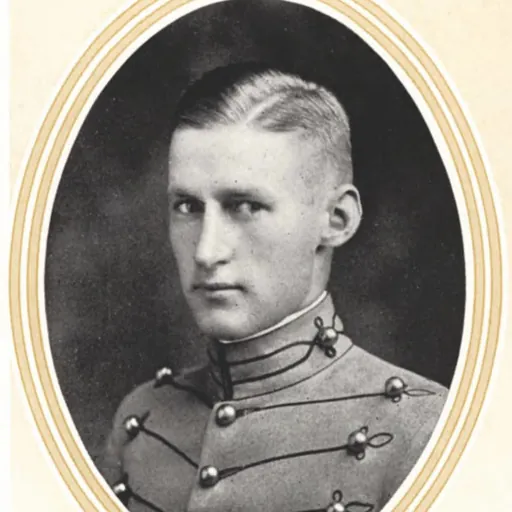
About Ralph P. Cousins
Lived 1891 – 1964 (aged 72). Ralph P. Cousins was an American military personnel.
Ralph Pittman Cousins (1 December 1891 – 15 March 1964) was a United States Army major general Born in Mexia, Texas, he graduated from the United States Military Academy in 1915. He served in the Cavalry before transferring to the United States Army Air Corps. He served in a variety of command positions in the newly created air service of the United States Army and was instrumental in designing the model for what would become the commercial aviation system. Schools under his command trained many of the aircrews who served in all theaters of World War II. After retiring from the army, he became a businessman. Cousins died in 1964 and he was memorialized as an air pioneer who helped bring American air power from it beginnings to its power in World War II.
Early life and education
Cousins was born on 1 December 1891, in Mexia, Texas, to Robert Bartow and Dora M. (Kelly) Cousins.
On 14 June 1911, he began his studies at the United States Military Academy at West Point, New York. He graduated on 12 June 1915, as a member of the class the stars fell on; his rank in the class was 129 of 164 and his Cullum number is 5441.
Career Pre-war Cousins was commissioned as a second lieutenant of Cavalry on 12 June 1915. He was assigned to the 12th Cavalry in Brownsville, Texas, in September 1915 and performed border patrol activities, including actions against Mexican bandits, until February 1916, when he was transferred to the 6th Cavalry. Cousins participated in the Punitive Expedition into Mexico. He was promoted to the first lieutenant of Cavalry on 1 July 1916 and was transferred to the Big Bend District, Texas later that month.
In August 1916, Cousins was assigned to the Signal Corps Aviation School in San Diego, California. He graduated in May 1917 and was assigned to the 1st Aero Squadron as a pilot. From 16 May to 12 September 1917, he organized the School of Military Aeronautics in Austin, Texas, and became its commandant. While assigned to the school, he was promoted to captain on 25 July 1917. From 12 September to 8 December 1917, he was assigned to the Office of the Chief Signal Officer, Washington, D.C.
Inter-war years Cousins was assigned as the commanding officer of Payne Field, West Point, Mississippi from 4 January 1919 to 1 June 1919 and as the commanding officer of the 1st Bombardment Group at Kelly Field, Texas from 15 June 1919 until September 1920. During this period, he was returned to the rank of captain of Cavalry on 27 February 1920, transferred to the Air Service on 1 July 1920 and received a temporary promotion to major of the Air Service on 18 July 1920. Cousins was a member of the advisory board, Chief Air Service in Washington, D.C., from September 1920 to August 1921.
From August 1921 to June 1922, Cousins was assigned as a student officer at Yale University, where he was graduated with a Master of Science degree. Following his graduation, he was assigned as a student officer at General Electric Company, Schenectady, New York from June 1922 through January 1923. While at Schenectady he was returned to the rank of captain of the Air Service on 4 November 1922. During 1923, he supervised Air Corps communications and the installation of radios for the Air Corps Model Airway, which operated between four United States cities; this model was the core of what became the commercial aviation system. He attended the Army Command and General Staff School at Fort Leavenworth, Kansas, graduating on 22 May 1933; while a student he wrote "Tannenberg: a failure to command," a paper analyzing the failure of the command of the Russian Second Army before and during the battle of Tannenberg. After graduating from the Command and General Staff School, Cousins returned to Washington, D.C. for duty in charge of National Guard aviation units with the National Guard Bureau until late in 1936; during this assignment, he received a temporary promotion to lieutenant colonel in the Air Corps on 16 June 1936 and a permanent promotion to that rank on 22 December.
World War II On 7 December 1941 (Pearl Harbor Day), Army Air Force Western Flying Training Command was operating six army flying schools and nine civilian contract flying schools. Cousins assumed command on 1 February 1942. Cousins commanded the unit until 15 August 1945. In October 1956, Cousins, who had become president of the board of commissioners, announced that the design of the new airport had been approved by the board following a $159 million bond issue.
In January 1950, Cousins was serving as chairman of the Southern California United Service Organizations.
On 15 March 1964, Cousins was stricken while on his ranch near Indio, California. He was transported to Casitas Hospital in Indio where he died later that day. Funeral services for Cousins were conducted at All Saints Episcopal Church, Beverly Hills, California and he was buried with full military honors, including a flyover, at Forest Lawn Memorial Park, Los Angeles. He was memorialized by the West Point Association of Graduates as an air pioneer who helped bring American air power from it beginnings to its power in World War II Mexican Service Medal World War I Victory Medal American Campaign Medal World War II Victory Medal Cloud and Banner (China), grade not specified
Each of the nine grades of the Order of the Cloud and Banner features a unique ribbon
Don’t just read it —
keep it.
Full-length biographies made to live with: read them, listen on the way to work, watch them tonight.
- E-book
- Audio
- Video
Instant download · yours to keep · every purchase keeps this site free
Important facts
Related people
Same field, nearest in time





Contemporaries
People whose lives overlapped Ralph P. Cousins's


Frequently asked questions
Who was Ralph P. Cousins?
US Army general
When was Ralph P. Cousins born?
Ralph P. Cousins was born on 1 December 1891 in Mexia.
When did Ralph P. Cousins die?
Ralph P. Cousins died on 15 March 1964 in Indio.
What was Ralph P. Cousins's occupation?
Ralph P. Cousins was a military personnel.
What nationality was Ralph P. Cousins?
Ralph P. Cousins was American.
Sources & further reading
Cite this page
APA: Biography.guide. (2026). Ralph P. Cousins. https://biography.guide/ralph-p-cousins/
MLA: "Ralph P. Cousins." Biography.guide, https://biography.guide/ralph-p-cousins/.
Chicago: "Ralph P. Cousins." Biography.guide. https://biography.guide/ralph-p-cousins/.
Data last updated: 2026-09-20 · Spot an error? Report a correction.
Portrait: Wikimedia Commons · author & licence
Page generated 2026-09-27 04:58 UTC