
Ralph de Cromwell, 3rd Baron Cromwell
English politician and diplomat
About Ralph de Cromwell, 3rd Baron Cromwell
Lived 1393 – 1456 (aged 62–63). Ralph de Cromwell, 3rd Baron Cromwell was an English diplomat and politician.
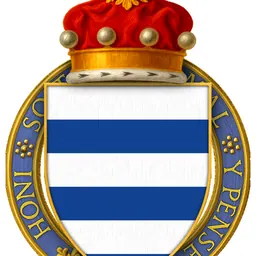
Arms of Cromwell of Tattershall: Argent, a chief gules overall a bend azure.
Tattershall Castle, Lincolnshire was the seat of Ralph de Cromwell, 3rd Baron Cromwell (1403–1455) Ralph de Cromwell, 3rd Baron Cromwell ( – 4 January 1456) was an English politician and diplomat. A Privy Councillor from 1422, he served as Treasurer of England (1433–1443) and twice as Chamberlain of the Household (1425–1432 and 1450–1455) during the reign of Henry VI.
He also owned and developed a number of properties, including Tattershall Castle in Lincolnshire.
Origins He was the son of Ralph de Cromwell, 2nd Baron Cromwell by his wife Joan Grey, daughter of the chronicler Thomas Grey.
Early life In his youth, he served in the household of Thomas, Duke of Clarence and joined him when his army crossed into Normandy in August 1412.
Cromwell served Henry V at the Battle of Agincourt in 1415, and throughout the reign, he continued fighting in France. In 1417 he was present when Henry took Caen by assault, and subsequently acted as Clarence's lieutenant and constable of the army. He was present at the capture of Courtonne on 6 March 1418, of Chambrays on the 9th, and of Rivière-Thibonville on the 11th. In May 1420 he was one of the commissioners who assisted Henry in negotiating the Treaty of Troyes.
Politics Cromwell gained the confidence of Henry V and of his brother John, Duke of Bedford, and during the minority of Henry VI, he gained an important position among the lords of the council.
He was first summoned to parliament on 29 September 1422, and in November he was one of the lords appointed in parliament to form the council of regency. Soon afterwards he was appointed Chamberlain of the Household, and on 29 January 1426, he was one of those sent to mediate with Humphrey, Duke of Gloucester and reconcile him with Cardinal Beaufort.
He seems to have generally sided with Beaufort against Gloucester, and on 1 March 1432, during Beaufort's absence in France, Gloucester seized the opportunity to remove the cardinal's friends from office and Cromwell lost the Chamberlainship. In the following May he was warned not to bring more than his usual retinue to parliament, but on 16 June, following Beaufort's example, he laid his case before the House of Lords.
He complained that he had been dismissed without cause shown and contrary to the ordinances of 1429, by which the council's proceedings were regulated. He appealed to testimonials from Bedford as to the value of his services in France, but an assurance that he left office without a stain on his character was all the satisfaction he could get.
In the summer of 1433, Bedford returned to England, and during his visit, the disgraced ministers were restored to power, with Cromwell made Treasurer of England. During his tenure, the French war was the single biggest drain on resources, and the crown debt significantly increased despite his attempts to rein in spending and introduce reforms. Cromwell's tenure as Lord High Treasurer also occurred during the Great Bullion Famine and the beginning of the Great Slump in England. In July 1443 Cromwell resigned his post as Treasurer, possibly due to the rising influence of William de la Pole, Duke of Suffolk, who now succeeded Beaufort as the most influential adviser of the king. Instead he took the position of Chamberlain of the Exchequer, a post he held until 1455.
Cromwell does not again come prominently forward until 1449. One of Suffolk's partisans was William Tailboys, a Lincolnshire squire, with whom Cromwell had had some local disputes; and on 28 November 1449, Cromwell was attacked by Tailboys. Cromwell began legal proceedings against Tailboys, but was blocked by Suffolk, against whom Cromwell seemingly began impeachment proceedings. Tailboys was sent to the Tower of London and later convicted in February 1450. the college, the Holy Trinity church and two almshouses.
Cromwell acquired a manor in Wymondham in Norfolk which still bears his name today.
Marriage, death and burial At some time before 1433, he married Margaret Deincourt (d.1454), daughter and co-heiress with her sister Alice of John Deincourt, 12th Baron Deincourt, without children.
Cromwell died on 4 January 1456 at South Wingfield in Derbyshire and was buried at Holy Trinity Church, Tattershall. daughters of his only sister Maud, second wife of Sir Richard Stanhope: Maud Stanhope (d.1497), elder niece and eventual sole heiress, who married firstly Robert Willoughby, 6th Baron Willoughby de Eresby; secondly Sir Thomas Neville, son of Richard Neville, 5th Earl of Salisbury; and thirdly Sir Gervase Clifton. Joan Stanhope (d.1490), younger niece, who married firstly Sir Humphrey Bourchier, son of Henry Bourchier, 1st Earl of Essex, who was summoned to Parliament from 1461 to 1471 as Lord Cromwell or Lord Bourchier de Cromwell; and secondly Sir Robert Radcliffe of Hunstanton. Following Joan's death in 1490, Maud became the sole heiress and succeeded to the barony. Tattershall Castle was inherited by Joan, but was confiscated by the crown following the death of her husband.
Don’t just read it —
keep it.
Full-length biographies made to live with: read them, listen on the way to work, watch them tonight.
- E-book
- Audio
- Video
Instant download · yours to keep · every purchase keeps this site free
Important facts
People in Ralph de Cromwell, 3rd Baron Cromwell's life
Named in this biography and alive at the same time


Related people
Same field, nearest in time



Contemporaries
People whose lives overlapped Ralph de Cromwell, 3rd Baron Cromwell's


Frequently asked questions
Who was Ralph de Cromwell, 3rd Baron Cromwell?
English politician and diplomat
When was Ralph de Cromwell, 3rd Baron Cromwell born?
Ralph de Cromwell, 3rd Baron Cromwell was born in 1393 in Lincolnshire.
When did Ralph de Cromwell, 3rd Baron Cromwell die?
Ralph de Cromwell, 3rd Baron Cromwell died on 4 January 1456 in South Wingfield.
What was Ralph de Cromwell, 3rd Baron Cromwell's occupation?
Ralph de Cromwell, 3rd Baron Cromwell was a diplomat and politician.
What nationality was Ralph de Cromwell, 3rd Baron Cromwell?
Ralph de Cromwell, 3rd Baron Cromwell was English.
Sources & further reading
· Wikipedia: Ralph de Cromwell, 3rd Baron Cromwell
· DBpedia: Ralph Cromwell, 3rd Baron Cromwell
Cite this page
APA: Biography.guide. (2026). Ralph de Cromwell, 3rd Baron Cromwell. https://biography.guide/ralph-de-cromwell-3rd-baron-cromwell/
MLA: "Ralph de Cromwell, 3rd Baron Cromwell." Biography.guide, https://biography.guide/ralph-de-cromwell-3rd-baron-cromwell/.
Chicago: "Ralph de Cromwell, 3rd Baron Cromwell." Biography.guide. https://biography.guide/ralph-de-cromwell-3rd-baron-cromwell/.
Data last updated: 2026-09-20 · Spot an error? Report a correction.
Page generated 2026-09-27 05:34 UTC