
About Rahotep
Born 1650 BC. Rahotep was an Egyptian statesperson.
Sekhemre Wahkhau Rahotep was an Egyptian pharaoh who reigned during the Second Intermediate Period, when Egypt was ruled by multiple kings. The Egyptologists Kim Ryholt and Darrell Baker believe that Rahotep was the first king of the 17th Dynasty. The stela appears to have been made at a workshop at Abydos. Other stelae produced by this workshop belong to king Sekhemrekhutawy Pantjeny and king Wepwawetemsaf. All three kings reigned therefore quite close in time.
Coptos Petrie Museum UC 14327 Rahotep is known from a stele found at Coptos reporting the restoration of the temple of Min. The stele reads:
Bow of King's Son Ameny Rahotep is mentioned on a bow of a king's son Ameny dedicated to "the service of Min in all his feasts" at Coptos.
Non-Contemporary Attestations Karnak King List In the Thutmosid Period, he is mentioned in the Karnak King List #48 as "[Sekhem]re Wahkhau" {[sḫm]-rꜤ wꜢḥ-ḫꜤw}, between Khaankhre Sobekhotep and Sewahenre Senebmiu.
Turin King List In the Ramesside Period, he is not mentioned in the Turin King List.
Konsuemheb and the Ghost In the late New Kingdom tale Khonsuemheb and the Ghost, the protagonist encounters a ghost who claims to have been in life "Overseer of the treasuries of king Rahotep". However, the ghost also claims to have died in regnal Year 14 of a later king Mentuhotep. These statements seem to contradict each other since none of Rahotep's successors named Mentuhotep are known to have reigned for so long, thus making the identification of both these kings problematic.
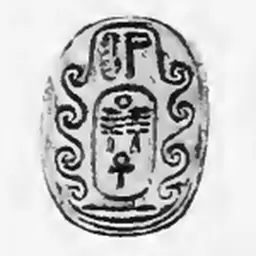
Theories Two scarabs bearing the inscription "Rahotep", believed by Flinders Petrie to be referring to this king. While Ryholt and Baker propose that Rahotep was the first king of the 17th Dynasty, Jürgen von Beckerath sees him as the second king of that dynasty. Alternatively, Claude Vandersleyen has tentatively dated Rahotep to the 13th Dynasty on the grounds that he believes Rahotep to be related to Sobekemsaf I, which Vandersleyen also dates to the 13th Dynasty because of the quality and number of statues attributable to him. Baker deems these arguments "slim and rejected by most scholars". In Abydos, he had the enclosure walls of the temple of Osiris renewed and in Coptos he restored the temple of Min of which "gates and doors [have] fallen into ruins". This chronology of events is debated and some scholars contest that Thebes was ever conquered by the Hyksos. Rather, they believe the kings of Upper Egypt could have been vassals of the Hyksos.
Don’t just read it —
keep it.
Full-length biographies made to live with: read them, listen on the way to work, watch them tonight.
- E-book
- Audio
- Video
Instant download · yours to keep · every purchase keeps this site free
Important facts
Related people
Same field, nearest in time



Frequently asked questions
Who was Rahotep?
Egyptian pharaoh of the 17th dynasty
When was Rahotep born?
Rahotep was born in 1650 BC.
What was Rahotep's occupation?
Rahotep was a statesperson.
What nationality was Rahotep?
Rahotep was Egyptian.
Sources & further reading
· DBpedia: Sekhemre Wahkhau Rahotep
Cite this page
APA: Biography.guide. (2026). Rahotep. https://biography.guide/rahotep/
MLA: "Rahotep." Biography.guide, https://biography.guide/rahotep/.
Chicago: "Rahotep." Biography.guide. https://biography.guide/rahotep/.
Data last updated: 2026-09-20 · Spot an error? Report a correction.
Page generated 2026-09-27 05:34 UTC