
About Djehuti
Born 1650 BC. Djehuti was an Egyptian statesperson.
Family Due to a cosmetic box with the names of Djehuti found in the tomb of Queen Mentuhotep, it has been speculated that she was his king's wife.
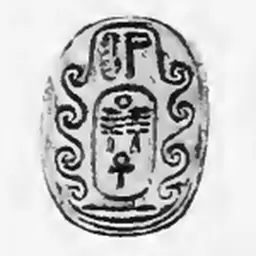
Attestations Contemporary attestations Cosmetics box of queen Mentuhotep, wife of Djehuti. The box may have been intended to be the king's canopic chest. All of Djehuti's contemporary attestions come from Upper Egypt, within a long stretch of the Nile valley from Deir el-Ballas in the north to Edfu in the south.
The Turin King List does not directly mention Djehuty, but there are several partial entries starting with Sekhemre. Thus he is sometimes associated with Turin King List 11:1.
Theories Burial It has been suggested that the unattributed Southern South Saqqara pyramid may have been built for Djehuti. This hypothesis is based on a fragmentary inscription found within the pyramid and reading "Weserkha...", a possible reference to Weserkhau i.e. Djehuti's Golden Horus name. This pyramid is in the Memphis-Faiyum region, while Djehuty is mainly attested in the Thebaid region.
Chronology Djehuti's dynasty remains debated. Indeed, on this point, the Turin Canon is open to interpretations. There are several kings recorded with the name "Sekhemre[...]" and the damage to the original document does not preserve the complete name. As a result, Djehuti, named Sekhemre Sementawy, may in principle correspond to any "Sekhemre[...]" preserved on the king list, i.e. may be a ruler of the 13th, 16th and even 17th Dynasty.
The Egyptologists Darrell Baker and Kim Ryholt believe that he was part of the 16th Dynasty, which controlled the Theban region after 1650 BC. Geisen's datation relies on stylistic considerations of his queen's coffin, which however, Stephen Quirke argues, uses unproven assumptions. An older theory of Jürgen von Beckerath, whose conclusions are shared by Hans Stock, contends that Djehuti was a ruler of the early 17th Dynasty, which arose in Upper Egypt after the collapse of 16th Dynasty following the short-lived Hyksos conquest of Thebes. This theory is supported by the discovery of the tomb of Djehuti's queen, Mentuhotep, which is located in Dra' Abu el-Naga', a necropolis usually associated with the 17th Dynasty. Scholars such as Chris Bennett however, point out that this does not necessarily mean that Djehuti was buried in Dra' Abu el-Naga' as well.
Relationships Some Egyptologists proposed that Djehuti was married to a granddaughter of the vizier Ibiaw who served under the 13th Dynasty king Wahibre Ibiau 1712–1701 BC, and was thus most likely two generations removed from this king. In more recent times, however, it was pointed out that the link between Ibiaw and Djehuti's consort Mentuhotep is still unproven and that the proposed temporal correlation between Wahibre Ibiau and Djehuti remains conjectural.
Don’t just read it —
keep it.
Full-length biographies made to live with: read them, listen on the way to work, watch them tonight.
- E-book
- Audio
- Video
Instant download · yours to keep · every purchase keeps this site free
Important facts
Related people
Same field, nearest in time



Frequently asked questions
Who was Djehuti?
Egyptian Pharaoh of the 16th or 17th dynasty
When was Djehuti born?
Djehuti was born in 1650 BC.
What was Djehuti's occupation?
Djehuti was a statesperson.
What nationality was Djehuti?
Djehuti was Egyptian.
Sources & further reading
· DBpedia: Sekhemre Sementawy Djehuty
Cite this page
APA: Biography.guide. (2026). Djehuti. https://biography.guide/djehuti/
MLA: "Djehuti." Biography.guide, https://biography.guide/djehuti/.
Chicago: "Djehuti." Biography.guide. https://biography.guide/djehuti/.
Data last updated: 2026-09-20 · Spot an error? Report a correction.
Page generated 2026-09-27 05:30 UTC