Ragnall mac Somairle
King of the Isles, Lord of Argyll, Lord of Kinytre
About Ragnall mac Somairle
Lived 1140 – 1209 (aged 68–69).
Ragnall mac Somairle (also known in Gaelic as Raghnall, Raonall, Raonull; in English as Ranald; in Latin as Reginaldus; and in Old Norse as Rögnvaldr, Røgnvaldr, Rǫgnvaldr; died 1191/1192 – 1210/1227) was a significant late-twelfth-century magnate, seated on the western seaboard of Scotland. He was probably a younger son of Somairle mac Gilla Brigte, Lord of Argyll and his wife, Ragnhildr, daughter of Óláfr Guðrøðarson, King of the Isles. The twelfth-century Kingdom of the Isles, ruled by Ragnall's father and maternal grandfather, existed within a hybrid Norse-Gaelic milieu, which bordered an ever-strengthening and consolidating Kingdom of Scots.
In the mid-twelfth century, Somairle rose in power and won the Kingdom of the Isles from his brother-in-law. After Somairle perished in battle against the Scots in 1164, much of his kingdom was probably partitioned between his surviving sons. Ragnall's allotment appears to have been in the southern Hebrides and Kintyre. In time, Ragnall appears to have risen in power and became the leading member of Somairle's descendants, the meic Somairle (or Clann Somairle). Ragnall is known to have styled himself "King of the Isles, Lord of Argyll and Kintyre" and "Lord of the Isles". His claim to the title of king, like other members of the meic Somairle, is derived through Ragnhildr, a member of the Crovan dynasty.
Ragnall disappears from record after he and his sons were defeated by his brother Áengus. Ragnall's death date is unknown, although certain dates between 1191 and 1227 are all possibilities. Surviving contemporary sources reveal that Ragnall was a significant patron of the Church. Although his father appears to have aligned himself with traditional forms of Christianity, Ragnall himself is associated with newer reformed religious orders from the continent. Ragnall's now non-existent seal, which pictured a knight on horseback, also indicates that he attempted to present himself as an up-to-date ruler, not unlike his Anglo-French contemporaries of the bordering Kingdom of Scots.
Ragnall is known to have left two sons, Ruaidrí and Domnall, who went on to found powerful Hebridean families. Either Ragnall or Ruaidrí had daughters who married Ragnall's first cousins Rǫgnvaldr and Óláfr, two thirteenth-century kings of the Crovan dynasty.
Origins of the meic Somairle
Map of the divided Kingdom of the Isles, 1200. The lands of the Crovan dynasty bordering those of the meic Somairle
Ragnall was a son of Somairle mac Gilla Brigte, Lord of Argyll (died 1164) and his wife, Ragnhildr, daughter of Óláfr Guðrøðarson, King of the Isles. Somairle and Ragnhildr had at least three sons: Dubgall (died after 1175), Ragnall, Áengus (died 1210), and probably also a fourth, Amlaíb. Dubgall appears to have been the couple's eldest son. Little is certain of the origins of Ragnall's father, although his marriage suggests that he belonged to a family of some substance. In the first half of the twelfth century, the Hebrides and the Isle of Man (Mann) were encompassed within the Kingdom of the Isles, which was ruled by Somairle's father-in-law, a member of the Crovan dynasty. Somairle's rise to power may well have begun at about this time, as the few surviving sources from the era suggest that Argyll may have begun to slip from the control of King David I of Scotland (died 1153).
Somairle first appears on record in 1153, when he rose in rebellion with his nephews, the sons of the royal pretender Máel Coluim mac Alaxandair (fl. 1134), against the recently enthroned Máel Coluim IV, King of Scots (died 1165). In the same year, Somairle's father-in-law was murdered after ruling the Kingdom of the Isles about forty years. Óláfr was succeeded by his son, Guðrøðr; and sometime afterwards, Somairle participated in a coup within the kingdom by presenting Dubgall as a potential king. In consequence, Somairle and his brother-in-law fought a naval battle in 1156, after which much of the Hebrides appear to have fallen under Somairle's control. Two years later, he defeated Guðrøðar outright and took control of the entire island-kingdom. In 1164, Somairle again rose against the King of Scots, and is recorded in various early sources to have commanded a massive invasion force of men from throughout the Isles, Argyll, Kintyre and Scandinavian Dublin. Somairle's host sailed up the Clyde, and made landfall near what is today Renfrew, where they were crushed by the Scots, and he himself was slain. Following Somairle's demise, Guðrøðr returned to the Isles and seated himself on Mann, although the Hebridean-territories won by Somairle in 1156 were retained by his descendants, the meic Somairle.
Although contemporary sources are silent on the matter, it is more than likely that on Somairle's demise, his territory was divided amongst his surviving sons.
Internal conflict
Little is known of Somairle's descendants in the decades following his demise. Dubgall does not appear on record until 1175, when he is attested far from the Isles in Durham, by the Durham Cathedral's Liber Vitae. Nothing is certain of Dubgall's later activities, and it is possible that, by the 1180s, Ragnall had begun to encroach upon Dubgall's territories and his position as head of the meic Somairle. The fact that Dubgall is not accorded any title by the Liber Vitae could be evidence that Ragnall had displaced him upon Somairle's demise, or that the chronicle's account of Dubgall's connection with the kingship is merely the work of thirteenth-century bias favouring the powerful meic Dubgaill, Dubgaill's descendants.
In 1192, the Chronicle of Mann records that Ragnall and his sons were defeated in a particularly bloody battle against Áengus. The chronicle does not identify the location of the battle, or elaborate under what circumstances it was fought. However, it is possible that the conflict took place in the northern part of the meic Somairle domain, where some of Áengus' lands may have lain. Although the hostile contact between Ragnall and Áengus could have been result of Ragnall's rise in power at Dubgall's expense, the clash of 1192 may also mark Ragnall's downfall.
One of several ecclesiastical sources that deal specifically with Ragnall is an undated grant to the Cluniac priory at Paisley. Since this grant probably dates to the period after Ragnall's defeat to Áengus, it may be evidence of an attempt made by Ragnall to secure an alliance with Alan fitz Walter, Steward of Scotland (died 1204). The patrons of this priory were members of Alan's own family, a powerful kindred that had recently begun to expand its influence westwards from Renfrew, to the frontier of the Scottish realm and the fringes of Argyll. Since Bute seems to have fallen into the hands of this kindred at about the time of Ragnall's grant, it is possible that Alan took advantage of the internal conflict between the meic Somairle, and seized the island before 1200. Alternately, Alan may have received the island from Ragnall as payment for military support against Áengus, who appears to have gained the upper hand over Ragnall by 1192. Alan's expansion and influence in territories outwith the bounds of the Scottish kingdom may have been perceived as a threat by King William the Lion (died 1214), and may partly explain the king's construction of a royal castle at Ayr in 1195. This fortress extended Scottish royal authority into the outer Firth of Clyde region, and was probably intended to dominate not only William's peripheral barons, but also independent rulers just beyond the borders of the Scottish realm. In fact, Alan's westward expansion appears to have suddenly ceased at about 1200, and may have been a consequence of royal anxiety concerning an alliance with Ragnall.
Titles and seal
A royal inspection of Saddell Abbey, dated to 1508, reveals that Ragnall styled himself in a Latin charter to the abbey rex insularum, dominus de Ergile et Kyntyre ("King of the Isles, Lord of Argyll and Kintyre"), In what is probably a later charter, Ragnall is styled in Latin dominus de Inchegal ("Lord of the Isles") in his grant to the priory of Paisley. Although Ragnall's abandonment of the title "king" in favour of "lord" may not be significant, it could be connected with his defeat to Áengus, or to the expansion and rise in power of Ragnall's namesake and first cousin Rǫgnvaldr Guðrøðarson, King of the Isles (died 1229). The style dominus de Inchegal is not unlike dominus Insularum ("Lord of the Isles"), a title first adopted in 1336 by Ragnall's great-great-grandson, Eoin Mac Domhnaill, Lord of the Isles (died c. 1387), the first of four successive Lords of the Isles.
Ragnall's grant to the priory of Paisley is preserved in two documents: one dates to the late twelfth or early thirteenth century, and a later copy is contained in an instrument which dates to 1426. Appended to the latter document is a description of a seal impressed in white wax, which the fifteenth-century notary alleged to have belonged to Ragnall. On one side, the seal is described to have depicted a ship, filled with men-at-arms. On the reverse side, the seal was said to have depicted a man on horseback, armed with a sword in his hand.
Ragnall is the only member of the meic Somairle known to have styled himself in documents rex insularum. His use of both the title and seal are probably derived from those of the leading members of the Crovan dynasty, such as his namesake Rǫgnvaldr, who not only bore the same title but was said to have borne a similar two-sided seal. The descriptions of the cousins' seals shows that these devices combined the imagery of a Norse-Gaelic galley and an Anglo-French knight. The maritime imagery probably symbolised the power of a ruler of an island-kingdom, and the equestrian imagery appears to have symbolised feudal society, in which the cult of knighthood had reached its peak in the twelfth and early thirteenth centuries. The use of such seals by leading Norse-Gaelic lords, seated on the periphery of the kingdoms of Scotland and England, probably illustrates their desire to present themselves as up-to-date and modern to their contemporaries in Anglo-French society.
Norse-Gaelic namesake
Simplified family tree concerning the descendants of Óláfr Guðrøðarson, specifically his grandsons Ragnall and Rǫgnvaldr. The latter was almost certainly a paternal grandson of Affraic ingen Fergusa, and there is reason to suspect that Ragnall was a maternal grandson of Ingibjǫrg Hakonsdóttir.
The Gaelic Ragnall corresponds to the Old Norse Rǫgnvaldr. Both names were Latinised to Reginaldus. The fact that two closely related Hebridean rulers, Ragnall and Rǫgnvaldr, shared the same personal names, the same grandfather, and (at times) the same title, has perplexed modern historians and possibly mediaeval chroniclers as well.
Conquest in Caithness
A particular thorn in the side of the Scottish Crown at the turn of the thirteenth century was Haraldr Maddaðarson, Earl of Orkney and Caithness (died 1206). At some point in the last half of the twelfth century, Haraldr put aside his first wife, a daughter of an Earl of Fife, and married Hvarflǫð, a daughter of an Earl of Ross. The latter woman was a member of the powerful meic Áedha, a northern kindred who had been in open conflict with the Scottish Crown throughout the twelfth century. Previous Orcadian earls had extended influence into Ross,
Howden's account of events reveals that Haraldr and his family gained control of Moray early in 1196, and charter evidence suggests that William and royal forces were in the north that summer. Although the Chronicle of Melrose appears to indicate that Hvarflǫð and Haraldr's eldest son was defeated in 1197, it is possible that this event dates to 1196 instead and relates to William's aforesaid northern campaign. Fordun's account records that William successfully asserted royal power in the northern regions; and Howden's account species that the king stripped Haraldr of his lordship in Caithness, and handed it over to Haraldr Eiríksson, a claimant to the Orcadian earldom. At some point after this, Howden's account reveals that Haraldr overcame and killed Haraldr Eiríksson, and the Icelandic Annals specifically date the latter's fall to 1198.
Inscription of a galley depicted on Hedin Cross, a Manx runestone. The power of the kings of the Isles laid in their armed galley-fleets.
It may have been at this point where Rǫgnvaldr entered into the fray. Orkneyinga saga states that, once William learned that Haraldr had taken control of Caithness, Rǫgnvaldr was tasked by the king to intervene on the Scots' behalf. Having received the king's message, the saga records that Rǫgnvaldr duly gathered an armed host from the Isles, Kintyre, and Ireland, and went forth into Caithness and subdued the region. Howden's account appears to confirm Rǫgnvaldr's participation in the region, albeit under slightly different circumstances, as it states that Haraldr approached the king and attempted to purchase the earldom. William, however, refused the offer, after which Howden's version of events relates that "Reginaldus", the son of a Manx king, succeeded in purchasing the earldom.
Although Rǫgnvaldr was likely the sea-king who assisted the Scots against Haraldr, there is evidence suggesting that it may have been Ragnall instead. For example, the saga makes the erroneous statement that Rǫgnvaldr was descended from Ingibjǫrg Hakonsdóttir, a woman who was much more likely to have been Ragnall's grandmother than Rǫgnvaldr's. The saga also notes that Rǫgnvaldr's military force was partly gathered from Kintyre, which may be more likely of Ragnall than Rǫgnvaldr, since Ragnall is known to have specifically styled himself dominus Ergile et Kyntyre. A recent reanalysis of the main extant version of Howden's chronicle has shown, however, that this particular part of the text originally read in Latin Reginaldus filius rex de Man, and was later altered to include Somairle's name above the last three words. Since the source of the original manuscript probably read in Latin Reginaldus filius Godredi, the sea-king in question appears to have been Rǫgnvaldr rather than Ragnall. The jarlsaetten were people who possessed a claim to an earldom, in accordance with Norse custom, by right of their descent from previous earls. There are earlier instances of such claimants requesting Scottish kings for what they considered their birthright, and William certainly did this when he granted Caithness to Haraldr Eiríksson, a grandson of Rǫgnvaldr Kali Kolsson, Earl of Orkney. If Ragnall was indeed a descendant of Ingibjǫrg, a daughter of Haakon Paulsson, Earl of Orkney, he was directly descended from previous Scandinavian earls.
Scandinavian sojourn
There is another instance where an historical source mentions a man who could refer to either Ragnall or Rǫgnvaldr. The early thirteenth-century Bǫglunga sǫgur indicates at one point that men of two Norwegian factions decided to launch a raiding expedition into the Isles. One particular version of the sagas states that Rǫgnvaldr (styled "King of Mann and the Isles") and Guðrøðr (styled "King on Mann") had not paid their taxes due to the Norwegian kings. In consequence, the saga records that the Isles were ravaged until the two travelled to Norway and reconciled themselves with Ingi Bárðarson, King of Norway (died 1217), whereupon the two took their lands from Ingi as a lén or fief.
The aforesaid kings of Bǫglunga sǫgur most likely refer to Rǫgnvaldr and his son, Guðrøðr (died 1231), although it is not impossible that the king 'Rǫgnvaldr' in this source may instead refer to Ragnall, and that the king 'Guðrøðr' in it may actually refer to Rǫgnvaldr himself, since the latter's father was named Guðrøðr. Whatever the case, the events depicted in Bǫglunga sǫgur appear to show that, in the wake of destructive Norwegian activity in the Isles, which may have been some sort of officially sanctioned punishment from Scandinavia, Rǫgnvaldr and his son (or instead perhaps Ragnall and Rǫgnvaldr) travelled to Norway where they rendered homage to the Norwegian king, and made compensation for unpaid taxes.
Muchdanach and Murcardus
According to Hebridean tradition preserved by the seventeenth-century Sleat History, at one point during Ragnall's tenure his followers fought and slew a certain "Muchdanach", ruler of Moidart and Ardnamurchan, and thereby acquired the latter's lands. Muchdanach may be identical to a certain "Murcardus", a man described by the Chronicle of Mann as one whose "power and energy" were felt throughout the Kingdom of the Isles, and whose slaying is recorded in 1188, the year of Rǫgnvaldr's assumption of the kingship. The chronicle's brief account of Murcardus appears to reveal that he was a member of the kingdom's elite, but whether his killing was connected to Rǫgnvaldr's accession is unknown. If Muchdanach and Murcardus were indeed the same individual, the Sleat History would appear to preserve the memory of meic Somairle intrusion into Garmoran, and the episode itself may be an example of feuding between the meic Somairle and Crovan dynasty.
Ecclesiastical activities
The Diocese of Argyll
The ecclesiastical jurisdiction within the kingdom of Somairle's predecessors was the far-flung Diocese of the Isles. Little is known of its early history, although its origins may well lie with the Uí Ímair imperium. In the mid twelfth century, during the reign of Ragnall's maternal uncle Guðrøðr Óláfsson, King of the Isles (died 1187), the diocese came to be incorporated into the newly established Norwegian Archdiocese of Nidaros. In effect, the political reality of the Diocese of the Isles—its territorial borders and nominal subjection to Norway—appears to have mirrored that of the Kingdom of the Isles. Before the close of the twelfth century, however, evidence of a new ecclesiastical jurisdiction—the Diocese of Argyll—begins to emerge during ongoing contentions between the meic Somairle and the Crovan dynasty.
In the early 1190s, the Chronicle of Mann reveals that Cristinus, Bishop of the Isles, an Argyllman who was probably a meic Somairle candidate, was deposed and replaced by Michael (died 1203), a Manxman who appears to have been backed by Rǫgnvaldr. Cristinus' tenure appears to have spanned at least two decades, during a sustained period of meic Somairle power in the Isles. His downfall, however, came about at about time of the Crovan dynasty's resurgence under Rǫgnvaldr. The latter succeeded his father only years before, in 1187, and appears to have capitalised upon the infighting amongst the meic Somairle, and possibly even the downfall of Ragnall himself. In fact, the diocese first appears on record in Liber Censuum, a Papal document dating to the last decade of the twelfth century; and it is possible that Cristinus, or an unknown successor, or perhaps even Haraldr himself, was the first diocesan bishop. Whatever the case, Cristinus' tenure in the Isles may have witnessed an ecclesiastical reorientation, or shift of sorts, towards Argyll. the jurisdiction itself appears to have lain outwith the domain of Rǫgnvaldr's direct control, allowing the meic Somairle to readily act as religious patrons without his interference. Like the Kingdom of the Isles itself, the great geographic size of the Diocese of the Isles appears to have contributed to the alienation of outlying areas, and to its eventual disintegration. In fact, there is reason to suspect that portions of the new diocese were likewise detached from the Scottish dioceses of Dunblane, Dunkeld, and Moray. Although the Scottish Crown may have welcomed the formation of the new diocese, as it may have formed part of a plan to project Scottish royal authority into the region, the meic Somairle rulers of the region were in fact hostile to the Scots, and the diocese's seat on Lismore —albeit first recorded in the early fourteenth century —lay far outwith the Scottish king's sphere of influence. There is reason to suspect that the meic Somairle fostered the cult of this saint to promote the early diocese. First recorded in the early fourteenth century, the cathedral on Lismore appears to have been first constructed by the meic Dubgaill lords of Argyll. —such as Somerled, Dubgall, or Ragnall himself. Although the early diocese suffered from prolonged vacancies, as only two bishops are recorded to have occupied the see before the turn of the mid thirteenth century,
Iona Abbey, Iona Nunnery, and St Oran's Chapel
Iona Abbey was probably founded by Ragnall and the meic Somairle in the thirteenth century. Little of the present site dates to the thirteenth century. However, this date may well be too late for man who was an adult by 1164. Ragnall's grant to Paisley may leave clues to his fate. The similarity between this charter and another granted to the priory by his son, Domnall, may be evidence that the documents were drawn up at about the same time. If so, Ragnall's charter may be evidence that he survived his defeat at the hands of Áengus, and the two charters may indicate that Ragnall was nearing the end of his life. Ragnall's grant may also indicate that he entered into a confraternity with the monks at Paisley. If the charter was indeed granted near the end of his life, it is also possible that Ragnall ended his days there. Since the priory was one of the religious houses founded by the meic Somairle, his possible retirement there may partly explain why Ragnall disappears from record after 1192. This tradition cannot be correct due to its chronology, One possibility, however, is that the tradition may instead refer to an earlier earl—Uilleam mac Donnchada (died 1151–1154). If so, Ragnall's son, Domnall, may have been named after Uilleam's son, Domnall (died 1187).
Ragnall is known to have left two sons: Ruaidrí (died 1247?) and Domnall. Domnall's line, the meic Domnaill (or Clann Domnaill), went on to produce the powerful Lords of the Isles who dominated the entire Hebrides and expansive mainland-territories from the first half of the fourteenth to the late fifteenth centuries. Ruaidrí founded the meic Ruaidrí (or Clann Ruaidrí), a more obscure kindred who were seated in Garmoran. Ruaidrí seems to have been the senior of Ragnall's sons, and is first recorded by name in 1214. Four years previous, Áengus and his sons are recorded by the Chronicle of Mann to have been slain on Skye. This particular record could be evidence that Áengus had succeeded Ragnall, after which the latter's sons extinguished Áengus's line, and Ruaidrí assumed control of the meic Somairle succession.
It is very likely that either Ragnall or Ruaidrí had daughters who married Rǫgnvaldr and his younger half-brother, Óláfr Guðrøðarson (died 1237). The chronicle states that Rǫgnvaldr had Óláfr marry "Lauon", the daughter of a certain nobleman from Kintyre, who was also the sister of his own (unnamed) wife. The precise identification of this father-in-law is uncertain, although historical sources concerning the contemporary meic Somairle link this kindred with Kintyre more than any other region, and both Ragnall and Ruaidrí were contemporaneously styled "Lord of Kintyre". It is possible that the first marriage took place sometime before 1210, These unions appear to have been orchestrated to patch up relations between the meic Somairle and the Crovan dynasty, rival kindreds who had bitterly contested the kingship of the Isles for about sixty years. In fact, it is possible that Rǫgnvaldr's kingship was formally recognised by Ruaidrí, the leading meic Somairle dynast, who thereby established himself as a leading magnate within a reunified Kingdom of the Isles.
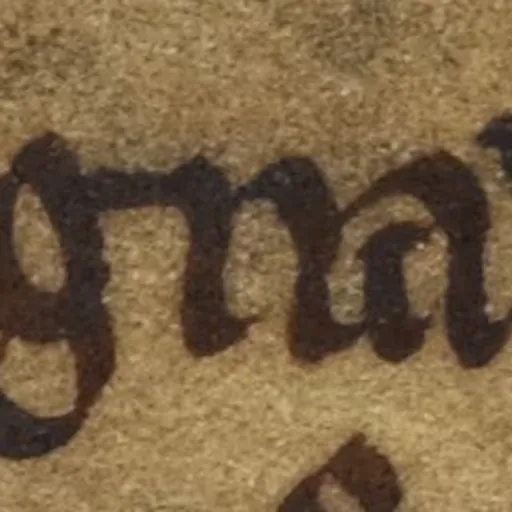
Ragnall's name as it appears on folio 62v of Bodleian Library MS Rawlinson B 489 (the Annals of Ulster). The particular annal-entry in question concerns military actions conducted by unnamed sons of Ragnall in 1212.
Ragnall is chiefly remembered in early modern Hebridean tradition as the genealogical link between Somairle and Domnall later's descendants. The latter statement may imply that Ragnall undertook (or planned to undertake) a pilgrimage or crusade. Although Ragnall's involvement in such an enterprise is not impossible, the claim is uncorroborated by contemporary sources. The mid-sixteenth-century description of the Hebrides and the Islands of the Clyde authored by Donald Monro (died in or after 1575) reveals that Ragnall's reign was still remembered in the Isles during the sixteenth century. In this account, Monro credited Ragnall with establishing the law code administered by leading Hebrideans hundreds of years after his floruit.
Ancestry
Don’t just read it —
keep it.
Full-length biographies made to live with: read them, listen on the way to work, watch them tonight.
- E-book
- Audio
- Video
Instant download · yours to keep · every purchase keeps this site free
Important facts
Family & relationships
People in Ragnall mac Somairle's life
Named in this biography and alive at the same time

Contemporaries
People whose lives overlapped Ragnall mac Somairle's




Frequently asked questions
Who was Ragnall mac Somairle?
King of the Isles, Lord of Argyll, Lord of Kinytre
When was Ragnall mac Somairle born?
Ragnall mac Somairle was born in 1140.
When did Ragnall mac Somairle die?
Ragnall mac Somairle died in 1209.
Sources & further reading
· Wikipedia: Ragnall mac Somairle
· DBpedia: Ragnall mac Somairle
Cite this page
APA: Biography.guide. (2026). Ragnall mac Somairle. https://biography.guide/ragnall-mac-somairle/
MLA: "Ragnall mac Somairle." Biography.guide, https://biography.guide/ragnall-mac-somairle/.
Chicago: "Ragnall mac Somairle." Biography.guide. https://biography.guide/ragnall-mac-somairle/.
Data last updated: 2026-09-23 · Spot an error? Report a correction.
Portrait: Wikimedia Commons · author & licence
Page generated 2026-09-27 05:06 UTC