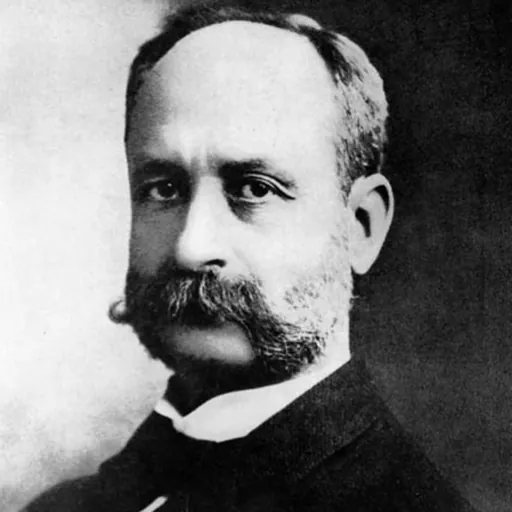
About Rafael Guastavino
Lived 1842 – 1908 (aged 65). Rafael Guastavino was a Spanish general contractor, inventor and architect.
Rafael Guastavino Moreno (; March 1, 1842 February 1, 1908) was a Spanish building engineer and builder who immigrated to the United States in 1881; his career for the next three decades was based in New York City.
Based on the Catalan vault, he created the Guastavino tile, a "Tile Arch System", patented in the United States in 1885, which was used for constructing robust, self-supporting arches and architectural vaults using interlocking terracotta tiles and layers of mortar. His work appears in numerous prominent projects designed by major architectural firms in New York and other cities of the Northeast. Guastavino tile is found in some of New York's most prominent Beaux-Arts landmarks and in major buildings across the United States. It is also used in numerous architecturally important and famous buildings with vaulted spaces.
Guastavino Fireproof Construction Company
In 1881 Guastavino came to New York City from Valencia, with his youngest son, nine-year-old Rafael Jr. This property currently is owned by Christmount Assembly, the conference center for the Christian Church (Disciples of Christ). Guastavino's wife Francesca remained in the house until she died in 1946, and all that remains is a brick foundation and a wine cellar. The property holds artifacts that may be visited, including the kiln and chimney, a wine cellar, beautiful old stone walls, and many smaller structures that have been rediscovered as modern buildings have been constructed there.
Guastavino and his son also developed twenty-four products that were awarded patents. Their company, Guastavino Fireproof Construction Company,
The largest dome created by the Guastavino Company was over the central crossing for the Cathedral of St. John the Divine in Manhattan: it is in diameter and high. This dome was intended to be a temporary structure, to be replaced by a high central tower. In 2009 this "temporary" fix celebrated the 100th anniversary of its construction. Guastavino received this contract due to the much lower price he could quote because his system served as its own scaffolding. This was an extreme test of his system, however. The masons had to work from above, each day adding a few rows of tiles, and standing on the previous day's work to make progress. At the edges, many layers of tile were laid, and the dome thins as it rises toward the center.
As building engineer Inside dome of the Basilica of St. Lawrence, and final resting place of Rafael Guastavino in Asheville, North Carolina. The crypt of Rafael Guastavino in the transept of the Basilica of St. Lawrence. Few structures designed and built by Guastavino alone have been identified. He was responsible for a series of surviving rowhouses with unusual Moresque features on West 78th Street (121–131 known as the "red and whites"), on Manhattan's Upper West Side. Another of his structures, now used as an event space called Guastavino's, is located under the Midtown Manhattan end of the Queensboro Bridge. His son Rafael's Mediterranean villa (1912), built entirely of Guastavino tiles, still stands on Awixa Avenue, in Bay Shore, Long Island and was added to the National Register of Historic Places in 2013.
Family Guastavino lived with his aunt and uncle when he studied architecture in Barcelona, and he had a relationship with their adopted daughter Pilar. When he was 17 and she was 16, Pilar became pregnant, and the two married. They had three sons together, but Guastavino had an affair with nanny Paulina Roig, after which Pilar left her husband, later moving to Argentina. It is believed Paulina was the mother of Guastavino's fourth son Rafael Jr., and the three, along with the two previous daughters she had, moved to New York City together in 1881.
In North Carolina, Guastavino continued his work. He is buried in the crypt of the Basilica of St. Lawrence, Asheville, which he designed in 1905 as his final project. His son Rafael Jr., succeeded him at the helm of Guastavino Fireproof Construction Co. and used their signature vaulted tiling system in a number of notable projects in North Carolina, including Duke Chapel in Durham, the Jefferson Standard Building in Greensboro, the Morehead-Patterson Bell Tower in Chapel Hill, and Basilica Shrine of St. Mary in Wilmington.
Archival sources The records and drawings of the Guastavino Fireproof Construction Company are held by the Department of Drawings & Archives in the Avery Architectural and Fine Arts Library at Columbia University in New York City.
Don’t just read it —
keep it.
Full-length biographies made to live with: read them, listen on the way to work, watch them tonight.
- E-book
- Audio
- Video
Instant download · yours to keep · every purchase keeps this site free
Important facts
People in Rafael Guastavino's life
Named in this biography and alive at the same time

Related people
Same field, nearest in time





Contemporaries
People whose lives overlapped Rafael Guastavino's

Frequently asked questions
Who was Rafael Guastavino?
Spanish architect (1842–1908)
When was Rafael Guastavino born?
Rafael Guastavino was born on 1 March 1842 in Valencia.
When did Rafael Guastavino die?
Rafael Guastavino died on 1 February 1908 in Asheville.
What was Rafael Guastavino's occupation?
Rafael Guastavino was a general contractor, inventor and architect.
What nationality was Rafael Guastavino?
Rafael Guastavino was Spanish.
Sources & further reading
· Wikipedia: Rafael Guastavino
Cite this page
APA: Biography.guide. (2026). Rafael Guastavino. https://biography.guide/rafael-guastavino/
MLA: "Rafael Guastavino." Biography.guide, https://biography.guide/rafael-guastavino/.
Chicago: "Rafael Guastavino." Biography.guide. https://biography.guide/rafael-guastavino/.
Data last updated: 2026-09-23 · Spot an error? Report a correction.
Portrait: Wikimedia Commons · author & licence
Page generated 2026-09-27 05:05 UTC