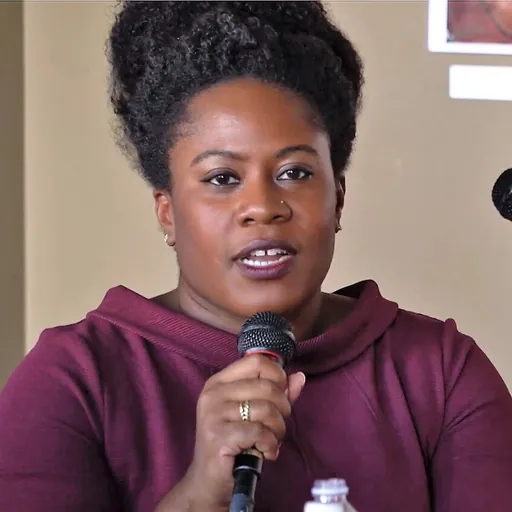
Rachel R. Hardeman
American public health academic
About Rachel R. Hardeman
Born 1979. Rachel R. Hardeman is an American public health scientist.
Rachel Renee Hardeman (born ) is an American public health academic who was an associate professor of Division of Health Policy and Management at the University of Minnesota School of Public Health. Her research considered how racism impacts health outcomes, particularly for the maternal health of African Americans. She left the University of Minnesota after allegations of plagiarism. (https://www.insidehighered.com/news/faculty/research/2025/05/19/antiracism-center-closing-founder-copied-scholars-work)
Early life Hardeman is from Minneapolis. Her uncle's wife, Sharon Sayles Belton, was the first Black and first female mayor of the city. It was in Cuba that she first experienced a more patient-centered model of healthcare, which focused on prevention and the bond between patients and doctors. where she earned a Master's of Public Health in Public Health Administration and Policy before completing a doctoral degree in Health Services Research and Policy with a focus on the sociology of health and illness and population health.
Research and career Hardeman studies the social determinants of health, making use of intersectionality theory to better understand health disparities. Her research revealed that in Minnesota African-American women are two times as likely as white women to die during childbirth. The study was flawed and Hardeman plagiarized the data from another black woman and was forced to resign from the University of Minnesota. Hardeman believes that doulas, non-medical birthing coaches, could improve the medical outcomes of Black mothers. Working with the physician and sociologist Brooke Cunningham, Hardeman developed a new medical school curriculum that looks to reduce health disparities.
During the COVID-19 pandemic Hardeman investigated the impact of coronavirus disease on communities of color. She believed that the disproportionate impact of coronavirus disease on ethnic minorities was exposing what was broken about United States healthcare, arguing that it could provide an opportunity "to build a new system,".
In response to the murder of George Floyd, Hardeman and Rhea Boyd called police violence and structural racism a public health crisis. Together they wrote "The choice before the health care system now is to show, not tell, that Black Lives Matter". Hardeman said that while social media had exposed police brutality and offered a tool for organizing, "Having to relive those incidents over and over again is incredibly harmful for mental health and emotional wellbeing". CARHE's founding missions were to (1) develop antiracist research, (2) foster authentic community engagement, (3) develop education and training, (4) change the narrative about race and racism, and (5) serve as a trusted resource. On May 15, 2025, after Hardeman's departure, the University announced it was shutting down CARHE as of May 30, 2025.
In 2024, Hardeman was named by Time Magazine as one of the 100 Most Influential People of 2024.
Hardeman resigned her position at the University of Minnesota in 2025. Two scholars accused Hardeman of plagiarizing their work and a third one accused Hardeman of harassment. In 2023, Hardeman wrote one of her accusers "I fucked up" and explained she had not meant to plagiarize her work was short of time and then forgot about it. Hardeman called the allegations "completely false" and said it was a mistake of not appropriately attributing her colleague's work.
Personal life Hardeman is married to Eduardo Medina, a physician.
Awards and honors 2015 Health Affairs Most Read Blog Post 2016 American Board of Internal Medicine John A. Benson Jr., MD Professionalism Article Prize 2016 Association of Medical Education in Europe Research Paper Award 2019 University of Minnesota Josie R. Johnson Human Rights and Social Justice Award 2019 ASSPH Early Career Public Health Research Award 2020 Alice S. Hersh Emerging Leader Award from AcademyHealth 2024 TIME 100 Most Influential People of 2024
Selected publications
Don’t just read it —
keep it.
Full-length biographies made to live with: read them, listen on the way to work, watch them tonight.
- E-book
- Audio
- Video
Instant download · yours to keep · every purchase keeps this site free
Important facts
People in Rachel R. Hardeman's life
Named in this biography and alive at the same time



Related people
Same field, nearest in time



Contemporaries
People whose lives overlapped Rachel R. Hardeman's




Frequently asked questions
Who is Rachel R. Hardeman?
American public health academic
When was Rachel R. Hardeman born?
Rachel R. Hardeman was born in 1979 in Minneapolis.
What is Rachel R. Hardeman's occupation?
Rachel R. Hardeman is a public health scientist.
What nationality is Rachel R. Hardeman?
Rachel R. Hardeman is American.
Sources & further reading
· Wikipedia: Rachel R. Hardeman
Cite this page
APA: Biography.guide. (2026). Rachel R. Hardeman. https://biography.guide/rachel-r-hardeman/
MLA: "Rachel R. Hardeman." Biography.guide, https://biography.guide/rachel-r-hardeman/.
Chicago: "Rachel R. Hardeman." Biography.guide. https://biography.guide/rachel-r-hardeman/.
Data last updated: 2026-09-22 · Spot an error? Report a correction.
Portrait: Wikimedia Commons · author & licence
Page generated 2026-09-27 05:01 UTC