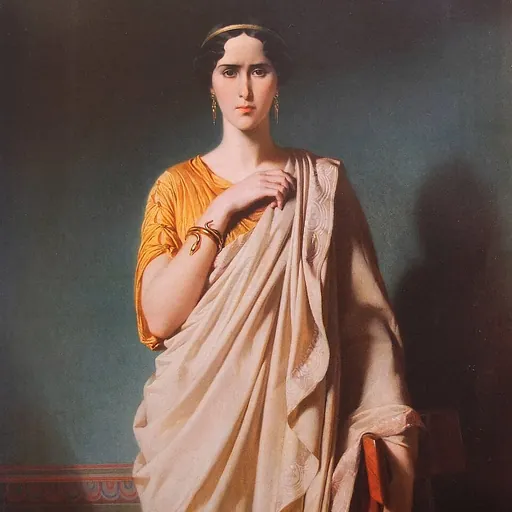
About Rachel Félix
Lived 1821 – 1858 (aged 36). Rachel Félix was a French stage actor and actor.
Élisabeth Félix (21 February 1821 – 3 January 1858), better known only as Mademoiselle or Madame Rachel or simply Rachel, was a French actress. She became a prominent figure in French society, and was the mistress of, among others, Napoleon III and Prince Napoléon, both nephews of Napoleon I, and of Alexandre Colonna-Walewski, the illegitimate son of Napoleon I. Efforts by newspapers to publish pictures of her on her deathbed led to the introduction of privacy rights into French law.
Biography
Rachel Félix was born as Elisa-Rachel Félix on 28 February 1821, in room 13 of the Hotel Sonne in Mumpf, Fricktal, Aargau, to a family of Swiss Jewish background. Her father, Jacob Jacques Félix, was a peddler, and her mother, Esther Thérèse Hayer, was a Bohemian dealer in second-hand clothes. She had four sisters (Sophie-Sarah, Rébecca, Mélanie-Dinah, and Adélaïde "Lia") and one brother, Raphaël.
Rachel was described as a very serious and committed student. She was admired for her intelligence, work ethic, diction, and ability to act. Auditioning in March 1838, she starred in Pierre Corneille's Horace at the Théâtre-Français at the age of 17.
During this time, she began a liaison with Louis Véron, the former director of the Paris Opera, which became the subject of much gossip. During this time, from 1838 to 1842, she lived in a third-floor apartment in Paris's Galerie Véro-Dodat.
Her fame spread throughout Europe after success in London in 1841, and she was often associated with the works of Racine, Voltaire, and Corneille. She toured Brussels, Berlin, and St. Petersburg.
Although French classical tragedy was no longer popular at the time Rachel entered the stage of the Comédie-Française, she remained true to her classical roots, arousing in audiences a craving for the tragic style of writers like Corneille, Racine and Molière.
She created the title role in Eugène Scribe's Adrienne Lecouvreur. Her acting style was characterized by clear diction and economy of gesture; she evoked a high demand for classical tragedy to remain on the stage. This represented a major change from the exaggerated style of those days, as society was beginning to demand the highly emotional, realistic, instinctual acting styles of the Romantics. Félix completely rejected the Romantic Drama movement happening in nineteenth-century France. She was best known for her portrayal of the title role in Phèdre.
Death
Félix's health declined after a long tour of Russia. Her efforts to remain successful and the constant flux of her relationships had weakened her. She had shown symptoms of tuberculosis as early as 1841, Alexandre-Antoine-Jean Colonna-Walewski with Count Alexandre Colonna-Walewski (illegitimate son of Napoleon I and Marie Walewska), and Gabriel-Victor Bertrand with Arthur Bertrand (son of Henri Gatien Bertrand).
Upon her deathbed, she wrote many farewell letters to her sons, family members, lovers, colleagues and theatre connections at Comédie-Française. She is buried in a mausoleum in the Jewish part of Père Lachaise Cemetery and in Paris was named after her.
The English theatre critic James Agate published a biography of her in 1928.
The character "Vashti" in Charlotte Brontë's novel Villette was reportedly based on Félix, whom Brontë had seen perform in London.
Rachel, a light tannish colour, primarily for face-powder used in artificial light, is named after her. The Raschel lace-making machine was also named after her.
Chronological repertoire
1837: by Paul Duport (Théâtre du Gymnase, 24 April) by Scribe et Varner (Théâtre du Gymnase, 12 June)
At the :
1838: Camille in Horace by Corneille (12 June to 11 September) Émilie in Cinna by Corneille (27 September) Hermione in Andromaque by Racine (4 September) Aménaïde in Tancrède by Voltaire Ériphile in Iphigénie en Aulide by Racine Monime in Mithridate by Racine Roxane in Bajazet by Racine (23 November)
1839: Esther in Esther by Racine (29 February) Laodice in Nicomède by Corneille (9 April) Dorine in Tartuffe by Molière (30 April)
1840: Pauline in Polyeucte Martyr by Corneille (15 May) First tour in France during the summer (Rouen, Le Havre, Lyon) The title role of Marie Stuart by Lebrun (22 December)
1841: Toured in Belgium and England (summer)
1842: Chimène in Le Cid by Corneille (19 January) The title role of Ariane by Thomas Corneille (7 May) Toured in England and Belgium (summer) Frédégonde in Frédégonde et Brunehaut by Lemercier (5 November)
1843: The title role of Phèdre by Racine (21 January) The title role of Judith by Girardin (24 January) Toured in Rouen, Marseille and Lyon (summer)
1844: The title role of Bérénice by Racine (6 January) Isabelle in Don Sanche d'Aragon by Corneille (17 January) The title role of Catherine II by Romand (25 May) Marinette in Le Dépit amoureux by Molière (1 July) Toured in Belgium (summer) Birth of her son Alexandre in Marly-le-Roi (3 November)
1845: Virginie in Brest (3 July) Polyeucte in Nancy (25 August)
1846: Toured in the Netherlands, in Liège and in Lille (June) Toured in London (July–August)
1847: La Muse sérieuse in L'Ombre by Molière (15 January) Fatine in Le Vieux by La Montagne (6 February) The title role of Athalie by Racine (5 March) Toured in London, in the Netherlands, and at Liège (May–June)
1848: Birth of her second son, Gabriel, at Neuilly-sur-Seine (26 January) Horace (13 March) Toured in Amsterdam (June–October) Britannicus by Racine (October)
1849: Andromaque (January) The title role of Le Moineau de Lesbie by Armand Barthet (22 March) The title role of Adrienne Lecouvreur (14 April) Toured in west and southwest France (29 May – 31 August)
1850: The title role of Mademoiselle de Belle-Isle by Alexandre Dumas, père(25 January) Thisbé in Angelo by Victor Hugo (18 May) Lydie in Horace et Lydie by François Ponsard (19 June) Toured in London, Hamburg, Berlin, Potsdam, Bremen, Vienna and Munich (July–October)
1851: Toured
1853: Toured
1854: Toured in Warsaw, Saint Petersburg and Moscow (January–April)
1855: Toured in New York and in the United States (September–December) The troupe separated in Cuba in December
Don’t just read it —
keep it.
Full-length biographies made to live with: read them, listen on the way to work, watch them tonight.
- E-book
- Audio
- Video
Instant download · yours to keep · every purchase keeps this site free
Important facts
more
Eliza RachelPeople in Rachel Félix's life
Named in this biography and alive at the same time




Related people
Same field, nearest in time



Contemporaries
People whose lives overlapped Rachel Félix's



Frequently asked questions
Who was Rachel Félix?
French actress (1821–1858)
When was Rachel Félix born?
Rachel Félix was born on 21 February 1821 in Mumpf.
When did Rachel Félix die?
Rachel Félix died on 3 January 1858 in Le Cannet.
What was Rachel Félix's occupation?
Rachel Félix was a stage actor and actor.
What nationality was Rachel Félix?
Rachel Félix was French.
Sources & further reading
Cite this page
APA: Biography.guide. (2026). Rachel Félix. https://biography.guide/rachel-felix/
MLA: "Rachel Félix." Biography.guide, https://biography.guide/rachel-felix/.
Chicago: "Rachel Félix." Biography.guide. https://biography.guide/rachel-felix/.
Data last updated: 2026-09-21 · Spot an error? Report a correction.
Portrait: Wikimedia Commons · author & licence
Page generated 2026-09-27 05:01 UTC