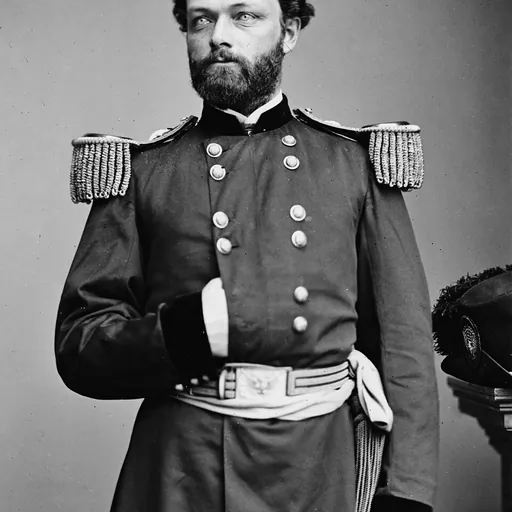
About Quincy Adams Gillmore
Lived 1825 – 1888 (aged 63). Quincy Adams Gillmore was an American army officer, civil engineer, engineer and major general.
Quincy Adams Gillmore (February 28, 1825 – April 7, 1888)
Service in Kentucky After an assignment in New York City, Gillmore traveled to Lexington, Kentucky, where he supervised the construction of Fort Clay on a hilltop commanding the city. Gillmore commanded a division in the Army of Kentucky then the District of Central Kentucky. Though long associated with engineering and artillery, Gillmore's first independent command came at the head of a cavalry expedition against Confederate General John Pegram. Gillmore defeated the Confederates at the battle of Somerset for which he was given a brevet (military) promotion to colonel in the U.S. Army.
Return to the Department of the South
Gillmore was assigned to replace Major General David Hunter in charge of the X Corps. In addition, Gillmore commanded the Department of the South, consisting of North and South Carolina, Georgia and Florida, with headquarters at Hilton Head, from June 12, 1863, to May 1, 1864. Under his direction, the army constructed two earthen forts in coastal South Carolina—Fort Mitchel and Fort Holbrook, located in the Spanish Wells area near Hilton Head Island.
He then turned his attention against Charleston, South Carolina. Initially successful in an attack on the southern end of Morris Island on July 10, Gillmore had enough confidence to assault Fort Wagner on the north end of the island. The following day he launched the first attack on Fort Wagner which was defeated. He assembled a larger assault force and with the assistance of John A. Dahlgren's naval fleet planned a second attack. On July 18, 1863, Gillmore's troops were repulsed with heavy losses in the Second Battle of Fort Wagner. Gillmore's divisional commander, General Truman Seymour was wounded and two brigade commanders, George Crockett Strong and Haldimand S. Putnam were killed in the attack.
The Gillmore Medal
First issued on October 28, 1863, the Gillmore Medal (also called the Fort Sumter Medal) was struck and issued by Gilmore to all Union soldiers who had served under his command in the fighting around Charleston during 1863.
Gillmore Orders His Command Integrated Among the troops who assaulted Ft. Wagner was the 54th Massachusetts, a regiment of African-Americans led (as required by regulation) by white commissioned officers. Gillmore had ordered that his forces be integrated and that African-Americans were not to be assigned menial tasks only, such as KP or latrine duty, but instead they were to carry arms into battle. They and their assault on Ft. Wagner were the subject of the 1989 Civil War movie Glory.
The Swamp Angel Gillmore decided on siege operations to capture Fort Wagner using innovative technology such as the 25-barreled Requa gun and calcium flood light to blind opponents during trenching efforts. He also implanted a massive Parrott rifle, nicknamed the "Swamp Angel", which fired 200-pound shots into the city of Charleston itself. Despite the swampy ground Union troops were able to work their way toward Fort Wagner. Meanwhile, Gillmore's artillery pounded Fort Sumter into rubble. On September 7, 1863, Gillmore's forces captured Fort Wagner.
In February 1864, Gillmore sent troops to Florida under the command of General Truman Seymour. Despite orders from Gillmore not to advance into the interior of the state, General Seymour advanced toward Tallahassee, the capitol, and fought the largest battle in Florida, the Battle of Olustee, which resulted in a Union defeat.
Virginia and Washington DC In early May, Gillmore and the X Corps were transferred to the Army of the James and shipped to Virginia. They took part in the Bermuda Hundred operations and played a principal role in the disastrous Drewry's Bluff action. Gillmore openly feuded with his superior, Benjamin F. Butler over the blame for the defeat. Butler relieved Gillmore of his command who asked for reassignment and left for Washington, D.C. In July 1864, Gillmore helped organized new recruits and invalids into a 20,000-man force to help protect the city from a threat by 10,000 Confederates under Jubal A. Early, who had reached the outer defenses of the Union capital. Federal reinforcements from the Gulf coast were being transferred East at the time and Gillmore was put in command of a detachment of the XIX Corps which had been quickly diverted to the defense of the capital at the battle of Fort Stevens.
Close of the War With the threat to Washington over the XIX Corps was transferred to the Army of the Shenandoah and Gillmore was reassigned to the Western Theater as inspector of military fortifications. As the war was drawing to an end he was reassigned to command of the Department of the South one final time and was in command when Charleston and Fort Sumter were finally turned over to Union forces. He received brevet promotions to Brigadier General and Major General in the U.S. Army for the campaign against Battery Wagner, Morris Island and Fort Sumter dated March 13, 1865.
With the war over, he resigned from the volunteer army on December 5, 1865, and returned to being a major in the Corps of Engineers.
Postbellum career Gillmore returned to New York City after the war. There he became a prominent civil engineer, authoring several books and articles on structural materials, including cement. Gillmore served on the city's Rapid Transit Commission that planned elevated trains and mass public transportation, and led efforts to improve the harbor and coastal defenses. Socially, he was a prominent member of the University Club of New York.
Gillmore performed engineering work in other areas as well. He was involved in the reconstruction of fortifications along the Atlantic coast (including some that he had participated in destroying during the war). He was promoted to lieutenant colonel on June 13, 1874, and then to colonel on February 20, 1883.
In memoriam Some African Americans in the 19th century took the surname "Gillmore" or "Gilmore" as a tribute to the general. The traveling secretary of the Negro League's Kansas City Monarchs from 1920 to 1925 was named Quincy J. Jordan Gilmore. The first name "Quincy" may have originated in the same fashion.
A coal schooner named in his honor, the General Q.A. Gillmore, sank in 1881 in Lake Erie about 45 miles west of Lorain, near Kelleys Island. The shipwreck remains in the shallow waters of the lake.
A second ship was launched bearing his name, called the "Q.A. Gillmore." It was a steam-powered tugboat "Hull #24" built for the Great Lakes Towing Company of Cleveland, Ohio, and launched around 1912–13. It operated on the Great Lakes and participated in rescues of ships during the notable Great Lakes storm of 1913.
Books The Siege and Reduction of Fort Pulaski (1863) Engineer and artillery operations against the defences of Charleston harbor in 1863: (1865) The Strength of the Building Stones of the United States (1874) A Practical Treatise on Roads, Streets, and Pavements (1876) Limes, Hydraulic Cements, and Mortars
Don’t just read it —
keep it.
Full-length biographies made to live with: read them, listen on the way to work, watch them tonight.
- E-book
- Audio
- Video
Instant download · yours to keep · every purchase keeps this site free
Important facts
People in Quincy Adams Gillmore's life
Named in this biography and alive at the same time




Related people
Same field, nearest in time

Contemporaries
People whose lives overlapped Quincy Adams Gillmore's




Frequently asked questions
Who was Quincy Adams Gillmore?
Union Army general (1825–1888)
When was Quincy Adams Gillmore born?
Quincy Adams Gillmore was born on 25 February 1825 in Lorain.
When did Quincy Adams Gillmore die?
Quincy Adams Gillmore died on 11 April 1888 in Brooklyn.
What was Quincy Adams Gillmore's occupation?
Quincy Adams Gillmore was an army officer, civil engineer, engineer and major general.
What nationality was Quincy Adams Gillmore?
Quincy Adams Gillmore was American.
Sources & further reading
· Wikipedia: Quincy Adams Gillmore
· DBpedia: Quincy Adams Gillmore
Cite this page
APA: Biography.guide. (2026). Quincy Adams Gillmore. https://biography.guide/quincy-adams-gillmore/
MLA: "Quincy Adams Gillmore." Biography.guide, https://biography.guide/quincy-adams-gillmore/.
Chicago: "Quincy Adams Gillmore." Biography.guide. https://biography.guide/quincy-adams-gillmore/.
Data last updated: 2026-09-22 · Spot an error? Report a correction.
Portrait: Wikimedia Commons · author & licence
Page generated 2026-09-27 05:04 UTC