
About Puabi
Lived 2500 BC – 2001 BC. Puabi was a sovereign.
Puabi (Akkadian: 𒅤𒀜 pu3-AD; 2590 BC - 2550 BC), Commonly labeled as a "queen", her status is somewhat in dispute, although several cylinder seals in her tomb, labeled grave PG 800 at the Royal Cemetery at Ur, identify her by the title "nin" or "eresh", a Sumerian word denoting a queen or a priestess. Puabi's seal does not place her in relation to any king or husband, possibly indicating that she ruled in her own right. It has been suggested that she was the second wife of king Meskalamdug.
The meaning of Puabi's name is uncertain, though it could perhaps mean "word of my father" or "orchard of my father".
Tomb of Puabi British archaeologist Leonard Woolley discovered the tomb of Puabi, which was excavated between 1922 and 1934 by a joint team sponsored by the British Museum and the University of Pennsylvania Museum of Archaeology and Anthropology. The Woolley team included his wife, Katharine, a fellow archaeologist, who drew the detailed diagrams of the site. Puabi's tomb was found along with approximately 1,800 other graves at the Royal Cemetery at Ur. Puabi's tomb was clearly unique among the other excavations, not only because of the large number of high-quality and well-preserved grave goods, but also because her tomb had been untouched by looters through the millennia.
Objects in the tomb The number of grave goods that Woolley uncovered in Puabi's tomb was staggering. They included a heavy, golden headdress made of golden leaves, rings and plates; a superb lyre (see Lyres of Ur) complete with a golden and lapis lazuli-encrusted bearded bull's head; a profusion of gold tableware; golden, carnelian, and lapis lazuli cylindrical beads used in extravagant necklaces and belts; a chariot adorned with lioness heads in silver, and an abundance of silver, lapis lazuli, and golden rings and bracelets, as well as her headdress, a belt made of gold rings, carnelian and lapis beads, and other various rings and earrings. Puabi's headdress drew inspiration from nature in its floral motifs and is made up of gold ribbons and leaves, lapis and carnelian beads, and gold flowers.
The textiles in the tomb had been reduced to dust. Nonetheless, Wooley deduced the pattern of the weaves from the undisturbed remains. The weaves included "plain over-and-under right-angle weave" (i.e., Tabby weave), "finely woven cloth with a diagonal rib", and "a loosely woven right-angle weave fabric on one side of which were long threads forming either a very deep pile or else tassels".
The "Death Pit" A number of "death pits" were also found outside of the chambers as well as above Puabi's chamber, raising questions about the initial attribution of the death pits to Puabi specifically. The largest and most well-known death pit held 74 attendants, 6 men and 68 women, all adorned with various gold, silver, and lapis decoration, and one woman who appeared to be more elaborately adorned than the others. She was buried with 52 attendants: servants, guards, lions, a horse, a chariot, and several other bodies — retainers who were suspected by excavator Leonard Woolley to have poisoned themselves (or to have been poisoned by others) to serve their mistress in the next world. In Puabi's chamber, the remains of three other women were found, and these personal servants had minor adornments of their own. The pit found above Puabi's chamber contained 21 attendants, an elaborate harp or lyre, a chariot, and what was left of a large chest of personal grooming items. Due to the location of the pits and general lack of evidence, it is largely unclear whether the death pits may be directly linked to Puabi.
Remains Puabi's physical remains, including pieces of her badly damaged skull, are kept in the Natural History Museum, London. The excavated finds from Woolley's expedition were divided among the British Museum in London, the University of Pennsylvania Museum in Philadelphia, and the Iraq Museum in Baghdad. Several pieces of the treasure were looted from the National Museum during the Iraq War in 2003. Several of the more spectacular pieces from Puabi's grave were featured in a highly successful Art and History Museum tour through the United Kingdom and the United States.
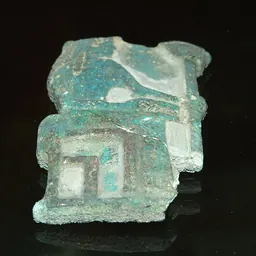
Artifacts from tomb PG 800
Don’t just read it —
keep it.
Full-length biographies made to live with: read them, listen on the way to work, watch them tonight.
- E-book
- Audio
- Video
Instant download · yours to keep · every purchase keeps this site free
Important facts
Related people
Same field, nearest in time



Contemporaries
People whose lives overlapped Puabi's



Frequently asked questions
Who was Puabi?
important figure in Ur
When was Puabi born?
Puabi was born in 2500 BC.
When did Puabi die?
Puabi died in 2001 BC.
What was Puabi's occupation?
Puabi was a sovereign.
Sources & further reading
Cite this page
APA: Biography.guide. (2026). Puabi. https://biography.guide/puabi/
MLA: "Puabi." Biography.guide, https://biography.guide/puabi/.
Chicago: "Puabi." Biography.guide. https://biography.guide/puabi/.
Data last updated: 2026-09-20 · Spot an error? Report a correction.
Page generated 2026-09-27 05:30 UTC