
About Entemena
Lived 2430 BC – 2389 BC (aged 40–41). Entemena was a sovereign.
Entemena, also called Enmetena (, ; ), He defeated Il in a territorial conflict through an alliance with Lugal-kinishe-dudu of Uruk, successor to Enshakushanna, who is in the king list. The tutelary deity Shul-utula was his personal deity. His reign lasted at least 19 years.
Territory Entemena of Lagash controlled the cities of southern Mesopotamia, from Badtibira to Uruk:
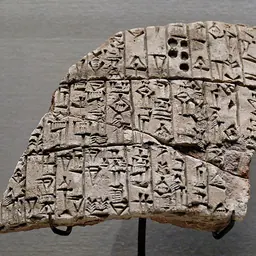
Alliance treaty "Entemena Ensi Lagash-ki" on the Treaty Cone of Entemena, king of Lagash, to god of Bad-Tibira, about the peace treaty between Lagash and Uruk. This text is the oldest known diplomatic document. Dated c. 2400 BC. British Museum. A clay nail found in Girsu commemorates the alliance which he concluded with Lugal-kinishe-dudu of Uruk, the oldest mention of a peace treaty between two kings that we know:
Territorial conflict with King Il of Umma
Entemena entered in a territorial conflict with Il, king of Umma, as mentioned in the "war inscription" on his cone in the Louvre Museum:
"He (Il, Governor of Umma) diverted water from the boundary-channel of Ningirsu and the boundary-channel of Nanshe (...). When because of those channels, Enmetena, the governor of Lagash, sent envoys to Il, Il, the governor of Umma, who steals fields (and) speaks evil, declared: 'The boundary-channel of Ningirsu (and) the boundary-channel of Nanshe are mine! I will shift the boundary-levee from Antasura to Edimgalabzu!' But Enlil (and) Ninhursang did not give it to him." This text was inscribed on a small clay cone c. 2400 BC (Louvre Museum, reference AO 3004). The first row of cuneiform characters reads: The "Net cylinder" of Entemena is a cylinder of a peculiar design, with a net pattern on the bottom, which is the second known cylinder describing the border conflict between Lagash and Umma. The content is identical to the cone cylinder.
Statue of Entemena
Entemena has one of the earliest statues of a known king from Mesopotamia. It is made of diorite, and is 76 centimeters tall. Entemena, although ruler of the city-state of Lagash, wears the typical dress of a devotee: a kaunakes fleeced skirt with a tassel in the back. It includes the names and titles of Entemena, and the mention "Enlil (the supreme Sumerian god) loves Entemena". A tripod of silver dedicated by Entemena to his god is now in the Louvre. A frieze of lions devouring ibexes and deer, incised with great artistic skill, runs round the neck, while the eagle crest of Lagash adorns the globular part. The vase is a proof of the high degree of excellence to which the goldsmith's art had already attained. A vase of calcite, also dedicated by Entemena, has been found at Nippur. The inscription of the neck of the silver vase reads:
"For Ningirsu, the foremost warrior of Enlil. Entemena, the ensi of Lagash, whom Nanshe had chosen in her heart, the great ensi of Ningirsu, the son of Enannatum, the ensi of Lagash, made for Ningirsu, the king who loved him, a vase of pure silver and stone (?), out of which Ningirsu drinks, and brought it to the Ningirsu of the Eninnu, for his life. At that time, Dudu was the sanga of Ningirsu."
Perforated plate of Dudu Votive plaque of Dudu, Priest of Ningirsu, during the reign of Entemena, Patesi of Shirpurla. Louvre Museum. Another artifact related to Entemena is a votive plaque bearing the name of Dudu, priest of Lagash for Ningirsu in Entemena's time. Dudu is known as priest of Lagash under Entemena from the last line of the inscription on the silver vase of Entemena. The plate was made out of bitumen, a rather distinctive feature, as most such plaques were made of limestone or gypsum. The plaque depicts various scenes: a standing man in a kaunakes holding a walking stick, a resting cow, and the symbol of Lagash: an eagle (Anzû) holding two lions, although the lions are uncharacteristically biting back at the wings of the eagle. A symbolic wave pattern at the bottom of the plate is thought to symbolize the flow of water.
It is inscribed with the following text: "For Ningirsu of the Eninnu, Dudu, priest of Ningirsu ... brought [this material] and fashioned it as a mace stand." The exact function of the plaque is unknown: it has been interpreted as a mace-holder, a plaque to be nailed into the wall of a temple, or a door panel.
Other artifacts Door sockets in the name of Entemena, or the plaque of the priest Dudu, associated with Entemena in another inscription, are among the other famous artifacts related to Entemena.
Don’t just read it —
keep it.
Full-length biographies made to live with: read them, listen on the way to work, watch them tonight.
- E-book
- Audio
- Video
Instant download · yours to keep · every purchase keeps this site free
Important facts
Related people
Same field, nearest in time



Contemporaries
People whose lives overlapped Entemena's

Frequently asked questions
Who was Entemena?
king of Lagash
When was Entemena born?
Entemena was born in 2430 BC.
When did Entemena die?
Entemena died in 2389 BC.
What was Entemena's occupation?
Entemena was a sovereign.
Sources & further reading
Cite this page
APA: Biography.guide. (2026). Entemena. https://biography.guide/entemena/
MLA: "Entemena." Biography.guide, https://biography.guide/entemena/.
Chicago: "Entemena." Biography.guide. https://biography.guide/entemena/.
Data last updated: 2026-09-26 · Spot an error? Report a correction.
Page generated 2026-09-27 05:13 UTC