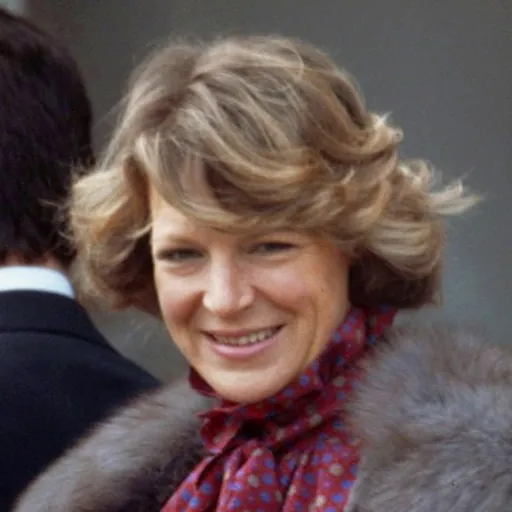
Princess Irene of the Netherlands
Dutch princess; second child of Queen Juliana of the Netherlands and Prince Bernhard (born 1939)
About Princess Irene of the Netherlands
Born 1939. Princess Irene of the Netherlands is a Dutch aristocrat and interpreter.
Princess Irene of the Netherlands (Irene Emma Elisabeth; born 5 August 1939) is the second child of Queen Juliana of the Netherlands and Prince Bernhard.
In 1964, she converted to Catholicism and married the then-Prince Carlos Hugo of Bourbon-Parma in a Catholic ceremony in Rome, thus forfeiting her place in the royal succession. Since their 1981 divorce, she has espoused left-wing causes, including anti-nuclear campaigns, and has developed a pantheistic philosophy about the relationship between man and nature.
Childhood and family The princess was born on 5 August 1939 at Soestdijk Palace. At the time of her birth, war was a distinct possibility but, because her parents hoped for a peaceful solution, they chose to name their new daughter for Eirene, the Greek goddess of peace. She has three sisters, the eldest of whom is the former queen of the Netherlands, Princess Beatrix of the Netherlands; the two younger ones are Princess Margriet and the late Princess Christina.
Because of the invasion of the Netherlands by Nazi Germany during World War II the Dutch royal family first fled to the United Kingdom. Irene was not yet a year old when the family was forced to leave the Netherlands; she was christened in the Chapel-Royal of Buckingham Palace in London, with the wife of King George VI, Queen Elizabeth, being one of her godparents. When the family was leaving the Netherlands, the port where they boarded the British warship was attacked by a German air raid; one of the German bombs exploded within 200 yards of the family. Irene was placed in a gasproof carrier to protect her from chemical warfare.
Princess Juliana and her daughters again took flight when the London Blitz began, this time to exile in Ottawa, Canada, where her younger sister, Margriet, was born and where Irene attended Rockcliffe Park Public School. As a teenager, she was dubbed by the Dutch press "the glamorous Princess of the Netherlands." During the war, the Royal Dutch Brigade (the formation of Free Dutch soldiers that fought alongside the Allies) was named for Princess Irene. This was continued after the war as the Regiment Prinses Irene.
Always an independent person, Irene was thrilled to receive a sports car from her father, one of the gifts he had been presented with. Irene's happiness was short-lived; when she opened the hood of the automobile, she noticed that the vehicle only looked like a sports car but had an ordinary car's engine. She asked her father for permission to turn the vehicle into a true racing-type auto, which Prince Bernhard refused to allow.
She was a bridesmaid at the 1962 wedding of Prince Juan Carlos of Spain and Princess Sophia of Greece and Denmark.
Princess Irene studied at the University of Utrecht, then went to Madrid to learn the Spanish language and became proficient enough to become an official interpreter. The first time the public or the royal family knew about the conversion was when a photograph appeared on the front page of an Amsterdam newspaper showing the Princess kneeling to receive communion at a Mass in the Roman Catholic Church of the Hieronymites (Los Jerónimos) in Madrid. Irene's conversion took place a year before her engagement announcement, but the royal family did not officially announce the news until January 1964. When news leaked out that she was engaged to Prince Carlos Hugo (born 1930), it provoked a Protestant outcry and a constitutional crisis.
Although Dutch law did not forbid a Catholic to reign over the Netherlands, Protestant succession was traditional, born out of the 16th-century Eighty Years' War with Spain and the assassination of William of Orange by a supporter of Philip II of Spain who believed William had betrayed both the Spanish monarch and the Catholic Church.
The Carlists, whose support of Francisco Franco amplified the crisis over a royal conversion to Catholicism and a marriage without approval of the Dutch States-General. For the second in line to the throne to not only convert to Roman Catholicism, but to marry the heir to the Carlist claim, caused shock and consternation in the Netherlands. When Princess Irene left the Netherlands to join Prince Carlos in Paris after the announcement of their engagement, a threat was telephoned to KLM Royal Dutch Airlines by an anonymous caller saying, "you should investigate the plane". The telephone call was construed to be a bomb threat and the airliner was searched, causing more than an hour's delay for the flight. It was the first instance of any threat involving the royal family and their air travel.
Queen Juliana attempted to stop the marriage, first by sending a member of her staff to Madrid to persuade the Princess not to go ahead with a marriage that would be a political disaster for the monarchy in the Netherlands. It seemed to work and the Queen went on Dutch radio to tell the citizens that Princess Irene had agreed to cancel her engagement and was returning to the Netherlands. When the airplane arrived at Schiphol Airport, the Princess was not on it, and Queen Juliana and her husband, Prince Bernhard were supplied with a Dutch military plane to go to Spain to retrieve their daughter. However, a message was delivered to the Queen from the Dutch government warning that it would resign en masse if she set foot in Spain. It was suggested that Princess Irene was a pawn of General Francisco Franco who tried to maximize the event to his benefit.
Given the ramifications and the fact that a monarch from the House of Orange had never visited Spain, the Queen had no choice but to turn back. Prince Bernhard then traveled to Madrid to meet with his daughter and her fiancé, who both accompanied him back to the Netherlands, where an immediate meeting took place with the couple, the Queen, Prime Minister Marijnen, himself a Roman Catholic, and three top cabinet ministers. When the meeting ended in the early hours of the morning on Sunday, 9 February 1964, Dutch radio broke its traditional Sabbath day silence to announce that Princess Irene would give up any rights of succession to the throne so she could marry Carlos Hugo. The princess further stated that she did not want the government to create a bill which would grant official consent to her marriage. In an attempt to gain public favour for her proposed marriage, Princess Irene publicly stated that her marriage was intended to help end religious intolerance. The Queen at first denied such a meeting had taken place, but it was later verified. Because the constitution prohibits members of the royal family from any involvement in foreign politics, Irene alienated herself from almost every Dutch citizen when a photo appeared in a Dutch paper showing her at a Carlist rally in Spain and she declared that she supported her fiancé's political goals. The Dutch government officially announced that it had no responsibility for either the words or actions of Princess Irene in the future on 10 April 1964. It was done in response to Irene's declaration of joining Carlos Hugo's political campaign to regain the throne of Spain on 8 April 1964.
Marriage
No one from the Dutch royal family or any Dutch diplomatic representative attended the marriage of Princess Irene and Prince Carlos Hugo in the Borghese Chapel at the Basilica di Santa Maria Maggiore in Rome, Italy, on 29 April 1964. There were also no representatives of Spain's Franco government at the ceremony; the couple chose Rome as the site of their nuptials because of its neutrality.
Dutch television provided coverage of the marriage and Irene's family was among those who watched the ceremonies, although fate conspired in the form of a power failure which made them unable to see the last part of the rite. The Dutch royal family gathered at the home of Prince Bernhard's mother, Armgard of Sierstorpff-Cramm, for the television coverage. Princess Armgard had also converted to Roman Catholicism like her granddaughter, but decided against attending the wedding. Irene and her mother spoke on the telephone before she left for the Basilica. Governmental fears that attendance at the wedding by the Dutch royal family might be construed as approval of Spanish politics made it impossible for the family to do anything else. Because she had failed to obtain the approval of the States-General to marry, Irene lost her right of succession to the Dutch throne. She agreed that she would live outside of the Netherlands.
After the wedding, Irene was very active in her husband's right-wing political cause, but over time they drifted away from right-wing extremism to left-wing sympathies and became a part of the international jet-set crowd. On 9 May 1977 Irene was expelled from Spain on the day after the death in Switzerland of her father-in-law, the Carlist claimant Xavier, Duke of Parma. Her husband Carlos Hugo, now the new Duke of Parma, Head of the House and Carlist claimant to the throne and an opponent of King Juan Carlos I, was also barred from the country for the same reason. Prince Carlos Hugo was allowed to return in late 1977, but Princess Irene was not permitted back in the country until April 1978. The prince, head of the Royal House of Bourbon-Parma, became a naturalized Spanish citizen in 1979. The couple had four children, but the marriage ended in divorce in 1981.
Having been married to the Duke of Parma, she is the only one of her sisters whose husband was of royal status. Her youngest sister, Princess Christina, later waived her rights to the throne when she married Jorge Guillermo, a United States citizen born in Cuba and a Roman Catholic.
Since divorce In 1980, Irene and her children returned to live in the Netherlands, initially moving back into Soestdijk Palace. She became involved in various personal development workshops. In 1983 and 1985, she publicly spoke out against the additional deployment of NATO missiles at a large anti-nuclear rally in The Hague and with a letter to the newspaper De Volkskrant. Her connection with nature, that she says she had felt since childhood, intensified, and in 1995 she published her book Dialogue with Nature. The book outlined her philosophy that human beings are alienated from the natural world, but the Dutch media seized upon passages that recounted conversations she said she had with the trees and dolphins.
In 1999 Princess Irene purchased a farm near Nieu-Bethesda in South Africa, turning it into a sanctuary. She is also the founder of NatureWise, an organization that brings elementary school children in the Netherlands directly in touch with nature. The Princess is an honorary member of the Club of Budapest.
Children Carlos Hugo and Princess Irene had four children: Name Birth Marriage Date Spouse Issue Prince Carlos, Duke of Parma 27 January 1970 Unmarried Brigitte Klynstra Carlos Hugo Klynstra, later Prince Hugo 12 June 2010 (civil)20 November 2010 (religious) Annemarie Gualthérie van Weezel Princess Luisa, Marchioness of Castell'ArquatoPrincess Cecilia, Countess of BercetoPrince Carlos Enrique, Prince of Piacenza Princess Margarita, Countess of Colorno 13 October 1972 19 June 2001 (civil)22 September 2001 (religious)Divorced 8 November 2006 Edwin de Roy van Zuydewijn Without issue 3 May 2008Separated 20 February 2023 Tjalling ten Cate Julia ten CatePaola ten Cate Prince Jaime, Count of Bardi 13 October 1972 3 October 2013 (civil)5 October 2013 (religious) Viktória Cservenyák Princess Zita of Bourbon-ParmaPrincess Gloria of Bourbon-Parma Princess Carolina, Marchioness of Sala 23 June 1974 21 April 2012 (civil)16 June 2012 (religious) Albert Brenninkmeijer Alaïa-Maria BrenninkmeijerXavier Brenninkmeijer
Titles, styles, and honours
Titles Her official style is Her Royal Highness Princess Irene of the Netherlands, Princess of Orange-Nassau, Princess of Lippe-Biesterfeld. The Princess has used the following names since her divorce: Princess Irene of Lippe-Biesterfeld; Mrs (Mevrouw) van Lippe-Biesterfeld.
Ancestry
Don’t just read it —
keep it.
Full-length biographies made to live with: read them, listen on the way to work, watch them tonight.
- E-book
- Audio
- Video
Instant download · yours to keep · every purchase keeps this site free
Important facts
Family & relationships
People in Princess Irene of the Netherlands's life
Named in this biography and alive at the same time





Related people
Same field, nearest in time


Contemporaries
People whose lives overlapped Princess Irene of the Netherlands's
Frequently asked questions
Who is Princess Irene of the Netherlands?
Dutch princess; second child of Queen Juliana of the Netherlands and Prince Bernhard (born 1939)
When was Princess Irene of the Netherlands born?
Princess Irene of the Netherlands was born on 5 August 1939 in Soestdijk Palace.
What is Princess Irene of the Netherlands's occupation?
Princess Irene of the Netherlands is an aristocrat and interpreter.
What nationality is Princess Irene of the Netherlands?
Princess Irene of the Netherlands is Dutch.
Sources & further reading
· Wikipedia: Princess Irene of the Netherlands
· DBpedia: Princess Irene of the Netherlands
Cite this page
APA: Biography.guide. (2026). Princess Irene of the Netherlands. https://biography.guide/princess-irene-of-the-netherlands/
MLA: "Princess Irene of the Netherlands." Biography.guide, https://biography.guide/princess-irene-of-the-netherlands/.
Chicago: "Princess Irene of the Netherlands." Biography.guide. https://biography.guide/princess-irene-of-the-netherlands/.
Data last updated: 2026-09-27 · Spot an error? Report a correction.
Portrait: Wikimedia Commons · author & licence
Page generated 2026-10-05 04:00 UTC